p.5 抽出テキスト
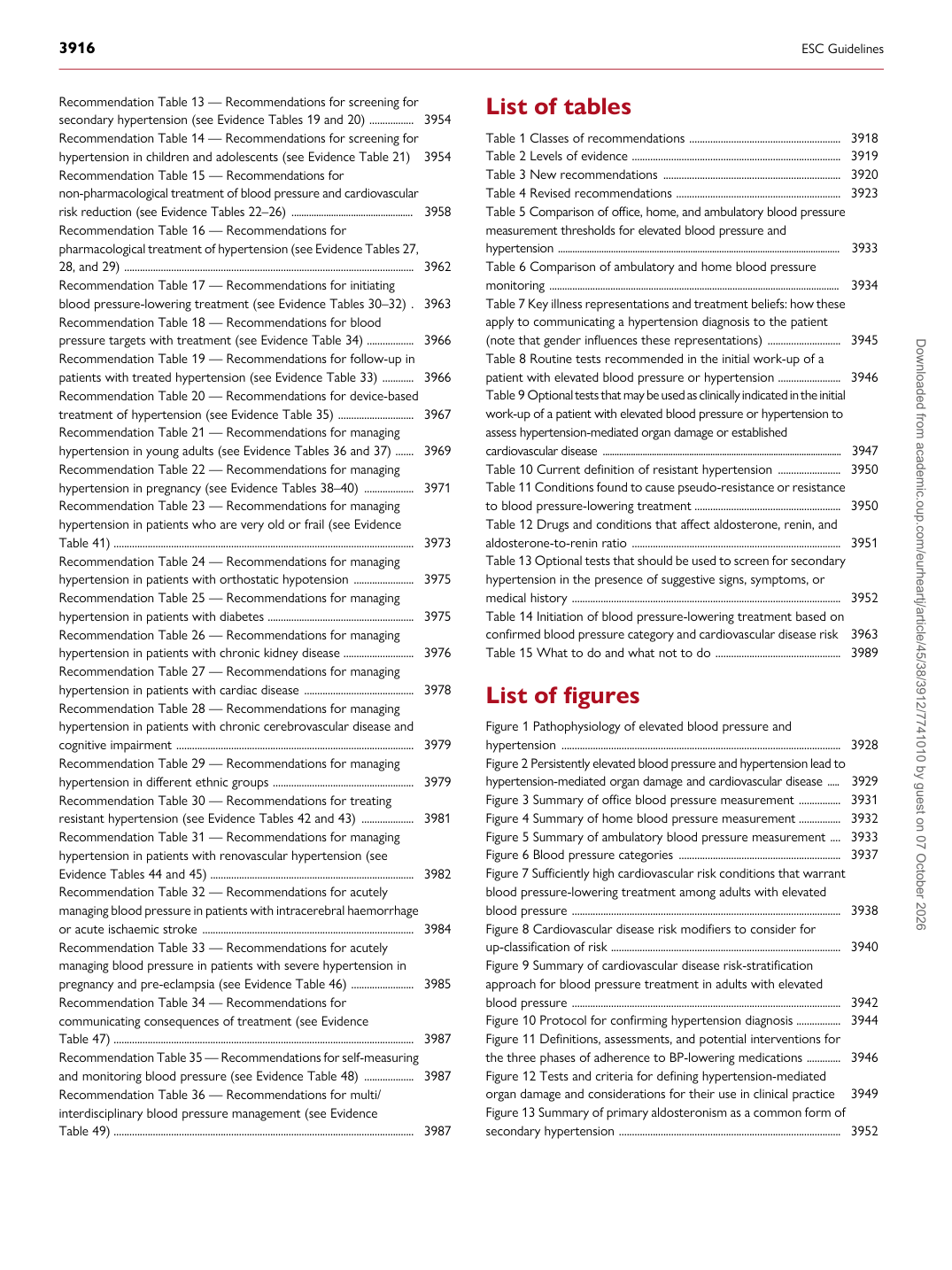
Recommendation Table 13 — Recommendations for screening for secondary hypertension (see Evidence Tables 19 and 20) ................. 3954 Recommendation Table 14 — Recommendations for screening for hypertension in children and adolescents (see Evidence Table 21) 3954 Recommendation Table 15 — Recommendations for non-pharmacological treatment of blood pressure and cardiovascular risk reduction (see Evidence Tables 22–26) ................................................. 3958 Recommendation Table 16 — Recommendations for pharmacological treatment of hypertension (see Evidence Tables 27, 28, and 29) ............................................................................................................... 3962 Recommendation Table 17 — Recommendations for initiating blood pressure-lowering treatment (see Evidence Tables 30–32) . 3963 Recommendation Table 18 — Recommendations for blood pressure targets with treatment (see Evidence Table 34) .................. 3966 Recommendation Table 19 — Recommendations for follow-up in patients with treated hypertension (see Evidence Table 33) ............ 3966 Recommendation Table 20 — Recommendations for device-based treatment of hypertension (see Evidence Table 35) ............................. 3967 Recommendation Table 21 — Recommendations for managing hypertension in young adults (see Evidence Tables 36 and 37) ....... 3969 Recommendation Table 22 — Recommendations for managing hypertension in pregnancy (see Evidence Tables 38–40) ................... 3971 Recommendation Table 23 — Recommendations for managing hypertension in patients who are very old or frail (see Evidence Table 41) ................................................................................................................... 3973 Recommendation Table 24 — Recommendations for managing hypertension in patients with orthostatic hypotension ....................... 3975 Recommendation Table 25 — Recommendations for managing hypertension in patients with diabetes ........................................................ 3975 Recommendation Table 26 — Recommendations for managing hypertension in patients with chronic kidney disease ........................... 3976 Recommendation Table 27 — Recommendations for managing hypertension in patients with cardiac disease .......................................... 3978 Recommendation Table 28 — Recommendations for managing hypertension in patients with chronic cerebrovascular disease and cognitive impairment ........................................................................................... 3979 Recommendation Table 29 — Recommendations for managing hypertension in different ethnic groups ...................................................... 3979 Recommendation Table 30 — Recommendations for treating resistant hypertension (see Evidence Tables 42 and 43) .................... 3981 Recommendation Table 31 — Recommendations for managing hypertension in patients with renovascular hypertension (see Evidence Tables 44 and 45) .............................................................................. 3982 Recommendation Table 32 — Recommendations for acutely managing blood pressure in patients with intracerebral haemorrhage or acute ischaemic stroke ................................................................................. 3984 Recommendation Table 33 — Recommendations for acutely managing blood pressure in patients with severe hypertension in pregnancy and pre-eclampsia (see Evidence Table 46) ........................ 3985 Recommendation Table 34 — Recommendations for communicating consequences of treatment (see Evidence Table 47) ................................................................................................................... 3987 Recommendation Table 35 — Recommendations for self-measuring and monitoring blood pressure (see Evidence Table 48) ................... 3987 Recommendation Table 36 — Recommendations for multi/ interdisciplinary blood pressure management (see Evidence Table 49) ................................................................................................................... 3987 List of tables

Table 1 Classes of recommendations .......................................................... 3918 Table 2 Levels of evidence ................................................................................ 3919 Table 3 New recommendations .................................................................... 3920 Table 4 Revised recommendations ............................................................... 3923 Table 5 Comparison of office, home, and ambulatory blood pressure measurement thresholds for elevated blood pressure and hypertension ..................................................................................................................... 3933 Table 6 Comparison of ambulatory and home blood pressure monitoring .................................................................................................................. 3934 Table 7 Key illness representations and treatment beliefs: how these apply to communicating a hypertension diagnosis to the patient (note that gender influences these representations) ............................ 3945 Table 8 Routine tests recommended in the initial work-up of a patient with elevated blood pressure or hypertension ........................ 3946 Table 9 Optional tests that may be used as clinically indicated in the initial work-up of a patient with elevated blood pressure or hypertension to assess hypertension-mediated organ damage or established cardiovascular disease ...................................................................................................... 3947 Table 10 Current definition of resistant hypertension ........................ 3950 Table 11 Conditions found to cause pseudo-resistance or resistance to blood pressure-lowering treatment ........................................................ 3950 Table 12 Drugs and conditions that affect aldosterone, renin, and aldosterone-to-renin ratio ................................................................................ 3951 Table 13 Optional tests that should be used to screen for secondary hypertension in the presence of suggestive signs, symptoms, or medical history ....................................................................................................... 3952 Table 14 Initiation of blood pressure-lowering treatment based on confirmed blood pressure category and cardiovascular disease risk 3963 Table 15 What to do and what not to do ................................................ 3989

List of figures

Figure 1 Pathophysiology of elevated blood pressure and hypertension ........................................................................................................... 3928 Figure 2 Persistently elevated blood pressure and hypertension lead to hypertension-mediated organ damage and cardiovascular disease ..... 3929 Figure 3 Summary of office blood pressure measurement ................ 3931 Figure 4 Summary of home blood pressure measurement ................ 3932 Figure 5 Summary of ambulatory blood pressure measurement .... 3933 Figure 6 Blood pressure categories .............................................................. 3937 Figure 7 Sufficiently high cardiovascular risk conditions that warrant blood pressure-lowering treatment among adults with elevated blood pressure ....................................................................................................... 3938 Figure 8 Cardiovascular disease risk modifiers to consider for up-classification of risk ........................................................................................ 3940 Figure 9 Summary of cardiovascular disease risk-stratification approach for blood pressure treatment in adults with elevated blood pressure ....................................................................................................... 3942 Figure 10 Protocol for confirming hypertension diagnosis ................. 3944 Figure 11 Definitions, assessments, and potential interventions for the three phases of adherence to BP-lowering medications ............. 3946 Figure 12 Tests and criteria for defining hypertension-mediated organ damage and considerations for their use in clinical practice 3949 Figure 13 Summary of primary aldosteronism as a common form of secondary hypertension ..................................................................................... 3952 Downloaded from academic.oup.com/eurheartj/article/45/38/3912/7741010 by guest on 07 October 2026