p.47 抽出テキスト
8.3 Pharmacological interventions

8.3.1. Treatment strategy to reduce adverse cardiovascular disease outcomes The main goal of reducing BP is to prevent adverse CVD outcomes. The relative risk reduction afforded by a fixed degree of BP reduction is largely independent of pre-treatment BP.116 There is a clear relationship between the intensity of BP lowering and the relative and absolute reduction in risk of CVD events for all adults, regardless of age (at least up to 85 years), sex, prior CVD, diabetes, or AF.116,131,443–445 With this strong evidence for the ‘the lower the better, but within reason’ paradigm, decision rules are required for selecting patients most likely to benefit from treatment.172 In this section, a summary of evidence for BP-lowering drug treatment is provided, followed by strategies for their use for preventing CVD.

8.3.2 Drug classes with evidence on clinical outcomes

in the target population The major drug classes with robust evidence for BP-mediated reduction in CVD events are ACE inhibitors, ARBs, dihydropyridine CCBs, diuretics (thiazides and thiazide-like diuretics such as hydrochlorothiazide, chlorthalidone, and indapamide), and beta-blockers (see Supplementary data online, Tables S7 and S8).122,446,447 The first four are recommended as first-line options for starting hypertension treatment in the general population. Beta-blockers can be added preferentially in circumstances such as in the presence of angina or heart failure, after myocardial infarction, or for controlling heart rate, where they are the cornerstone of therapy.122,448,449 In such settings, second-generation (cardioselective) and, specifically, third-generation (vasodilating) beta-blockers are preferred.450 However, beta-blockers are less effective than ACE inhibitors, ARBs, CCBs, or diuretics at preventing stroke, and have a higher discontinuation rate due to side effects.451,452 Beta-blockers and diuretics, especially when combined, are associated with an increased risk of new-onset diabetes in predisposed patients.453,454 The effect of RAS blockers and CCBs on preventing progression of HMOD also appears to be superior to betablockers.455–458 Beta-blockers should also be avoided in patients with isolated systolic hypertension or more generally with arterial stiffness, as they increase stroke volume (given the lower heart rate).218 When therapy and adherence with the above-mentioned drug classes is optimized but insufficient to reach BP goals, other drug classes can be used for treating hypertension. Of these, spironolactone, an MRA, appears to be the most effective at further lowering BP in resistant hypertension; however, more evidence of CVD risk-lowering effects with MRAs among all hypertensive populations, especially those without resistant hypertension, is needed.459 Specifically, while use of MRAs in patients with heart failure has provided clinical evidence on the effectiveness of MRAs for preventing CVD events, dedicated outcome trials in patients with primary hypertension without heart failure are lacking. Because the present guidelines require trial evidence for CVD outcome benefit for a BP-lowering drug or procedure to achieve a Class I recommendation, and given no outcome trials of MRAs have been conducted in general samples of patients with primary hypertension, we have given MRAs a Class IIa recommendation (see below). We acknowledge that spironolactone was provided a Class I recommendation in the 2018 ESC/ESH Guidelines on the management of arterial hypertension. However, to be consistent with our requirement for trial evidence for CVD outcomes benefit in patients with hypertension, the task force agreed to provide a Class IIa recommendation for spironolactone in these 2024 Guidelines. Importantly, it was also agreed that a Class IIa recommendation (i.e. should be considered) is an endorsement of MRAs for

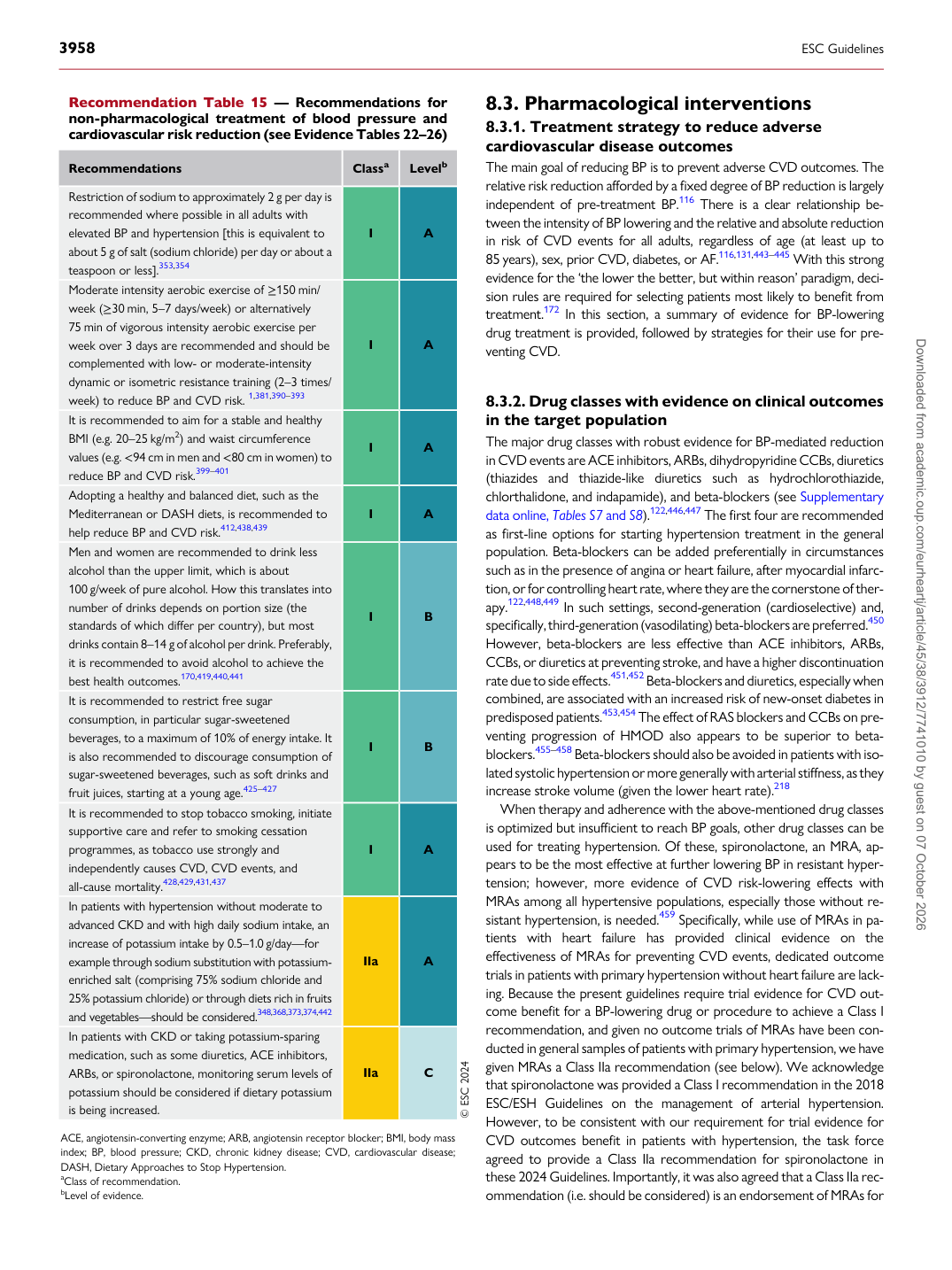
Recommendation Table 15 — Recommendations for non-pharmacological treatment of blood pressure and cardiovascular risk reduction (see Evidence Tables 22–26)

Recommendations Classa Levelb

Restriction of sodium to approximately 2 g per day is recommended where possible in all adults with elevated BP and hypertension [this is equivalent to about 5 g of salt (sodium chloride) per day or about a teaspoon or less].353,354 I A Moderate intensity aerobic exercise of ≥150 min/ week (≥30 min, 5–7 days/week) or alternatively 75 min of vigorous intensity aerobic exercise per week over 3 days are recommended and should be complemented with low- or moderate-intensity dynamic or isometric resistance training (2–3 times/ week) to reduce BP and CVD risk. 1,381,390–393 I A It is recommended to aim for a stable and healthy BMI (e.g. 20–25 kg/m2) and waist circumference values (e.g. <94 cm in men and <80 cm in women) to reduce BP and CVD risk.399–401 I A Adopting a healthy and balanced diet, such as the Mediterranean or DASH diets, is recommended to help reduce BP and CVD risk.412,438,439 I A Men and women are recommended to drink less alcohol than the upper limit, which is about 100 g/week of pure alcohol. How this translates into number of drinks depends on portion size (the standards of which differ per country), but most drinks contain 8–14 g of alcohol per drink. Preferably, it is recommended to avoid alcohol to achieve the best health outcomes.170,419,440,441 I B It is recommended to restrict free sugar consumption, in particular sugar-sweetened beverages, to a maximum of 10% of energy intake. It is also recommended to discourage consumption of sugar-sweetened beverages, such as soft drinks and fruit juices, starting at a young age.425–427 I B It is recommended to stop tobacco smoking, initiate supportive care and refer to smoking cessation programmes, as tobacco use strongly and independently causes CVD, CVD events, and all-cause mortality.428,429,431,437 I A In patients with hypertension without moderate to advanced CKD and with high daily sodium intake, an increase of potassium intake by 0.5–1.0 g/day—for example through sodium substitution with potassiumenriched salt (comprising 75% sodium chloride and 25% potassium chloride) or through diets rich in fruits and vegetables—should be considered.348,368,373,374,442 IIa A In patients with CKD or taking potassium-sparing medication, such as some diuretics, ACE inhibitors, ARBs, or spironolactone, monitoring serum levels of potassium should be considered if dietary potassium is being increased. IIa C © ESC 2024

ACE, angiotensin-converting enzyme; ARB, angiotensin receptor blocker; BMI, body mass index; BP, blood pressure; CKD, chronic kidney disease; CVD, cardiovascular disease; DASH, Dietary Approaches to Stop Hypertension. aClass of recommendation. bLevel of evidence. Downloaded from academic.oup.com/eurheartj/article/45/38/3912/7741010 by guest on 07 October 2026