p.44 抽出テキスト
and Diet, ExerCIse and carDiovascular hEalth-Salt  (DECIDE-Salt) trials was compelling,348,368 even though sodium restriction in these trials was not below 2 g/day. It is recommended to restrict total dietary sodium intake to approximately 2 g/day or less (equivalent to approximately 5 g or about a teaspoon of salt per day). This includes added salt and salt already contained in food. While the feasibility of this sodium target can be debated, the evidence for the benefits of this sodium target among patients with elevated BP or hypertension is sufficient, particularly in terms of lowering BP. The optimal sodium intake in the general population with non-elevated BP is less clear (noting also that the BP-lowering effect of salt reduction among patients with non-elevated BP appears lower).353,354 A more feasible compromise in the general population might be a target sodium intake range of 2– 4 g/day.369,370 It needs to be emphasized that large parts of daily sodium intake occur by means of sodium consumption contained in processed foods. 8.2.1.2 Potassium

Optimal dietary potassium intake, e.g. by consuming diets rich in fruits and vegetables, has BP-lowering effects and may be associated with lower CVD risk.348,364,368,371–373 The association between potassium intake, systolic BP, and CVD events may be sex-specific, being stronger in women.374 The World Health Organization (WHO) recommends over 3.5 g/day (∼90 mmol/day) of dietary potassium.375 Excessive potassium supplementation should, however, be avoided374 and CKD guidelines recommend dietary potassium restriction to <2.4 g/day in persons with advanced CKD (see Supplementary data online).376 A lower urinary sodium-to-potassium ratio (Na+/K+ ratio; a surrogate for reduced dietary sodium intake complemented by increased potassium intake) has been associated with a greater reduction in systolic and diastolic BP than with a higher ratio.348,377 In patients with hypertension and high dietary sodium, increased dietary intake of potassium (in addition to lower dietary sodium) should be considered.348,350,378 In patients with persistently high sodium intake (>5 g/day)

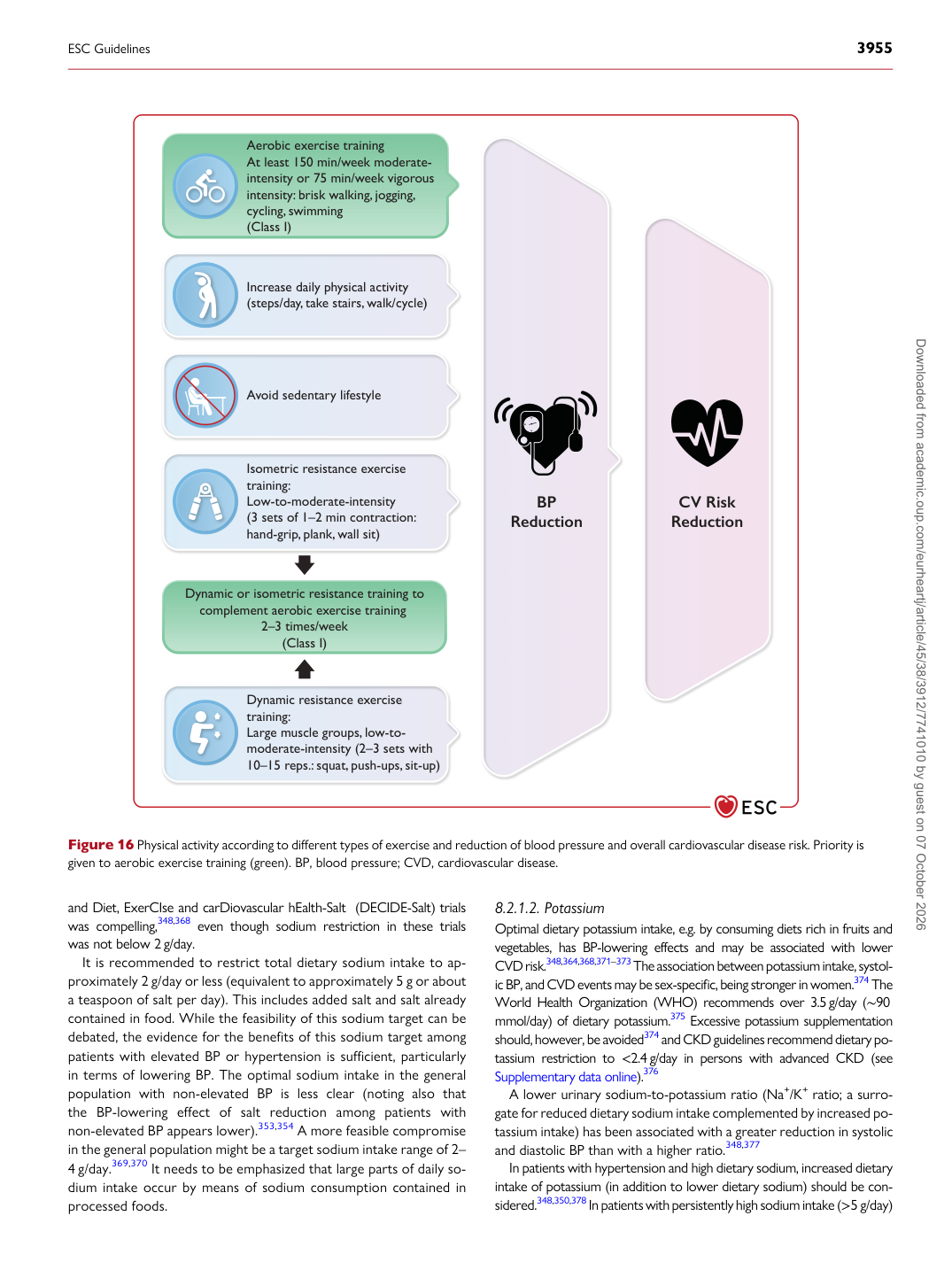
Aerobic exercise training At least 150 min/week moderateintensity or 75 min/week vigorous intensity: brisk walking, jogging, cycling, swimming (Class I)

Isometric resistance exercise training: Low-to-moderate-intensity (3 sets of 1–2 min contraction: hand-grip, plank, wall sit)

Dynamic resistance exercise training: Large muscle groups, low-tomoderate-intensity (2–3 sets with 10–15 reps.: squat, push-ups, sit-up)

Increase daily physical activity (steps/day, take stairs, walk/cycle)

Avoid sedentary lifestyle

BP Reduction CV Risk Reduction

Dynamic or isometric resistance training to

complement aerobic exercise training

2–3 times/week (Class I)

Figure 16 Physical activity according to different types of exercise and reduction of blood pressure and overall cardiovascular disease risk. Priority is given to aerobic exercise training (green). BP, blood pressure; CVD, cardiovascular disease.

ESC Guidelines                                                                                                                                                                                          3955

Downloaded from academic.oup.com/eurheartj/article/45/38/3912/7741010 by guest on 07 October 2026