p.43 抽出テキスト
7.6.5 Phaeochromocytoma/paraganglioma

Phaeochromocytomas/paragangliomas (PPGLs) are a rare form of secondary hypertension characterized by a highly heterogeneous clinical presentation.335,336 PPGLs are usually discovered incidentally.337 A PPGL should be suspected in the presence of signs and symptoms of catecholamine excess or in syndromic PPGL, in patients with a family history of PPGL, and in carriers of a germline mutation in one of the PPGL-causing genes.338 Since normetanephrine and metanephrine are secreted constitutively, as opposed to the highly variable nature of catecholamine secretion, they are preferred as screening tests for PPGL (Table 13).

8 Preventing and treating elevated

blood pressure and hypertension

The ultimate goal of preventing and treating elevated BP and hypertension is to reduce CVD, to improve quality of life, and to prevent premature death. Crucially, besides BP, other CVD risk factors need to be comprehensively addressed (e.g. smoking, glucose, dyslipidaemia) as detailed in the 2021 ESC Guidelines on cardiovascular disease prevention in clinical practice.170 Indeed, it is worth emphasizing that, when combined, these CVD risk factors have multiplicative (not additive) effects on CVD risk.340

8.1 Prevention strategies in early life

Detailed information on this topic is provided in the Supplementary data online. High BP tracks from childhood to adulthood.341,342 Hypertension in childhood was redefined in a 2022 ESC Consensus Document.343 8.2 Non-pharmacological interventions

A major underlying contributor to elevated BP and hypertension in the general adult population is unhealthy lifestyle, with severe consequences for all-cause and CVD mortality. As such, we give lifestyle interventions to reduce BP a special status in our recommendations throughout these guidelines (Figures 16 and 17). This is reflected by a modified approach to the class of recommendations for lifestyle interventions compared with medical interventions (pharmacological or procedural). Given the salutary benefits of healthy lifestyle on a range of outcomes that extend well beyond BP-lowering effects,347 including broad mental and physical health benefits, we do not require lifestyle interventions to have RCT evidence for efficacy in reducing CVD events through BP lowering to achieve a Class I recommendation. In deciding to give lifestyle interventions this status, the task force also recognizes that: (i) lifestyle interventions are less likely to be subjected to clinical outcomes trials (e.g. due to funding limitations and lack of interest from industry), and (ii) the risks of adverse effects and toxicity relating to healthy lifestyle interventions are low. In contrast, in these guidelines, to achieve a Class I recommendation (irrespective of level of evidence) there needs to be evidence that medical interventions that reduce BP also decrease CVD events by BP lowering.

8.2.1 Dietary sodium and potassium intake

8.2.1.1. Sodium Reducing dietary salt (sodium chloride) intake in individuals with high baseline intake lowers CVD event rates.348 Extensive observational studies have reported dose–response associations between high dietary sodium intake and CVD events.349–351 The potential impact of salt reduction on population health is significant, particularly in countries where the population’s average salt intake is high. Pooled data from longterm follow-up salt-reduction trials demonstrate that reducing salt by 2.5 g/day is associated with an approximately 20% reduction in CVD events at the population level.349 The health benefits of salt reduction are likely mediated, largely, by BP-lowering effects.352–354 An almost linear relationship has been described in a dose–response meta-analysis between sodium intake ranging from 0.4 to 7.6 g/day and reduction of systolic and diastolic BP is independent of baseline BP.355,356 Women appear to be, on average, more sodium sensitive than men,357 and may have greater outcome benefits when receiving comparable sodium-restricted diets.358 Trial evidence for the BP-lowering benefits of salt reduction extend down to daily sodium intakes of <1.5 g/day.356,358–361 The task force acknowledges that the observational data linking sodium intake to CVD outcomes are mixed and that some studies have not found a link between salt intake and CVD.362,363 In addition, a potential J-curve exists between sodium intake and CVD events (whereby some analyses suggest that sodium reduction to very low levels could be harmful).363,364 While there are differences of opinion, the task force agreed that, on balance, (i) observational J-curve data are often due to reverse causality or confounding,114,348,365,366 (ii) the relationship between dietary sodium and stroke is typically linear in shape, without any J-curve, (iii) if the J-curve were causal, the adverse effect of very low sodium on CVD would have to be mediated by some harmful mechanism that overcomes the expected benefit mediated by BP lowering (which is unlikely), and (iv) estimation of sodium intake using spot-urine sodium testing (which was commonly done in studies reporting a J-curve) may not be as valid as other methods.367 For example, most (but not all)362 reports measuring 24 h urine sodium excretion (a surrogate measure of sodium intake) have not reported a J-curve association with CVD.350,364 Furthermore the causal evidence demonstrating reduced CVD with sodium restriction (using potassiumenriched salt substitutes) in the Salt Substitute and Stroke Study (SSaSS)

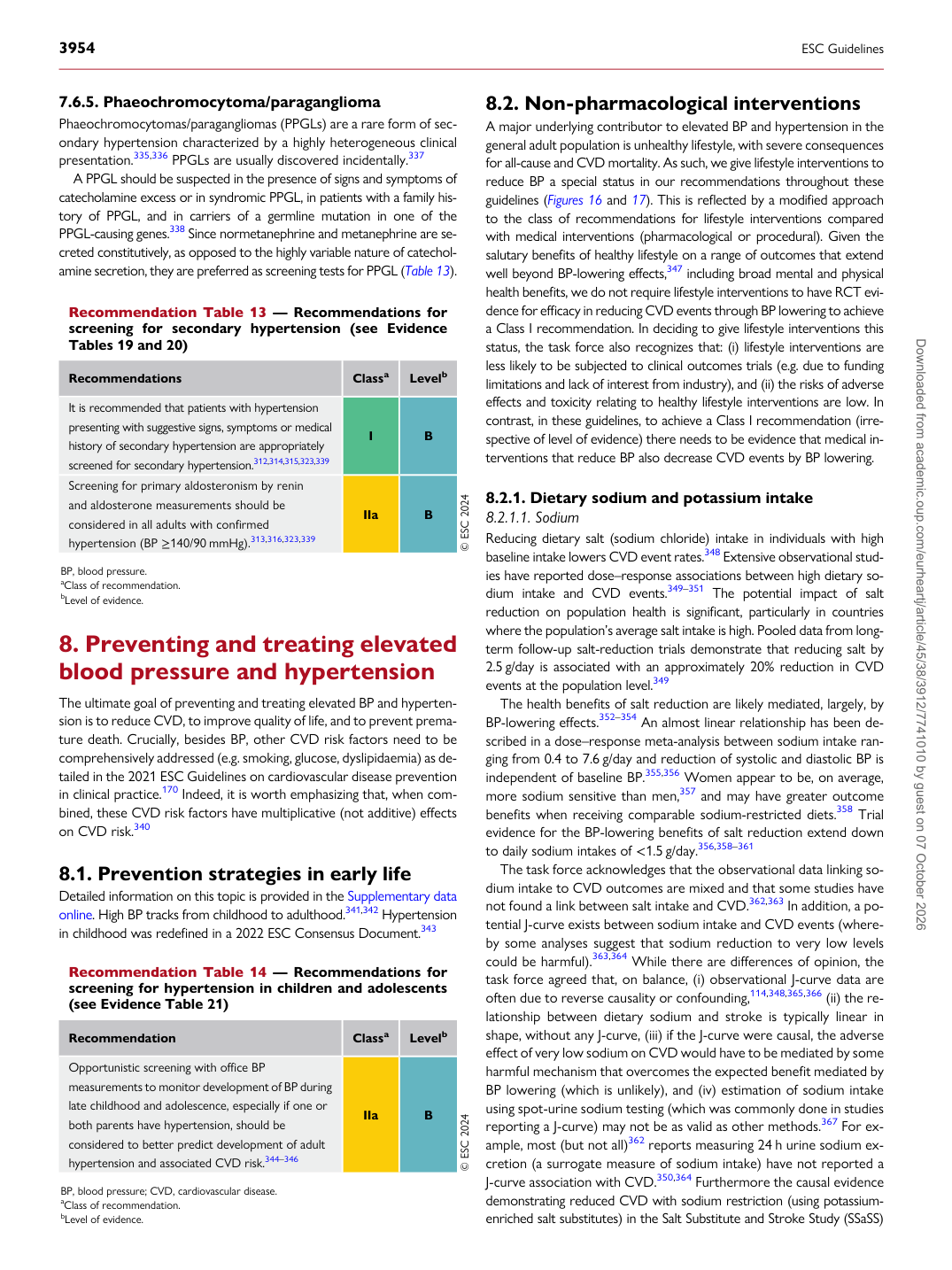
Recommendation Table 13 — Recommendations for screening for secondary hypertension (see Evidence Tables 19 and 20)

Recommendations Classa Levelb

It is recommended that patients with hypertension presenting with suggestive signs, symptoms or medical history of secondary hypertension are appropriately screened for secondary hypertension.312,314,315,323,339 I B Screening for primary aldosteronism by renin and aldosterone measurements should be considered in all adults with confirmed hypertension (BP ≥140/90 mmHg).313,316,323,339 IIa B © ESC 2024

BP, blood pressure. aClass of recommendation. bLevel of evidence.

Recommendation Table 14 — Recommendations for screening for hypertension in children and adolescents (see Evidence Table 21)

Recommendation Classa Levelb

Opportunistic screening with office BP measurements to monitor development of BP during late childhood and adolescence, especially if one or both parents have hypertension, should be considered to better predict development of adult hypertension and associated CVD risk.344–346 IIa B © ESC 2024

BP, blood pressure; CVD, cardiovascular disease. aClass of recommendation. bLevel of evidence. Downloaded from academic.oup.com/eurheartj/article/45/38/3912/7741010 by guest on 07 October 2026