p.40 抽出テキスト
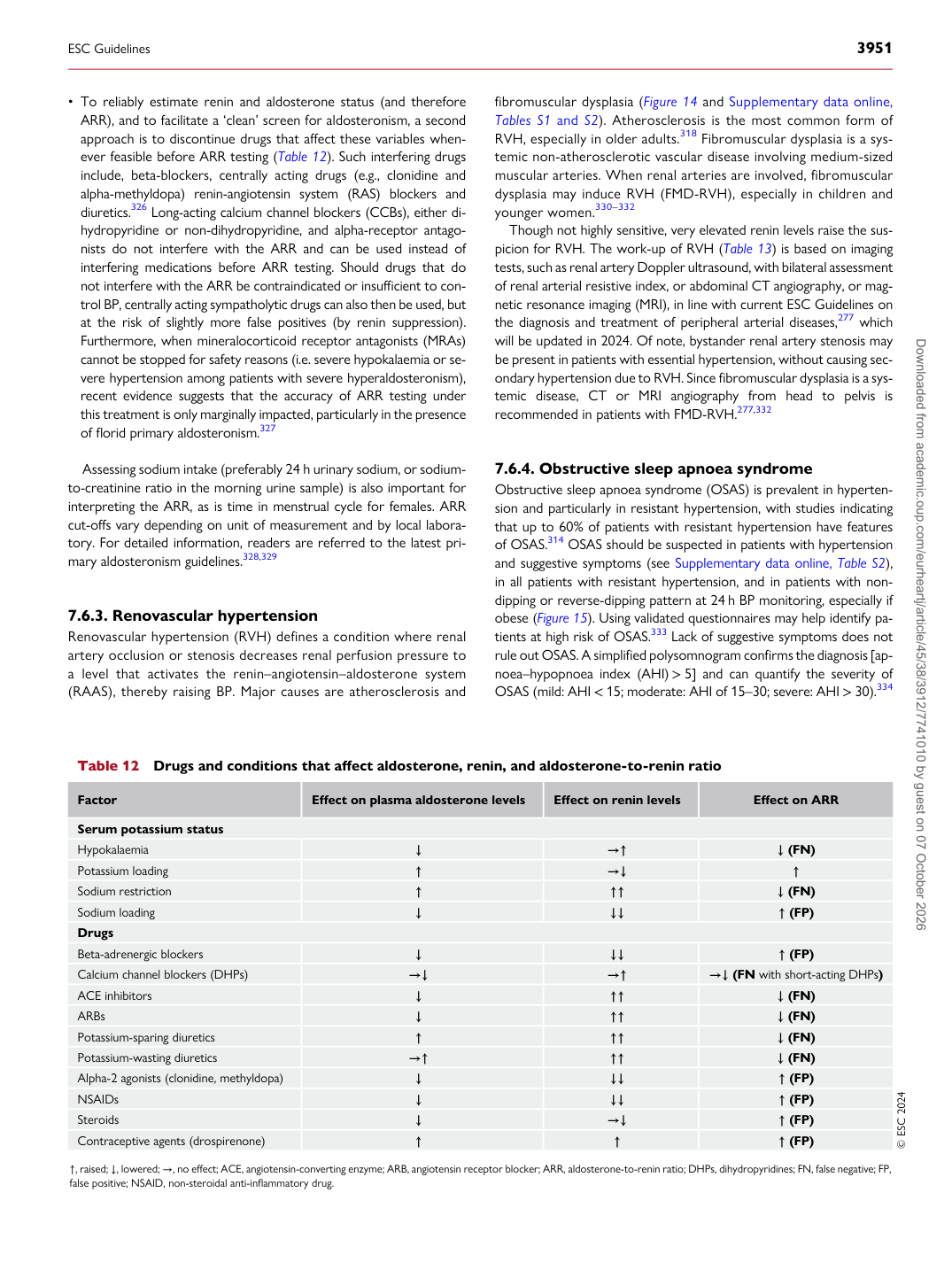
• To reliably estimate renin and aldosterone status (and therefore ARR), and to facilitate a ‘clean’ screen for aldosteronism, a second approach is to discontinue drugs that affect these variables whenever feasible before ARR testing (Table 12). Such interfering drugs include, beta-blockers, centrally acting drugs (e.g., clonidine and alpha-methyldopa) renin-angiotensin system (RAS) blockers and diuretics.326 Long-acting calcium channel blockers (CCBs), either dihydropyridine or non-dihydropyridine, and alpha-receptor antagonists do not interfere with the ARR and can be used instead of interfering medications before ARR testing. Should drugs that do not interfere with the ARR be contraindicated or insufficient to control BP, centrally acting sympatholytic drugs can also then be used, but at the risk of slightly more false positives (by renin suppression). Furthermore, when mineralocorticoid receptor antagonists (MRAs) cannot be stopped for safety reasons (i.e. severe hypokalaemia or severe hypertension among patients with severe hyperaldosteronism), recent evidence suggests that the accuracy of ARR testing under this treatment is only marginally impacted, particularly in the presence of florid primary aldosteronism.327

Assessing sodium intake (preferably 24 h urinary sodium, or sodiumto-creatinine ratio in the morning urine sample) is also important for interpreting the ARR, as is time in menstrual cycle for females. ARR cut-offs vary depending on unit of measurement and by local laboratory. For detailed information, readers are referred to the latest primary aldosteronism guidelines.328,329

7.6.3 Renovascular hypertension

Renovascular hypertension (RVH) defines a condition where renal artery occlusion or stenosis decreases renal perfusion pressure to a level that activates the renin–angiotensin–aldosterone system (RAAS), thereby raising BP. Major causes are atherosclerosis and fibromuscular dysplasia (Figure 14 and Supplementary data online, Tables S1 and S2). Atherosclerosis is the most common form of RVH, especially in older adults.318 Fibromuscular dysplasia is a systemic non-atherosclerotic vascular disease involving medium-sized muscular arteries. When renal arteries are involved, fibromuscular dysplasia may induce RVH (FMD-RVH), especially in children and younger women.330–332

Though not highly sensitive, very elevated renin levels raise the suspicion for RVH. The work-up of RVH (Table 13) is based on imaging tests, such as renal artery Doppler ultrasound, with bilateral assessment of renal arterial resistive index, or abdominal CT angiography, or magnetic resonance imaging (MRI), in line with current ESC Guidelines on the diagnosis and treatment of peripheral arterial diseases,277 which will be updated in 2024. Of note, bystander renal artery stenosis may be present in patients with essential hypertension, without causing secondary hypertension due to RVH. Since fibromuscular dysplasia is a systemic disease, CT or MRI angiography from head to pelvis is recommended in patients with FMD-RVH.277,332

7.6.4 Obstructive sleep apnoea syndrome

Obstructive sleep apnoea syndrome (OSAS) is prevalent in hypertension and particularly in resistant hypertension, with studies indicating that up to 60% of patients with resistant hypertension have features of OSAS.314 OSAS should be suspected in patients with hypertension and suggestive symptoms (see Supplementary data online, Table S2), in all patients with resistant hypertension, and in patients with nondipping or reverse-dipping pattern at 24 h BP monitoring, especially if obese (Figure 15). Using validated questionnaires may help identify patients at high risk of OSAS.333 Lack of suggestive symptoms does not rule out OSAS. A simplified polysomnogram confirms the diagnosis [apnoea–hypopnoea index (AHI) > 5] and can quantify the severity of OSAS (mild: AHI < 15; moderate: AHI of 15–30; severe: AHI > 30).334

Table 12 Drugs and conditions that affect aldosterone, renin, and aldosterone-to-renin ratio

Factor Effect on plasma aldosterone levels Effect on renin levels Effect on ARR

Serum potassium status Hypokalaemia ↓ →↑ ↓ (FN) Potassium loading ↑ →↓ ↑ Sodium restriction ↑ ↑↑ ↓ (FN) Sodium loading ↓ ↓↓ ↑ (FP) Drugs Beta-adrenergic blockers ↓ ↓↓ ↑ (FP) Calcium channel blockers (DHPs) →↓ →↑ →↓ (FN with short-acting DHPs) ACE inhibitors ↓ ↑↑ ↓ (FN) ARBs ↓ ↑↑ ↓ (FN) Potassium-sparing diuretics ↑ ↑↑ ↓ (FN) Potassium-wasting diuretics →↑ ↑↑ ↓ (FN) Alpha-2 agonists (clonidine, methyldopa) ↓ ↓↓ ↑ (FP) NSAIDs ↓ ↓↓ ↑ (FP) Steroids ↓ →↓ ↑ (FP) Contraceptive agents (drospirenone) ↑ ↑ ↑ (FP) © ESC 2024

↑, raised; ↓, lowered; →, no effect; ACE, angiotensin-converting enzyme; ARB, angiotensin receptor blocker; ARR, aldosterone-to-renin ratio; DHPs, dihydropyridines; FN, false negative; FP, false positive; NSAID, non-steroidal anti-inflammatory drug.

ESC Guidelines                                                                                                                                                                                          3951

Downloaded from academic.oup.com/eurheartj/article/45/38/3912/7741010 by guest on 07 October 2026