p.39 抽出テキスト
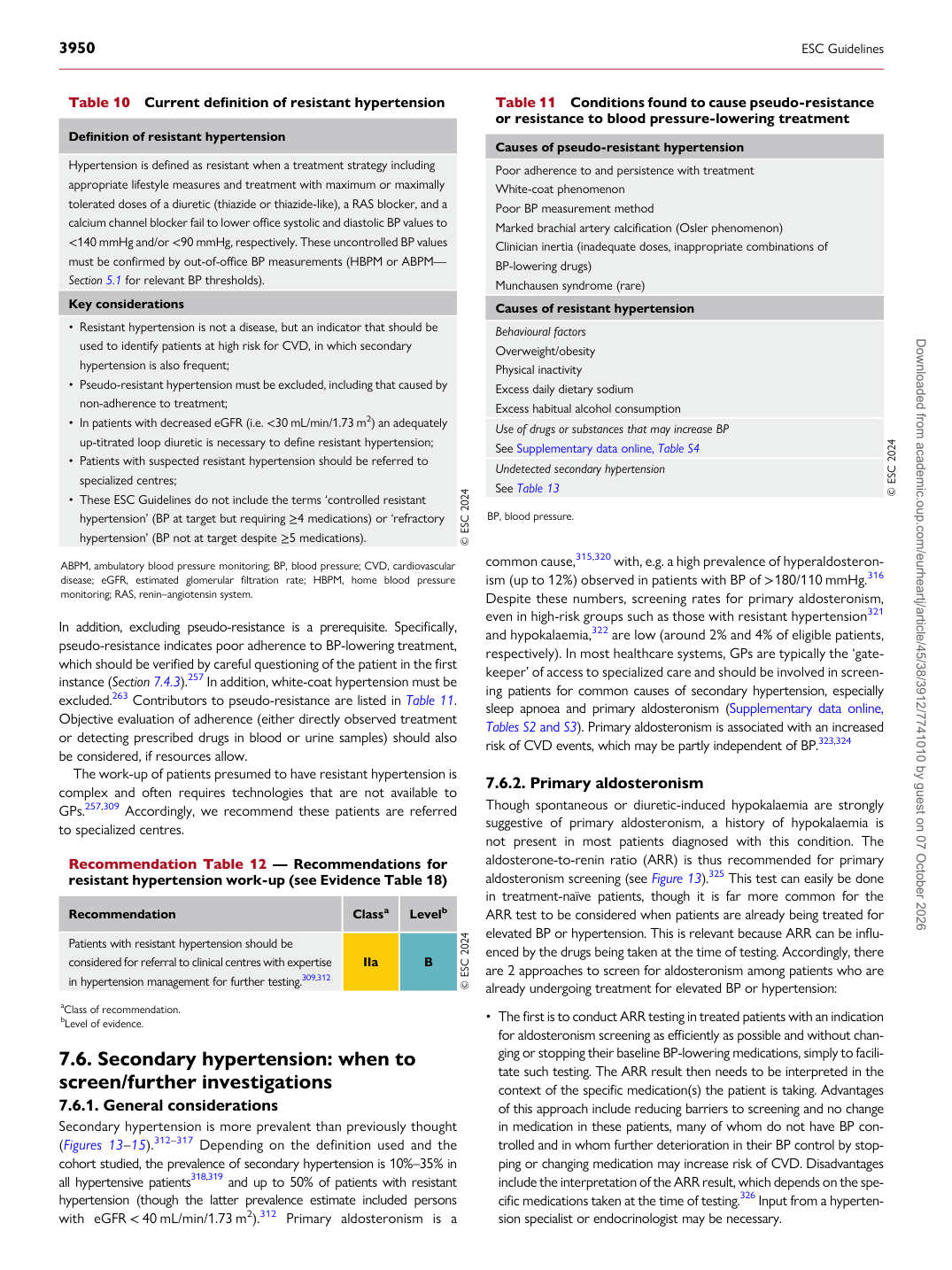
In addition, excluding pseudo-resistance is a prerequisite. Specifically, pseudo-resistance indicates poor adherence to BP-lowering treatment, which should be verified by careful questioning of the patient in the first instance (Section 7.4.3).257 In addition, white-coat hypertension must be excluded.263 Contributors to pseudo-resistance are listed in Table 11. Objective evaluation of adherence (either directly observed treatment or detecting prescribed drugs in blood or urine samples) should also be considered, if resources allow. The work-up of patients presumed to have resistant hypertension is complex and often requires technologies that are not available to GPs.257,309 Accordingly, we recommend these patients are referred to specialized centres.

7.6 Secondary hypertension: when to

screen/further investigations 7.6.1. General considerations Secondary hypertension is more prevalent than previously thought (Figures 13–15).312–317 Depending on the definition used and the cohort studied, the prevalence of secondary hypertension is 10%–35% in all hypertensive patients318,319 and up to 50% of patients with resistant hypertension (though the latter prevalence estimate included persons with eGFR < 40 mL/min/1.73 m2).312 Primary aldosteronism is a common cause,315,320 with, e.g. a high prevalence of hyperaldosteronism (up to 12%) observed in patients with BP of >180/110 mmHg.316

Despite these numbers, screening rates for primary aldosteronism, even in high-risk groups such as those with resistant hypertension321 and hypokalaemia,322 are low (around 2% and 4% of eligible patients, respectively). In most healthcare systems, GPs are typically the ‘gatekeeper’ of access to specialized care and should be involved in screening patients for common causes of secondary hypertension, especially sleep apnoea and primary aldosteronism (Supplementary data online, Tables S2 and S3). Primary aldosteronism is associated with an increased risk of CVD events, which may be partly independent of BP.323,324

7.6.2 Primary aldosteronism

Though spontaneous or diuretic-induced hypokalaemia are strongly suggestive of primary aldosteronism, a history of hypokalaemia is not present in most patients diagnosed with this condition. The aldosterone-to-renin ratio (ARR) is thus recommended for primary aldosteronism screening (see Figure 13).325 This test can easily be done in treatment-naïve patients, though it is far more common for the ARR test to be considered when patients are already being treated for elevated BP or hypertension. This is relevant because ARR can be influenced by the drugs being taken at the time of testing. Accordingly, there are 2 approaches to screen for aldosteronism among patients who are already undergoing treatment for elevated BP or hypertension: • The first is to conduct ARR testing in treated patients with an indication for aldosteronism screening as efficiently as possible and without changing or stopping their baseline BP-lowering medications, simply to facilitate such testing. The ARR result then needs to be interpreted in the context of the specific medication(s) the patient is taking. Advantages of this approach include reducing barriers to screening and no change in medication in these patients, many of whom do not have BP controlled and in whom further deterioration in their BP control by stopping or changing medication may increase risk of CVD. Disadvantages include the interpretation of the ARR result, which depends on the specific medications taken at the time of testing.326 Input from a hypertension specialist or endocrinologist may be necessary.

Recommendation Table 12 — Recommendations for resistant hypertension work-up (see Evidence Table 18)

Recommendation Classa Levelb

Patients with resistant hypertension should be considered for referral to clinical centres with expertise in hypertension management for further testing.309,312 IIa B © ESC 2024 aClass of recommendation. bLevel of evidence.

Table 10 Current definition of resistant hypertension

Definition of resistant hypertension

Hypertension is defined as resistant when a treatment strategy including appropriate lifestyle measures and treatment with maximum or maximally tolerated doses of a diuretic (thiazide or thiazide-like), a RAS blocker, and a calcium channel blocker fail to lower office systolic and diastolic BP values to <140 mmHg and/or <90 mmHg, respectively. These uncontrolled BP values must be confirmed by out-of-office BP measurements (HBPM or ABPM— Section 5.1 for relevant BP thresholds). Key considerations • Resistant hypertension is not a disease, but an indicator that should be

used to identify patients at high risk for CVD, in which secondary hypertension is also frequent; • Pseudo-resistant hypertension must be excluded, including that caused by

non-adherence to treatment; • In patients with decreased eGFR (i.e. <30 mL/min/1.73 m2) an adequately up-titrated loop diuretic is necessary to define resistant hypertension; • Patients with suspected resistant hypertension should be referred to specialized centres; • These ESC Guidelines do not include the terms ‘controlled resistant

hypertension’ (BP at target but requiring ≥4 medications) or ‘refractory hypertension’ (BP not at target despite ≥5 medications). © ESC 2024

ABPM, ambulatory blood pressure monitoring; BP, blood pressure; CVD, cardiovascular disease; eGFR, estimated glomerular filtration rate; HBPM, home blood pressure monitoring; RAS, renin–angiotensin system. Table 11 Conditions found to cause pseudo-resistance or resistance to blood pressure-lowering treatment

Causes of pseudo-resistant hypertension Poor adherence to and persistence with treatment White-coat phenomenon Poor BP measurement method Marked brachial artery calcification (Osler phenomenon) Clinician inertia (inadequate doses, inappropriate combinations of BP-lowering drugs) Munchausen syndrome (rare) Causes of resistant hypertension Behavioural factors Overweight/obesity Physical inactivity Excess daily dietary sodium Excess habitual alcohol consumption Use of drugs or substances that may increase BP See Supplementary data online, Table S4 Undetected secondary hypertension See Table 13 © ESC 2024

BP, blood pressure. Downloaded from academic.oup.com/eurheartj/article/45/38/3912/7741010 by guest on 07 October 2026