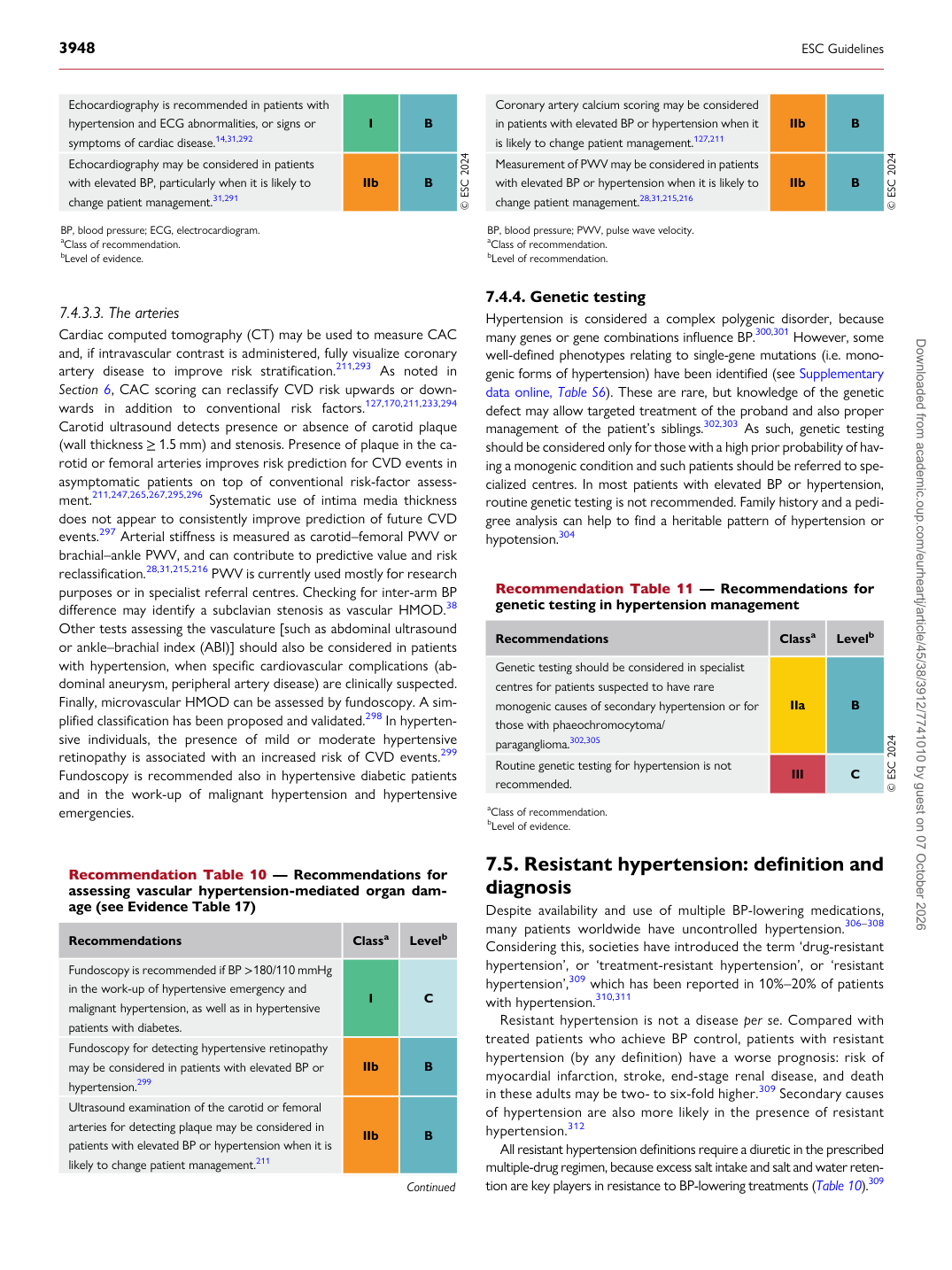
p.37 抽出テキスト
7.4.3.3 The arteries

Cardiac computed tomography (CT) may be used to measure CAC and, if intravascular contrast is administered, fully visualize coronary artery disease to improve risk stratification.211,293 As noted in Section 6, CAC scoring can reclassify CVD risk upwards or downwards in addition to conventional risk factors.127,170,211,233,294 Carotid ultrasound detects presence or absence of carotid plaque (wall thickness ≥ 1.5 mm) and stenosis. Presence of plaque in the carotid or femoral arteries improves risk prediction for CVD events in asymptomatic patients on top of conventional risk-factor assessment.211,247,265,267,295,296 Systematic use of intima media thickness does not appear to consistently improve prediction of future CVD events.297 Arterial stiffness is measured as carotid–femoral PWV or brachial–ankle PWV, and can contribute to predictive value and risk reclassification.28,31,215,216 PWV is currently used mostly for research purposes or in specialist referral centres. Checking for inter-arm BP difference may identify a subclavian stenosis as vascular HMOD.38 Other tests assessing the vasculature [such as abdominal ultrasound or ankle–brachial index (ABI)] should also be considered in patients with hypertension, when specific cardiovascular complications (abdominal aneurysm, peripheral artery disease) are clinically suspected. Finally, microvascular HMOD can be assessed by fundoscopy. A simplified classification has been proposed and validated.298 In hypertensive individuals, the presence of mild or moderate hypertensive retinopathy is associated with an increased risk of CVD events.299 Fundoscopy is recommended also in hypertensive diabetic patients and in the work-up of malignant hypertension and hypertensive emergencies. 7.4.4 Genetic testing

Hypertension is considered a complex polygenic disorder, because many genes or gene combinations influence BP.300,301 However, some well-defined phenotypes relating to single-gene mutations (i.e. monogenic forms of hypertension) have been identified (see Supplementary data online, Table S6). These are rare, but knowledge of the genetic defect may allow targeted treatment of the proband and also proper management of the patient’s siblings.302,303 As such, genetic testing should be considered only for those with a high prior probability of having a monogenic condition and such patients should be referred to specialized centres. In most patients with elevated BP or hypertension, routine genetic testing is not recommended. Family history and a pedigree analysis can help to find a heritable pattern of hypertension or hypotension.304

7.5 Resistant hypertension: definition and

diagnosis Despite availability and use of multiple BP-lowering medications, many patients worldwide have uncontrolled hypertension.306–308 Considering this, societies have introduced the term ‘drug-resistant hypertension’, or ‘treatment-resistant hypertension’, or ‘resistant hypertension’,309 which has been reported in 10%–20% of patients with hypertension.310,311 Resistant hypertension is not a disease per se. Compared with treated patients who achieve BP control, patients with resistant hypertension (by any definition) have a worse prognosis: risk of myocardial infarction, stroke, end-stage renal disease, and death in these adults may be two- to six-fold higher.309 Secondary causes of hypertension are also more likely in the presence of resistant hypertension.312 All resistant hypertension definitions require a diuretic in the prescribed multiple-drug regimen, because excess salt intake and salt and water retention are key players in resistance to BP-lowering treatments (Table 10).309

Echocardiography is recommended in patients with hypertension and ECG abnormalities, or signs or symptoms of cardiac disease.14,31,292 I B Echocardiography may be considered in patients with elevated BP, particularly when it is likely to change patient management.31,291 IIb B © ESC 2024

BP, blood pressure; ECG, electrocardiogram. aClass of recommendation. bLevel of evidence.

Recommendation Table 10 — Recommendations for assessing vascular hypertension-mediated organ damage (see Evidence Table 17)

Recommendations Classa Levelb

Fundoscopy is recommended if BP >180/110 mmHg in the work-up of hypertensive emergency and malignant hypertension, as well as in hypertensive patients with diabetes. I C Fundoscopy for detecting hypertensive retinopathy may be considered in patients with elevated BP or hypertension.299 IIb B Ultrasound examination of the carotid or femoral arteries for detecting plaque may be considered in patients with elevated BP or hypertension when it is likely to change patient management.211 IIb B

Continued Coronary artery calcium scoring may be considered

in patients with elevated BP or hypertension when it is likely to change patient management.127,211 IIb B Measurement of PWV may be considered in patients with elevated BP or hypertension when it is likely to change patient management.28,31,215,216 IIb B © ESC 2024

BP, blood pressure; PWV, pulse wave velocity. aClass of recommendation. bLevel of recommendation.

Recommendation Table 11 — Recommendations for genetic testing in hypertension management

Recommendations Classa Levelb

Genetic testing should be considered in specialist centres for patients suspected to have rare monogenic causes of secondary hypertension or for those with phaeochromocytoma/ paraganglioma.302,305 IIa B Routine genetic testing for hypertension is not recommended. III C © ESC 2024 aClass of recommendation. bLevel of evidence. Downloaded from academic.oup.com/eurheartj/article/45/38/3912/7741010 by guest on 07 October 2026