p.32 抽出テキスト
7 Diagnosing hypertension and

investigating underlying causes

7.1 Screening for hypertension

Hypertension is predominantly an asymptomatic condition that is typically detected by systematic or opportunistic screening in a healthcare setting. Systematic screening refers to any process where individuals are identified and invited to a healthcare setting solely to measure their BP and CVD risk profile. Opportunistic screening refers to BP being measured when the patient presents to a healthcare setting for any reason, such as a routine check-up or the treatment of an acute or chronic condition. Self-screening and non-physician screening are also increasingly used.227–230 Few data are available on the effectiveness of different hypertension screening strategies to reduce the morbidity and mortality associated with hypertension.231–233 More evidence is needed before systematic screening programmes with BP measurement can be recommended in all adults to reduce CVD events.231 Opportunistic BP screening in a primary care setting appears effective, with an estimated 90% of all adults aged >40 years in the UK having a BP check within a 5-year time period,234 though these findings may not extrapolate to other countries. When patients provide HBPM recordings, these can also be used as part of an opportunistic screening programme (see Section 5.2).235 Despite ongoing uncertainty about the effect of hypertension screening programmes on CVD outcomes, many studies have demonstrated that screening (mostly opportunistic screening) increases hypertension detection, and that the benefits of screening likely outweigh harms.70 Global initiatives to raise BP awareness, such as the May Measurement Month,228 or targeted initiatives, such as the barbershop health outreach programmes,229 are successful examples of BP screening campaigns. Screening for hypertension, like for global CVD risk assessment, should be intermittently repeated, e.g. every 3 years. Considering the rate of progression to hypertension in European population samples,236 it is reasonable to measure BP at least every 3 years in the case of non-elevated BP and low–moderate CVD risk (i.e. individuals aged <40 years). More frequent BP checks (i.e. yearly) should be considered in individuals 40 years or older and individuals with elevated BP not currently meeting indications for treatment170 (Figure 10). 7.2 Confirming the diagnosis of

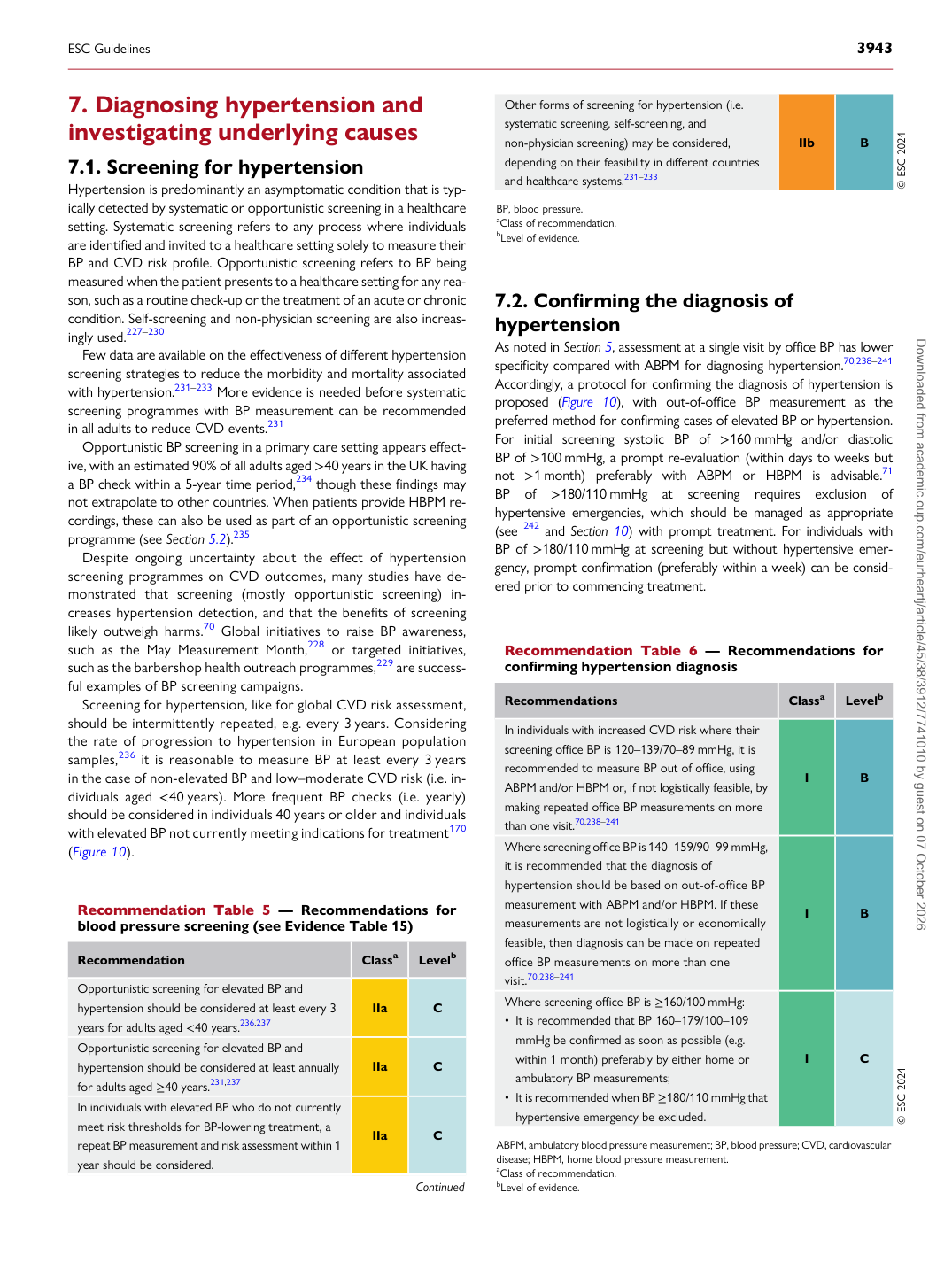
hypertension As noted in Section 5, assessment at a single visit by office BP has lower specificity compared with ABPM for diagnosing hypertension.70,238–241 Accordingly, a protocol for confirming the diagnosis of hypertension is proposed (Figure 10), with out-of-office BP measurement as the preferred method for confirming cases of elevated BP or hypertension. For initial screening systolic BP of >160 mmHg and/or diastolic BP of >100 mmHg, a prompt re-evaluation (within days to weeks but not >1 month) preferably with ABPM or HBPM is advisable.71 BP of >180/110 mmHg at screening requires exclusion of hypertensive emergencies, which should be managed as appropriate (see 242 and Section 10) with prompt treatment. For individuals with BP of >180/110 mmHg at screening but without hypertensive emergency, prompt confirmation (preferably within a week) can be considered prior to commencing treatment.

Recommendation Table 5 — Recommendations for blood pressure screening (see Evidence Table 15)

Recommendation Classa Levelb

Opportunistic screening for elevated BP and hypertension should be considered at least every 3 years for adults aged <40 years.236,237 IIa C Opportunistic screening for elevated BP and hypertension should be considered at least annually for adults aged ≥40 years.231,237 IIa C In individuals with elevated BP who do not currently meet risk thresholds for BP-lowering treatment, a repeat BP measurement and risk assessment within 1 year should be considered. IIa C

Continued Other forms of screening for hypertension (i.e.

systematic screening, self-screening, and non-physician screening) may be considered, depending on their feasibility in different countries and healthcare systems.231–233 IIb B © ESC 2024

BP, blood pressure. aClass of recommendation. bLevel of evidence.

Recommendation Table 6 — Recommendations for confirming hypertension diagnosis

Recommendations Classa Levelb

In individuals with increased CVD risk where their screening office BP is 120–139/70–89 mmHg, it is recommended to measure BP out of office, using ABPM and/or HBPM or, if not logistically feasible, by making repeated office BP measurements on more than one visit.70,238–241 I B Where screening office BP is 140–159/90–99 mmHg, it is recommended that the diagnosis of hypertension should be based on out-of-office BP measurement with ABPM and/or HBPM. If these measurements are not logistically or economically feasible, then diagnosis can be made on repeated office BP measurements on more than one visit.70,238–241 I B Where screening office BP is ≥160/100 mmHg: • It is recommended that BP 160–179/100–109

mmHg be confirmed as soon as possible (e.g. within 1 month) preferably by either home or ambulatory BP measurements; • It is recommended when BP ≥180/110 mmHg that

hypertensive emergency be excluded. I C © ESC 2024

ABPM, ambulatory blood pressure measurement; BP, blood pressure; CVD, cardiovascular disease; HBPM, home blood pressure measurement. aClass of recommendation. bLevel of evidence.

ESC Guidelines                                                                                                                                                                                          3943

Downloaded from academic.oup.com/eurheartj/article/45/38/3912/7741010 by guest on 07 October 2026