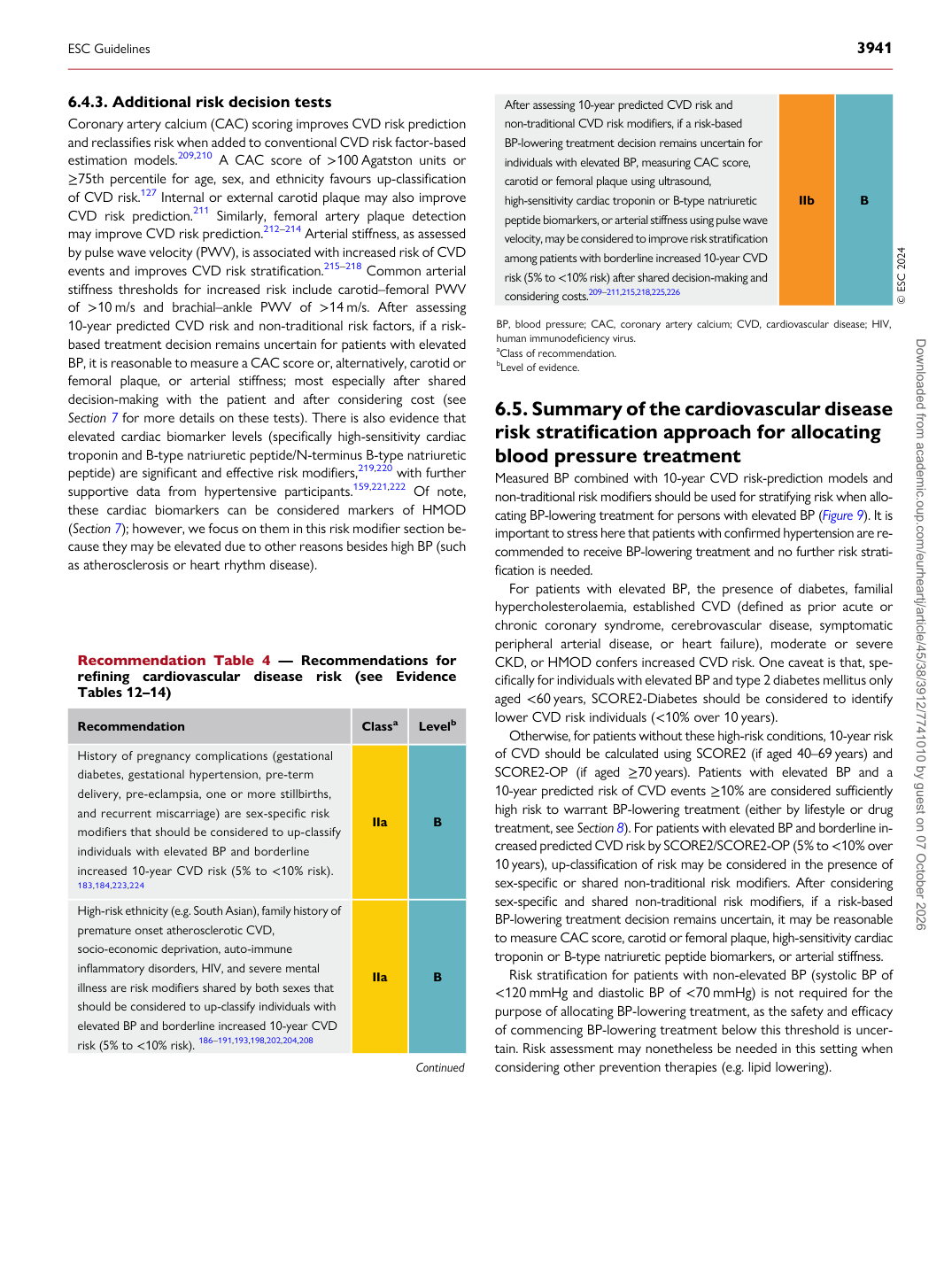
p.30 抽出テキスト
6.4.3 Additional risk decision tests

Coronary artery calcium (CAC) scoring improves CVD risk prediction and reclassifies risk when added to conventional CVD risk factor-based estimation models.209,210 A CAC score of >100 Agatston units or ≥75th percentile for age, sex, and ethnicity favours up-classification of CVD risk.127 Internal or external carotid plaque may also improve CVD risk prediction.211 Similarly, femoral artery plaque detection may improve CVD risk prediction.212–214 Arterial stiffness, as assessed by pulse wave velocity (PWV), is associated with increased risk of CVD events and improves CVD risk stratification.215–218 Common arterial stiffness thresholds for increased risk include carotid–femoral PWV of >10 m/s and brachial–ankle PWV of >14 m/s. After assessing 10-year predicted CVD risk and non-traditional risk factors, if a riskbased treatment decision remains uncertain for patients with elevated BP, it is reasonable to measure a CAC score or, alternatively, carotid or femoral plaque, or arterial stiffness; most especially after shared decision-making with the patient and after considering cost (see Section 7 for more details on these tests). There is also evidence that elevated cardiac biomarker levels (specifically high-sensitivity cardiac troponin and B-type natriuretic peptide/N-terminus B-type natriuretic peptide) are significant and effective risk modifiers,219,220 with further supportive data from hypertensive participants.159,221,222 Of note, these cardiac biomarkers can be considered markers of HMOD (Section 7); however, we focus on them in this risk modifier section because they may be elevated due to other reasons besides high BP (such as atherosclerosis or heart rhythm disease). 6.5 Summary of the cardiovascular disease

risk stratification approach for allocating blood pressure treatment Measured BP combined with 10-year CVD risk-prediction models and non-traditional risk modifiers should be used for stratifying risk when allocating BP-lowering treatment for persons with elevated BP (Figure 9). It is important to stress here that patients with confirmed hypertension are recommended to receive BP-lowering treatment and no further risk stratification is needed. For patients with elevated BP, the presence of diabetes, familial hypercholesterolaemia, established CVD (defined as prior acute or chronic coronary syndrome, cerebrovascular disease, symptomatic peripheral arterial disease, or heart failure), moderate or severe CKD, or HMOD confers increased CVD risk. One caveat is that, specifically for individuals with elevated BP and type 2 diabetes mellitus only aged <60 years, SCORE2-Diabetes should be considered to identify lower CVD risk individuals (<10% over 10 years). Otherwise, for patients without these high-risk conditions, 10-year risk of CVD should be calculated using SCORE2 (if aged 40–69 years) and SCORE2-OP (if aged ≥70 years). Patients with elevated BP and a 10-year predicted risk of CVD events ≥10% are considered sufficiently high risk to warrant BP-lowering treatment (either by lifestyle or drug treatment, see Section 8). For patients with elevated BP and borderline increased predicted CVD risk by SCORE2/SCORE2-OP (5% to <10% over 10 years), up-classification of risk may be considered in the presence of sex-specific or shared non-traditional risk modifiers. After considering sex-specific and shared non-traditional risk modifiers, if a risk-based BP-lowering treatment decision remains uncertain, it may be reasonable to measure CAC score, carotid or femoral plaque, high-sensitivity cardiac troponin or B-type natriuretic peptide biomarkers, or arterial stiffness. Risk stratification for patients with non-elevated BP (systolic BP of <120 mmHg and diastolic BP of <70 mmHg) is not required for the purpose of allocating BP-lowering treatment, as the safety and efficacy of commencing BP-lowering treatment below this threshold is uncertain. Risk assessment may nonetheless be needed in this setting when considering other prevention therapies (e.g. lipid lowering).

Recommendation Table 4 — Recommendations for refining cardiovascular disease risk (see Evidence Tables 12–14)

Recommendation Classa Levelb

History of pregnancy complications (gestational diabetes, gestational hypertension, pre-term delivery, pre-eclampsia, one or more stillbirths, and recurrent miscarriage) are sex-specific risk modifiers that should be considered to up-classify individuals with elevated BP and borderline increased 10-year CVD risk (5% to <10% risk). 183,184,223,224 IIa B

High-risk ethnicity (e.g. South Asian), family history of premature onset atherosclerotic CVD, socio-economic deprivation, auto-immune inflammatory disorders, HIV, and severe mental illness are risk modifiers shared by both sexes that should be considered to up-classify individuals with elevated BP and borderline increased 10-year CVD risk (5% to <10% risk). 186–191,193,198,202,204,208 IIa B

Continued After assessing 10-year predicted CVD risk and

non-traditional CVD risk modifiers, if a risk-based BP-lowering treatment decision remains uncertain for individuals with elevated BP, measuring CAC score, carotid or femoral plaque using ultrasound, high-sensitivity cardiac troponin or B-type natriuretic peptide biomarkers, or arterial stiffness using pulse wave velocity, may be considered to improve risk stratification among patients with borderline increased 10-year CVD risk (5% to <10% risk) after shared decision-making and considering costs.209–211,215,218,225,226 IIb B © ESC 2024

BP, blood pressure; CAC, coronary artery calcium; CVD, cardiovascular disease; HIV, human immunodeficiency virus. aClass of recommendation. bLevel of evidence.

ESC Guidelines                                                                                                                                                                                          3941

Downloaded from academic.oup.com/eurheartj/article/45/38/3912/7741010 by guest on 07 October 2026