p.28 抽出テキスト
enriched with older adults.135,136,146 In addition, the average CVD event rate in the control arm of a landmark meta-analysis showing the benefits of more intensive BP-lowering treatment was approximately equivalent to a 10% 10-year risk.116 Finally, the task force, which included patient members, felt that age-specific risk thresholds could result in BP treatment decisions being made solely based on age, which is difficult to support scientifically or otherwise. To try to avoid any confusion with the 2021 ESC Guidelines on cardiovascular disease prevention in clinical practice, we use the terms ‘sufficiently high risk’ or ‘increased risk’ to describe a person with 10-year CVD risk of ≥10% (rather than the terms ‘high risk’ or ‘very high risk’). 6.4 Refining cardiovascular disease risk

estimation beyond risk models The SCORE2 and SCORE2-OP risk-prediction models incorporate traditional risk factors such as age, sex, systolic BP, cholesterol values, and smoking status to predict 10-year risk of CVD.165,166 However, they do not include ‘non-traditional’ CVD risk factors (detailed below and hereafter termed ’risk modifiers’). Non-traditional CVD risk modifiers can improve the predictive performance (i.e. discrimination) of other CVD risk-prediction models, and may also apply to SCORE2 or SCORE2-OP.173 For example, among individuals with elevated BP and borderline increased 10-year predicted CVD risk by SCORE2 or SCORE2-OP (estimates of 5% to <10%), these nontraditional CVD risk modifiers may help up-classify the patient’s risk and thereby prompt BP-lowering treatment (Figure 8).

6.4.1 Sex-specific non-traditional cardiovascular

disease risk modifiers Sex differences in the distribution of traditional and non-traditional CVD risk factors have been documented among patients with hypertension.174 Although sex itself is included as an input variable in the SCORE2 and SCORE2-OP, and though these models were derived separately in men and women, some sex-specific, nontraditional risk modifiers were not included, and their associated impact on CVD risk may not be fully captured by SCORE2, SCORE2-OP, or SCORE2-Diabetes. The relationship between BP and overall CVD risk is similar in both sexes, though some studies even suggest a stronger relative risk for CVD for a given BP level among females compared with males.117 Female-specific, non-traditional CVD risk modifiers often arise at specific times throughout the life course, especially during pregnancy and the peri-partum period. Women with a history of hypertensive disorders of pregnancy, including gestational hypertension and pre-eclampsia, have a two-fold higher long-term risk of CVD vs. women without these pregnancy conditions.175–177 The relative long-term CVD risk associated with hypertensive disorders of pregnancy may also be higher in younger vs. older pregnant women.178,179 Most, but not all, of the excess CVD risk associated with hypertensive disorders of pregnancy is captured by conventional CVD risk factors.176,178 Gestational diabetes is independently associated with an approximately two-fold increase in the long-term relative risk of CVD events.180 Other complications such as preterm delivery, recurrent miscarriage, and one or more stillbirths are associated with a 40% relative increase in long-term CVD risk.181–185 Accordingly, a history of specific pregnancy complications, including gestational hypertension, pre-eclampsia, gestational diabetes, pre-term delivery, one or more stillbirths, and recurrent miscarriage, can be considered as non-traditional CVD risk modifiers to up-classify women with elevated BP and borderline increased 10-year predicted CVD risk (5% to <10%) to sufficiently high risk, thereby influencing the risk-based management of their elevated BP. Evidence whether other female-specific conditions (infertility, polycystic ovary syndrome, and premature menopause) and male-specific conditions (androgenic alopecia and erectile dysfunction) improve prediction of CVD sufficiently to inform risk-based BP-lowering treatment decisions is inconclusive at present.

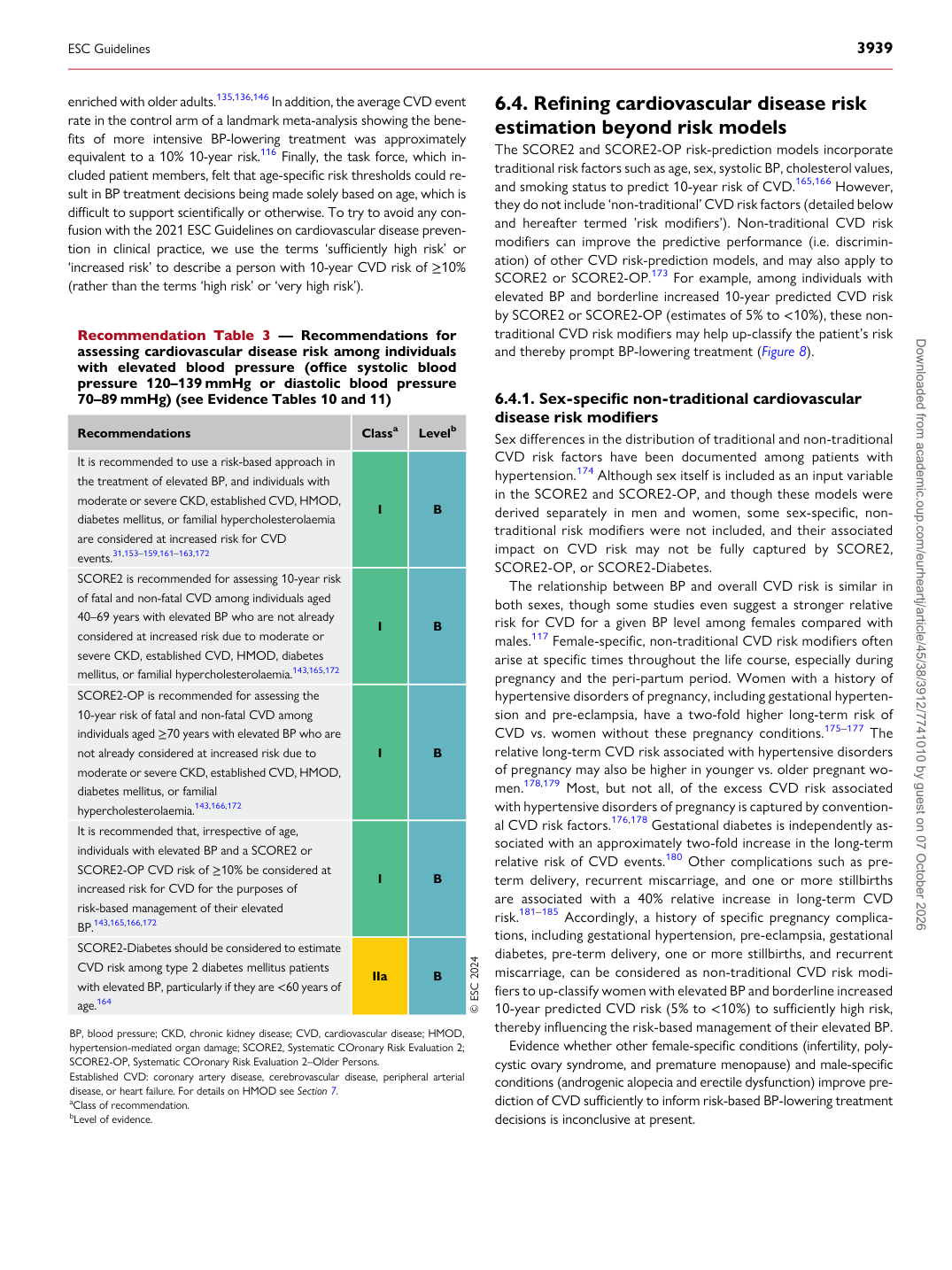
Recommendation Table 3 — Recommendations for assessing cardiovascular disease risk among individuals with elevated blood pressure (office systolic blood pressure 120–139 mmHg or diastolic blood pressure 70–89 mmHg) (see Evidence Tables 10 and 11)

Recommendations Classa Levelb

It is recommended to use a risk-based approach in the treatment of elevated BP, and individuals with moderate or severe CKD, established CVD, HMOD, diabetes mellitus, or familial hypercholesterolaemia are considered at increased risk for CVD events.31,153–159,161–163,172 I B SCORE2 is recommended for assessing 10-year risk of fatal and non-fatal CVD among individuals aged 40–69 years with elevated BP who are not already considered at increased risk due to moderate or severe CKD, established CVD, HMOD, diabetes mellitus, or familial hypercholesterolaemia.143,165,172 I B SCORE2-OP is recommended for assessing the 10-year risk of fatal and non-fatal CVD among individuals aged ≥70 years with elevated BP who are not already considered at increased risk due to moderate or severe CKD, established CVD, HMOD, diabetes mellitus, or familial hypercholesterolaemia.143,166,172 I B It is recommended that, irrespective of age, individuals with elevated BP and a SCORE2 or SCORE2-OP CVD risk of ≥10% be considered at increased risk for CVD for the purposes of risk-based management of their elevated BP.143,165,166,172 I B SCORE2-Diabetes should be considered to estimate CVD risk among type 2 diabetes mellitus patients with elevated BP, particularly if they are <60 years of age.164 IIa B © ESC 2024

BP, blood pressure; CKD, chronic kidney disease; CVD, cardiovascular disease; HMOD, hypertension-mediated organ damage; SCORE2, Systematic COronary Risk Evaluation 2; SCORE2-OP, Systematic COronary Risk Evaluation 2–Older Persons. Established CVD: coronary artery disease, cerebrovascular disease, peripheral arterial disease, or heart failure. For details on HMOD see Section 7. aClass of recommendation. bLevel of evidence.

ESC Guidelines                                                                                                                                                                                          3939

Downloaded from academic.oup.com/eurheartj/article/45/38/3912/7741010 by guest on 07 October 2026