p.27 抽出テキスト
Systematic COronary Risk Evaluation 2 (SCORE2)-Diabetes riskprediction model should be considered to confirm CVD risk is sufficiently high (≥10%) among individuals with type 2 diabetes mellitus who are aged <60 years.164 In the absence of these sufficiently high-risk conditions, risk-prediction models (SCORE2 and SCORE-OP) have been developed in the general population to predict 10-year risk of CVD.165,166 In adults with elevated BP without the above sufficiently high-risk conditions, risk-prediction models are recommended to inform BP-lowering treatment decisions. Risk-prediction models are more accurate than clinical judgment or tallying of individual risk factors.167–169

6.3.1. 10-year cardiovascular disease risk-prediction models Prediction models differ in their input variables, predicted endpoints (outputs), and populations in which they were derived and validated. We endorse the use of SCORE2 for individuals aged 40–69 years and SCORE2–Older Persons (SCORE2-OP) for individuals aged ≥70 years for predicting 10-year global risk of fatal and non-fatal CVD events (stroke or myocardial infarction).165,166 The management of adults aged <40 years is discussed in Section 9.1. The SCORE2 and SCORE2-OP models are preferred over other 10-year risk-prediction models, as they predict both fatal and non-fatal CVD events, have been validated and recalibrated to European populations, and because SCORE2-OP is adjusted for the competing risk of non-cardiovascular mortality. Calculating SCORE2 or SCORE2-OP is recommended for individuals with elevated BP who are not already at sufficiently high CVD risk due to established CVD, moderate or severe CKD, probable or definite familial hypercholesterolaemia, diabetes mellitus, or HMOD.165,166,170

For the purpose of BP-lowering treatment decisions, individuals with elevated BP and a predicted 10-year CVD risk of ≥10% by SCORE2 or SCORE2-OP are considered in these guidelines to be sufficiently high risk, with details on the choice of lifestyle or drugs to facilitate BP-lowering treatment in this setting provided in Section 8.171,172 A number of considerations influenced our choice to recommend a single risk threshold of ≥10%, vs. the alternative option of using age-specific risk thresholds, such as those provided in the 2021 ESC Guidelines on cardiovascular disease prevention in clinical practice.170 For example, contemporary data indicate the heightened importance of BP control in older adults due to their higher absolute CVD risk (resulting in a lower NNT) and concomitantly to reduce age-dependent adverse outcomes attributable to increased BP, such as dementia. Recent treat-to-target trials (testing systolic BP targets of approximately 120 mmHg) used a single CVD risk inclusion threshold and were also

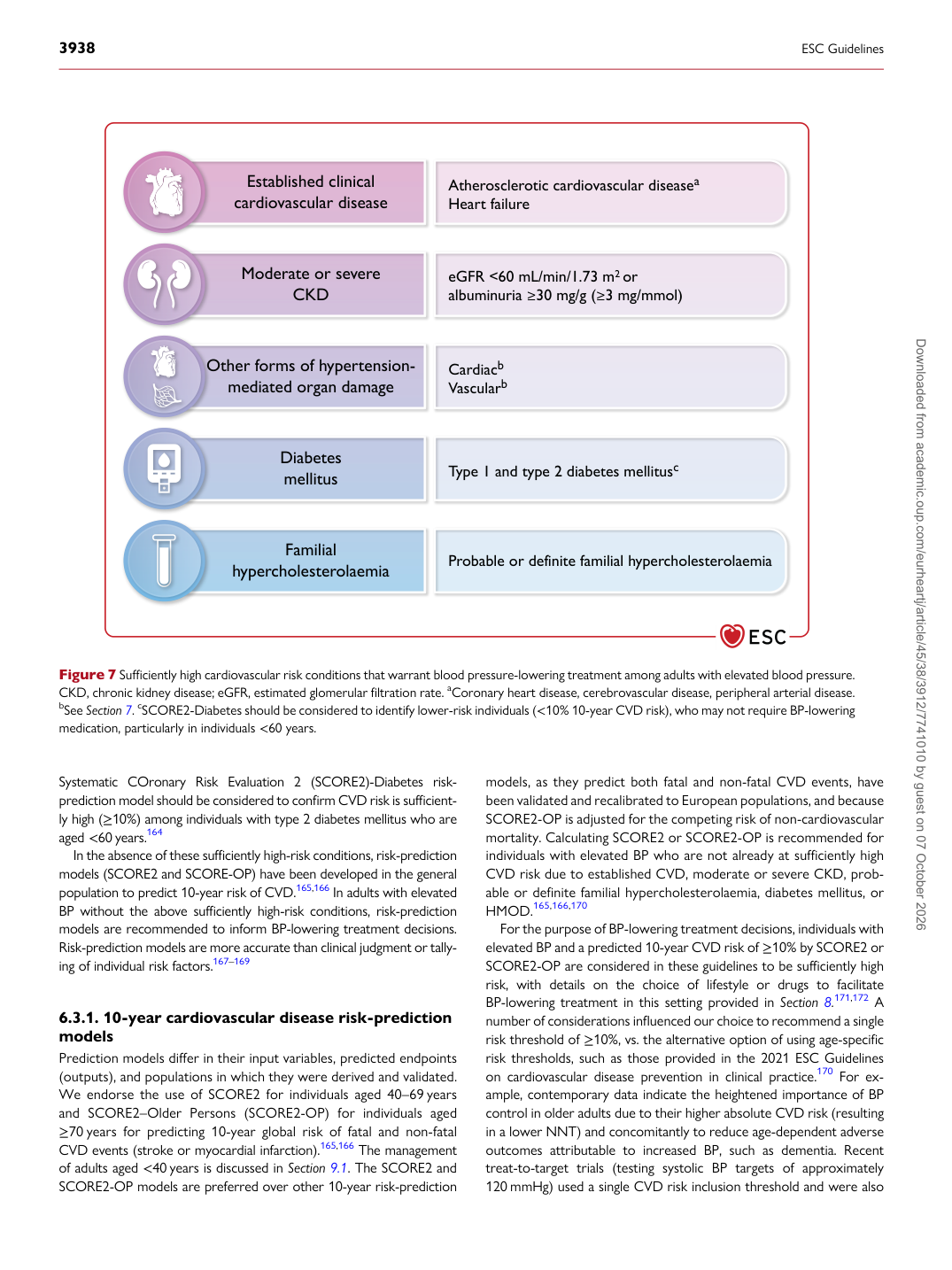
Moderate or severe

CKD eGFR <60 mL/min/1.73 m2 or albuminuria ≥30 mg/g (≥3 mg/mmol)

Familial hypercholesterolaemia Probable or definite familial hypercholesterolaemia

Diabetes

mellitus Type 1 and type 2 diabetes mellitusc

Established clinical cardiovascular disease Atherosclerotic cardiovascular diseasea

Heart failure

Other forms of hypertension-

mediated organ damage Cardiacb

Vascularb

Figure 7 Sufficiently high cardiovascular risk conditions that warrant blood pressure-lowering treatment among adults with elevated blood pressure. CKD, chronic kidney disease; eGFR, estimated glomerular filtration rate. aCoronary heart disease, cerebrovascular disease, peripheral arterial disease. bSee Section 7. cSCORE2-Diabetes should be considered to identify lower-risk individuals (<10% 10-year CVD risk), who may not require BP-lowering medication, particularly in individuals <60 years. Downloaded from academic.oup.com/eurheartj/article/45/38/3912/7741010 by guest on 07 October 2026