p.25 抽出テキスト
6 Definition and classification of

elevated blood pressure and hypertension, and cardiovascular disease risk assessment

6.1 Definition and classification of

elevated blood pressure and hypertension Epidemiological studies demonstrate a continuous and log-linear association between BP and adverse CVD outcomes.22,32,33,114,115 Starting at levels as low as 90 mmHg systolic, the higher the BP the higher the relative risk of CVD including atherosclerosis.32,114 These observational data are complemented by randomized clinical trials (RCTs),116 which have provided experimental evidence regarding the BP range for which BP lowering with treatment is proven to reduce CVD events. Of note, some studies suggest a stronger relative risk for CVD for a given BP among females compared with males.117,118 A healthy lifestyle should be encouraged for all adults to prevent an increase in BP and development of hypertension.119,120 To aid pharmacological treatment decisions, the 2024 ESC Guidelines recommend a simplified categorization of adults according to their BP (Figure 6). In compiling this categorization, priority was given to evidence from randomized trials over observational data. However, it is important to reiterate that the risk of CVD attributable to BP is continuous and that interpreting randomized trial data is an iterative process involving an element of subjectivity. As such, no categorization of BP can be considered immutable or flawless. The 2024 Guidelines define hypertension as a confirmed office systolic BP of ≥140 mmHg or diastolic BP of ≥90 mmHg. For this diagnosis to be made, confirmation is recommended with out-of-office measurements (HBPM or ABPM) or at least one repeat office measurement at a subsequent visit, as detailed in Section 5 and Section 7.2. This definition is based on several factors. First, meta-analyses of randomized trials provide evidence among all adults and across various settings for the benefit of BP-lowering therapy among patients with BP above this threshold.116,121,122 Second, most adults with BP above this threshold are at increased CVD risk, typically with 10-year risk estimates of ≥10% for fatal and non-fatal CVD events.123–125 The higher the patient’s baseline absolute risk for CVD, the greater the net benefit from BP-lowering treatment and, at the population level, the lower the estimated number needed to treat (NNT).126–128 Third, this more traditional BP threshold for hypertension is already widely used by policymakers to define a disease state, and maintaining this BP threshold to define hypertension (vs. lowering it) does not require most adults to be labelled with what is widely considered a disease.129

Here, we introduce a new BP category called ‘elevated BP’, which is defined as an office systolic BP of 120–139 mmHg or diastolic BP of 70–89 mmHg. Within this BP range, the efficacy of BP-lowering therapy has been established in meta-analyses of RCTs,116 but average CVD risk in the elevated BP group is not sufficiently high to merit drug treatment in all patients.123,124,130 Pharmacological treatment initiation is, however, suggested for a subgroup of patients within this BP range who are at increased global risk of CVD as identified by the risk stratification approach outlined in Sections 6.3, 6.4, and 8. Non-elevated BP is defined as a systolic BP of <120 mmHg and a diastolic BP of <70 mmHg. Fewer individuals within this BP range are at increased risk of CVD,124 and evidence for CVD benefit with BP-lowering pharmacological treatment is lacking due to an absence of trials. We use the term ‘non-elevated BP’ to define this BP category in recognition that these are treatment categories and not prognostic categories. Because the relative risk for CVD starts to increase at BP below this threshold (even as low as 90 mmHg systolic BP), particularly among women,117,118 we avoid terms like ‘normal BP’, ‘optimal BP’, or ‘normotension’ in defining this category.

6.2 Principles of a risk-based approach for

managing blood pressure and preventing cardiovascular disease In the context of BP-lowering interventions, randomized trials demonstrate a consistent relative risk reduction in adverse CVD outcomes per unit reduction in BP.131,139 However, many medical interventions incur costs and have side effects. Therefore, guidance is needed on selecting patients most likely to benefit from BP-lowering treatment. This is especially true among adults with elevated BP (office systolic BP of 120–139 mmHg and/or diastolic BP of 70–89 mmHg). Practical aspects for implementing a risk-based approach are further discussed in Section 8.

6.2.1 Role of cardiovascular disease risk assessment

The risk of adverse CVD outcomes increases log-linearly with constant increments in systolic BP and diastolic BP.22,32,33,114,140 Concurrently, at higher BP, there is clustering of additional CVD risk factors.141,142 Consequently, many patients with hypertension will have an estimated 10-year risk for CVD events of ≥10%,116,121,122 which, for the purposes of these guidelines, is considered sufficiently high risk to merit consideration of BP-lowering treatment in the setting of elevated BP.143 Using BP thresholds for hypertension alone for allocating treatment would lead to under-treatment of many high-risk patients.144,145,115 A substantial proportion of excess CVD events attributable to BP occur in patients with BP levels below the traditional threshold for

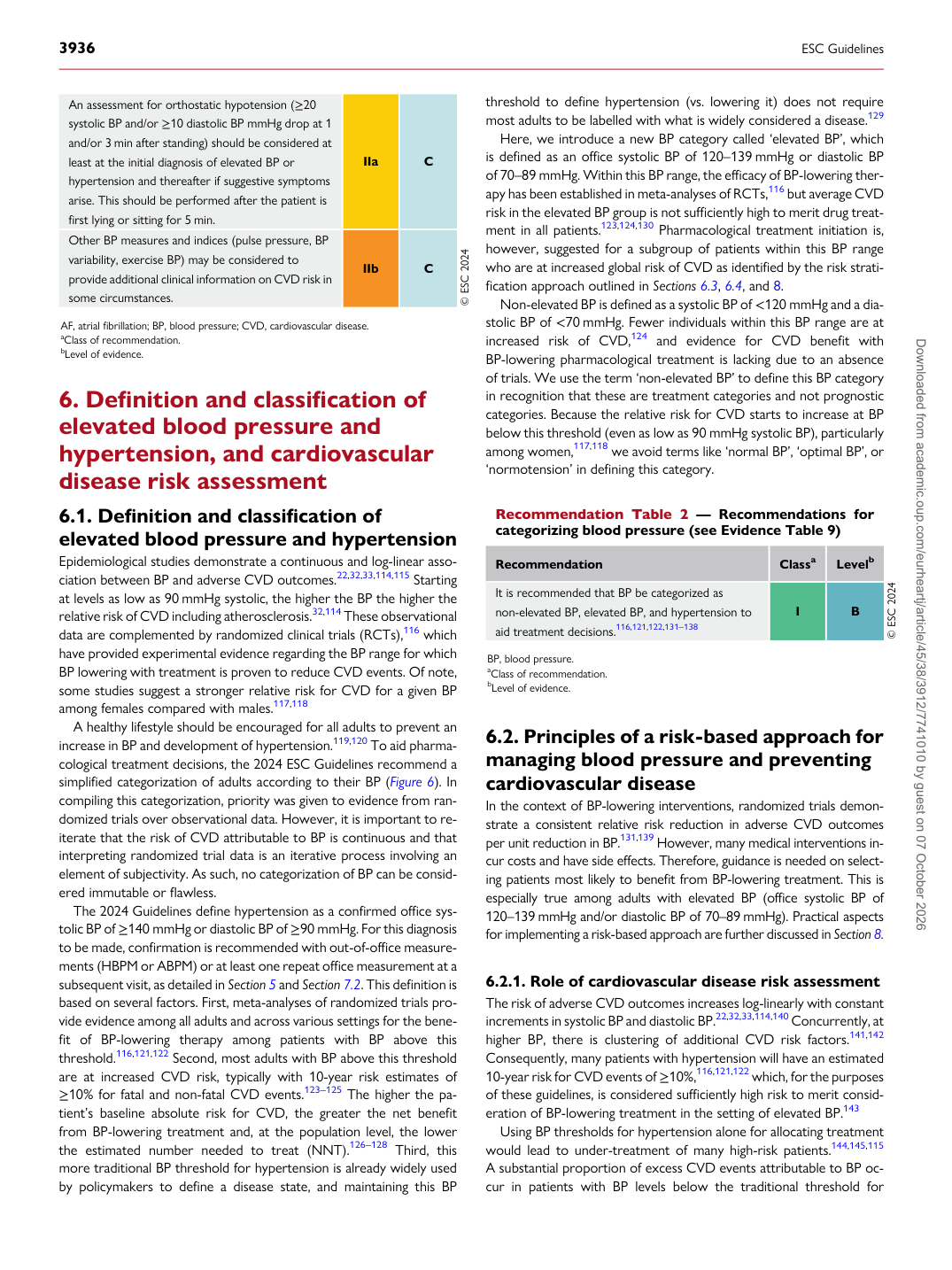
An assessment for orthostatic hypotension (≥20 systolic BP and/or ≥10 diastolic BP mmHg drop at 1 and/or 3 min after standing) should be considered at least at the initial diagnosis of elevated BP or hypertension and thereafter if suggestive symptoms arise. This should be performed after the patient is first lying or sitting for 5 min. IIa C Other BP measures and indices (pulse pressure, BP variability, exercise BP) may be considered to provide additional clinical information on CVD risk in some circumstances. IIb C © ESC 2024

AF, atrial fibrillation; BP, blood pressure; CVD, cardiovascular disease. aClass of recommendation. bLevel of evidence.

Recommendation Table 2 — Recommendations for categorizing blood pressure (see Evidence Table 9)

Recommendation Classa Levelb

It is recommended that BP be categorized as non-elevated BP, elevated BP, and hypertension to aid treatment decisions.116,121,122,131–138 I B © ESC 2024

BP, blood pressure. aClass of recommendation. bLevel of evidence. Downloaded from academic.oup.com/eurheartj/article/45/38/3912/7741010 by guest on 07 October 2026