p.20 抽出テキスト
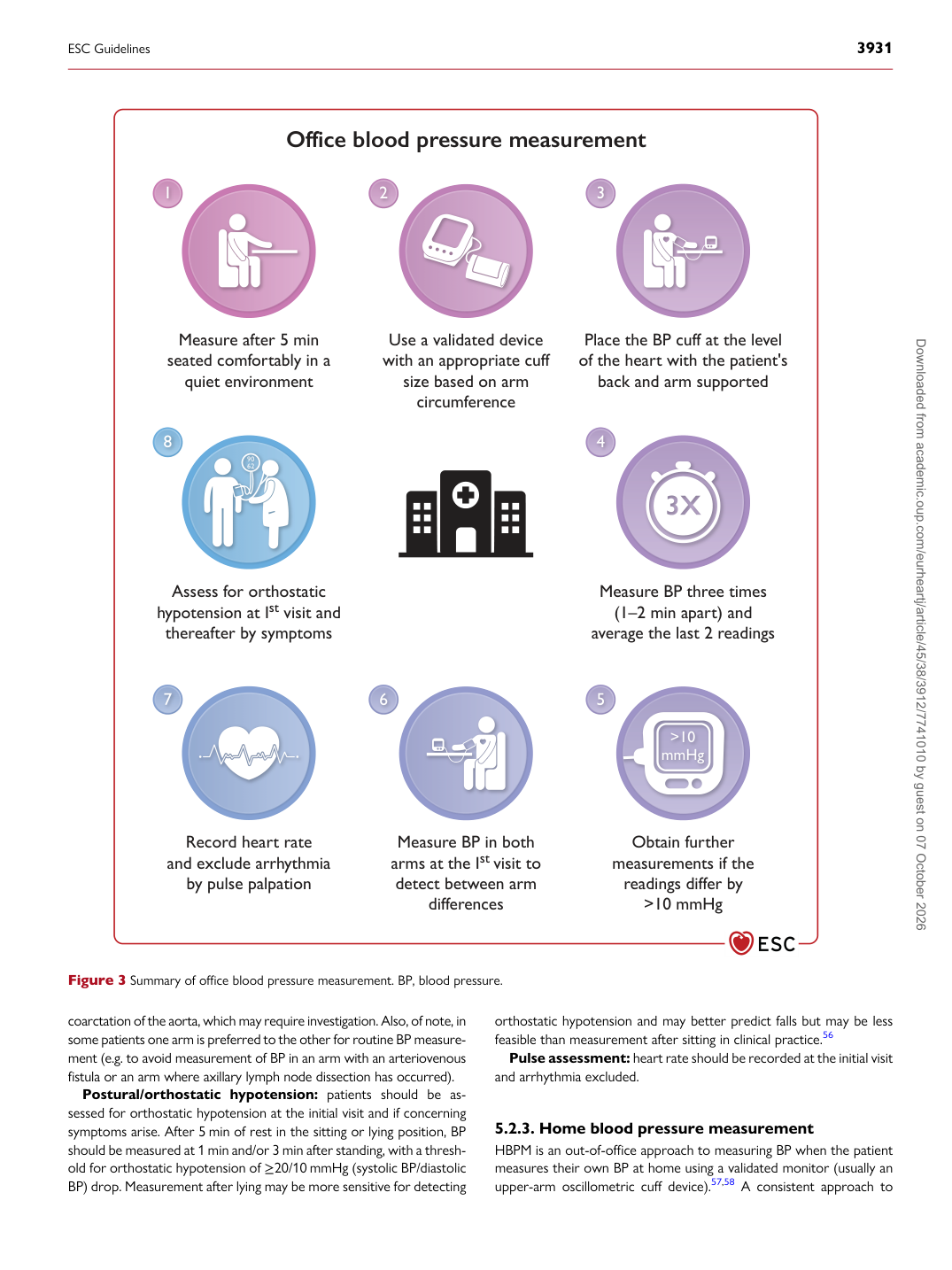
coarctation of the aorta, which may require investigation. Also, of note, in some patients one arm is preferred to the other for routine BP measurement (e.g. to avoid measurement of BP in an arm with an arteriovenous fistula or an arm where axillary lymph node dissection has occurred). Postural/orthostatic hypotension: patients should be assessed for orthostatic hypotension at the initial visit and if concerning symptoms arise. After 5 min of rest in the sitting or lying position, BP should be measured at 1 min and/or 3 min after standing, with a threshold for orthostatic hypotension of ≥20/10 mmHg (systolic BP/diastolic BP) drop. Measurement after lying may be more sensitive for detecting orthostatic hypotension and may better predict falls but may be less feasible than measurement after sitting in clinical practice.56

Pulse assessment: heart rate should be recorded at the initial visit and arrhythmia excluded.

5.2.3 Home blood pressure measurement

HBPM is an out-of-office approach to measuring BP when the patient measures their own BP at home using a validated monitor (usually an upper-arm oscillometric cuff device).57,58 A consistent approach to

>10 mmHg

1 2 3

4

5

6

7

8 Office blood pressure measurement

Measure after 5 min seated comfortably in a

quiet environment Use a validated device with an appropriate cuff

size based on arm

circumference Place the BP cuff at the level of the heart with the patient's

back and arm supported

Assess for orthostatic hypotension at Ist visit and

thereafter by symptoms Measure BP three times

(1–2 min apart) and average the last 2 readings

Record heart rate and exclude arrhythmia

by pulse palpation Measure BP in both arms at the Ist visit to

detect between arm

differences Obtain further measurements if the

readings differ by

>10 mmHg

90 62

Figure 3 Summary of office blood pressure measurement. BP, blood pressure.

ESC Guidelines                                                                                                                                                                                          3931

Downloaded from academic.oup.com/eurheartj/article/45/38/3912/7741010 by guest on 07 October 2026