p.18 抽出テキスト
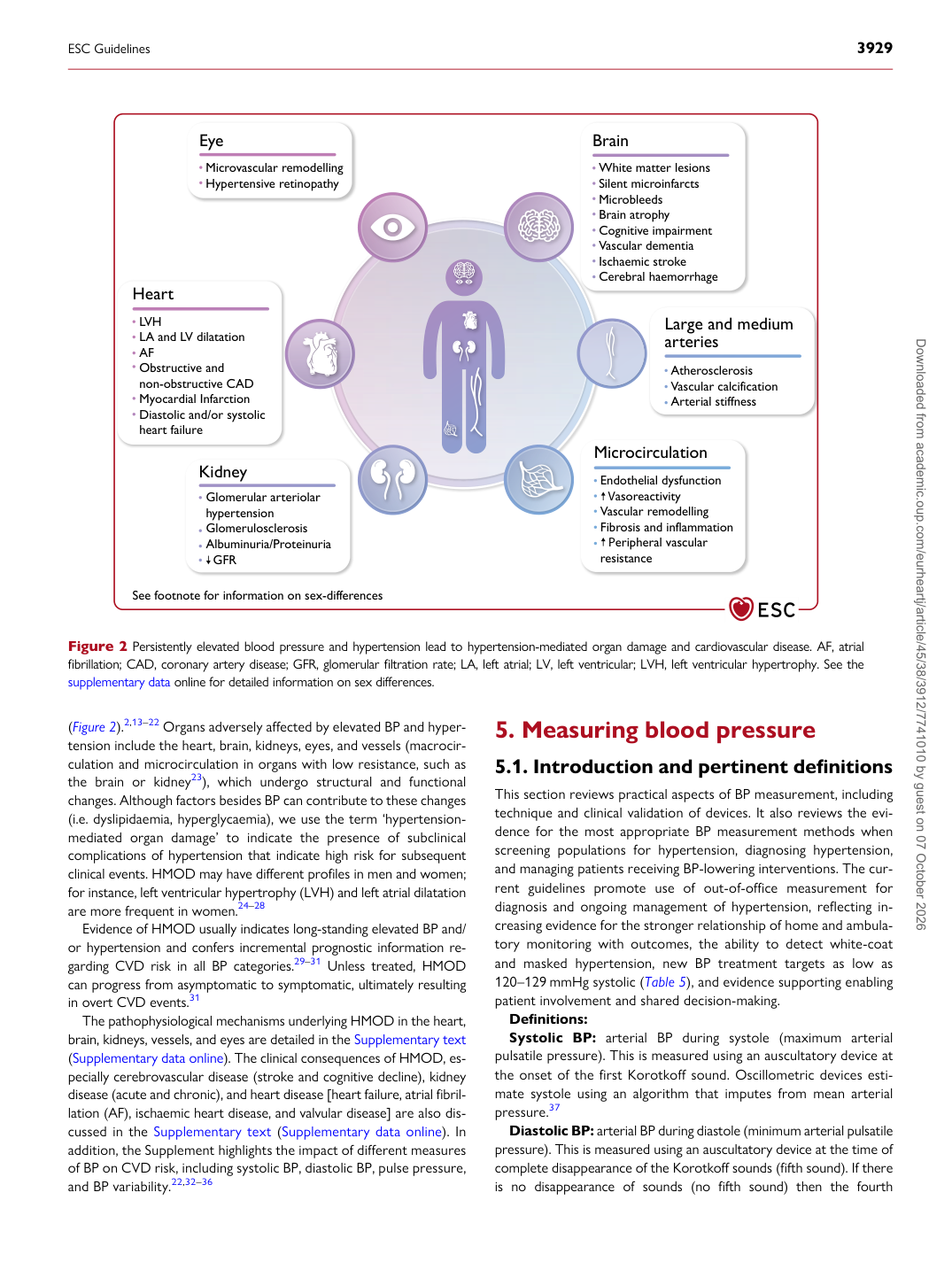
(Figure 2).2,13–22 Organs adversely affected by elevated BP and hypertension include the heart, brain, kidneys, eyes, and vessels (macrocirculation and microcirculation in organs with low resistance, such as the brain or kidney23), which undergo structural and functional changes. Although factors besides BP can contribute to these changes (i.e. dyslipidaemia, hyperglycaemia), we use the term ‘hypertensionmediated organ damage’ to indicate the presence of subclinical complications of hypertension that indicate high risk for subsequent clinical events. HMOD may have different profiles in men and women; for instance, left ventricular hypertrophy (LVH) and left atrial dilatation are more frequent in women.24–28 Evidence of HMOD usually indicates long-standing elevated BP and/ or hypertension and confers incremental prognostic information regarding CVD risk in all BP categories.29–31 Unless treated, HMOD can progress from asymptomatic to symptomatic, ultimately resulting in overt CVD events.31 The pathophysiological mechanisms underlying HMOD in the heart, brain, kidneys, vessels, and eyes are detailed in the Supplementary text (Supplementary data online). The clinical consequences of HMOD, especially cerebrovascular disease (stroke and cognitive decline), kidney disease (acute and chronic), and heart disease [heart failure, atrial fibrillation (AF), ischaemic heart disease, and valvular disease] are also discussed in the Supplementary text (Supplementary data online). In addition, the Supplement highlights the impact of different measures of BP on CVD risk, including systolic BP, diastolic BP, pulse pressure, and BP variability.22,32–36 5 Measuring blood pressure

5.1 Introduction and pertinent definitions

This section reviews practical aspects of BP measurement, including technique and clinical validation of devices. It also reviews the evidence for the most appropriate BP measurement methods when screening populations for hypertension, diagnosing hypertension, and managing patients receiving BP-lowering interventions. The current guidelines promote use of out-of-office measurement for diagnosis and ongoing management of hypertension, reflecting increasing evidence for the stronger relationship of home and ambulatory monitoring with outcomes, the ability to detect white-coat and masked hypertension, new BP treatment targets as low as 120–129 mmHg systolic (Table 5), and evidence supporting enabling patient involvement and shared decision-making. Definitions: Systolic BP: arterial BP during systole (maximum arterial pulsatile pressure). This is measured using an auscultatory device at the onset of the first Korotkoff sound. Oscillometric devices estimate systole using an algorithm that imputes from mean arterial pressure.37 Diastolic BP: arterial BP during diastole (minimum arterial pulsatile pressure). This is measured using an auscultatory device at the time of complete disappearance of the Korotkoff sounds (fifth sound). If there is no disappearance of sounds (no fifth sound) then the fourth

See footnote for information on sex-differences White matter lesions Silent microinfarcts Microbleeds Brain atrophy Cognitive impairment Vascular dementia Ischaemic stroke Cerebral haemorrhage

Brain

Microvascular remodelling Hypertensive retinopathy

Eye

Atherosclerosis Vascular calcification Arterial stiffness

Large and medium arteries

Endothelial dysfunction Vasoreactivity Vascular remodelling Fibrosis and inflammation Peripheral vascular resistance

Microcirculation

LVH LA and LV dilatation AF Obstructive and non-obstructive CAD Myocardial Infarction Diastolic and/or systolic heart failure

Heart

Kidney

Glomerular arteriolar hypertension Glomerulosclerosis Albuminuria/Proteinuria GFR

Figure 2 Persistently elevated blood pressure and hypertension lead to hypertension-mediated organ damage and cardiovascular disease. AF, atrial fibrillation; CAD, coronary artery disease; GFR, glomerular filtration rate; LA, left atrial; LV, left ventricular; LVH, left ventricular hypertrophy. See the supplementary data online for detailed information on sex differences.

ESC Guidelines                                                                                                                                                                                          3929

Downloaded from academic.oup.com/eurheartj/article/45/38/3912/7741010 by guest on 07 October 2026