p.16 抽出テキスト
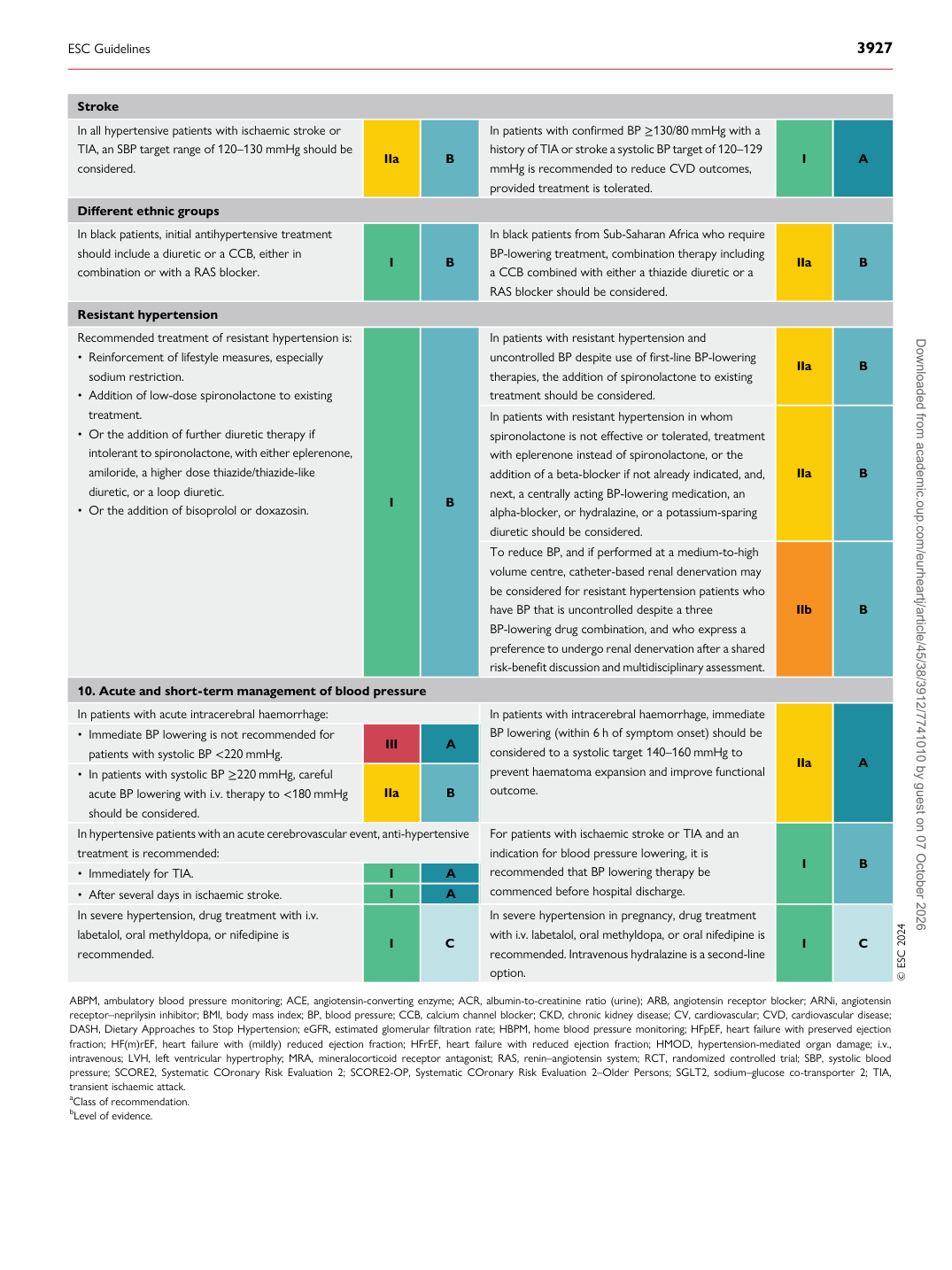
Stroke In all hypertensive patients with ischaemic stroke or TIA, an SBP target range of 120–130 mmHg should be considered. IIa B In patients with confirmed BP ≥130/80 mmHg with a history of TIA or stroke a systolic BP target of 120–129

mmHg is recommended to reduce CVD outcomes, provided treatment is tolerated. I A

Different ethnic groups In black patients, initial antihypertensive treatment should include a diuretic or a CCB, either in combination or with a RAS blocker. I B In black patients from Sub-Saharan Africa who require

BP-lowering treatment, combination therapy including a CCB combined with either a thiazide diuretic or a RAS blocker should be considered. IIa B

Resistant hypertension Recommended treatment of resistant hypertension is: • Reinforcement of lifestyle measures, especially

sodium restriction. • Addition of low-dose spironolactone to existing treatment. • Or the addition of further diuretic therapy if

intolerant to spironolactone, with either eplerenone, amiloride, a higher dose thiazide/thiazide-like diuretic, or a loop diuretic. • Or the addition of bisoprolol or doxazosin. I B In patients with resistant hypertension and uncontrolled BP despite use of first-line BP-lowering

therapies, the addition of spironolactone to existing treatment should be considered. IIa B In patients with resistant hypertension in whom spironolactone is not effective or tolerated, treatment with eplerenone instead of spironolactone, or the addition of a beta-blocker if not already indicated, and, next, a centrally acting BP-lowering medication, an alpha-blocker, or hydralazine, or a potassium-sparing diuretic should be considered. IIa B To reduce BP, and if performed at a medium-to-high volume centre, catheter-based renal denervation may be considered for resistant hypertension patients who have BP that is uncontrolled despite a three BP-lowering drug combination, and who express a preference to undergo renal denervation after a shared risk-benefit discussion and multidisciplinary assessment. IIb B

10 Acute and short-term management of blood pressure

In patients with acute intracerebral haemorrhage: In patients with intracerebral haemorrhage, immediate BP lowering (within 6 h of symptom onset) should be

considered to a systolic target 140–160 mmHg to prevent haematoma expansion and improve functional outcome. IIa A

• Immediate BP lowering is not recommended for

patients with systolic BP <220 mmHg. III A • In patients with systolic BP ≥220 mmHg, careful

acute BP lowering with i.v. therapy to <180 mmHg should be considered. IIa B In hypertensive patients with an acute cerebrovascular event, anti-hypertensive treatment is recommended: For patients with ischaemic stroke or TIA and an indication for blood pressure lowering, it is

recommended that BP lowering therapy be commenced before hospital discharge.

I B • Immediately for TIA. I A • After several days in ischaemic stroke. I A In severe hypertension, drug treatment with i.v. labetalol, oral methyldopa, or nifedipine is recommended. I C In severe hypertension in pregnancy, drug treatment

with i.v. labetalol, oral methyldopa, or oral nifedipine is recommended. Intravenous hydralazine is a second-line option. I C © ESC 2024

ABPM, ambulatory blood pressure monitoring; ACE, angiotensin-converting enzyme; ACR, albumin-to-creatinine ratio (urine); ARB, angiotensin receptor blocker; ARNi, angiotensin receptor–neprilysin inhibitor; BMI, body mass index; BP, blood pressure; CCB, calcium channel blocker; CKD, chronic kidney disease; CV, cardiovascular; CVD, cardiovascular disease; DASH, Dietary Approaches to Stop Hypertension; eGFR, estimated glomerular filtration rate; HBPM, home blood pressure monitoring; HFpEF, heart failure with preserved ejection fraction; HF(m)rEF, heart failure with (mildly) reduced ejection fraction; HFrEF, heart failure with reduced ejection fraction; HMOD, hypertension-mediated organ damage; i.v., intravenous; LVH, left ventricular hypertrophy; MRA, mineralocorticoid receptor antagonist; RAS, renin–angiotensin system; RCT, randomized controlled trial; SBP, systolic blood pressure; SCORE2, Systematic COronary Risk Evaluation 2; SCORE2-OP, Systematic COronary Risk Evaluation 2–Older Persons; SGLT2, sodium–glucose co-transporter 2; TIA, transient ischaemic attack. aClass of recommendation. bLevel of evidence.

ESC Guidelines                                                                                                                                                                                          3927

Downloaded from academic.oup.com/eurheartj/article/45/38/3912/7741010 by guest on 07 October 2026