p.14 抽出テキスト
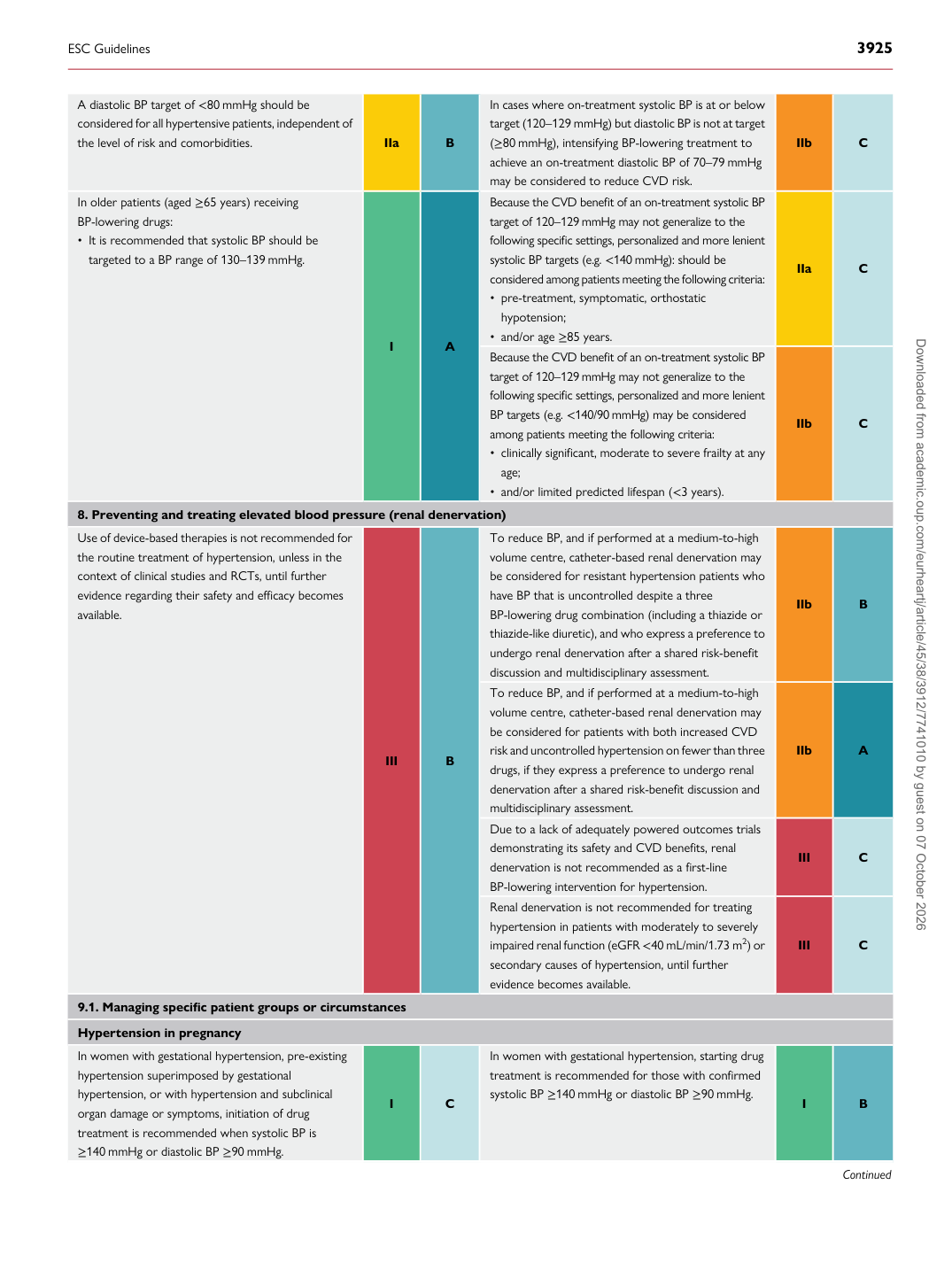
A diastolic BP target of <80 mmHg should be considered for all hypertensive patients, independent of the level of risk and comorbidities. IIa B In cases where on-treatment systolic BP is at or below

target (120–129 mmHg) but diastolic BP is not at target (≥80 mmHg), intensifying BP-lowering treatment to achieve an on-treatment diastolic BP of 70–79 mmHg may be considered to reduce CVD risk. IIb C

In older patients (aged ≥65 years) receiving BP-lowering drugs: • It is recommended that systolic BP should be targeted to a BP range of 130–139 mmHg.

I A Because the CVD benefit of an on-treatment systolic BP

target of 120–129 mmHg may not generalize to the following specific settings, personalized and more lenient systolic BP targets (e.g. <140 mmHg): should be considered among patients meeting the following criteria: • pre-treatment, symptomatic, orthostatic hypotension; • and/or age ≥85 years. IIa C Because the CVD benefit of an on-treatment systolic BP target of 120–129 mmHg may not generalize to the following specific settings, personalized and more lenient BP targets (e.g. <140/90 mmHg) may be considered among patients meeting the following criteria: • clinically significant, moderate to severe frailty at any age; • and/or limited predicted lifespan (<3 years). IIb C

8 Preventing and treating elevated blood pressure (renal denervation)

Use of device-based therapies is not recommended for the routine treatment of hypertension, unless in the context of clinical studies and RCTs, until further evidence regarding their safety and efficacy becomes available.

III B To reduce BP, and if performed at a medium-to-high volume centre, catheter-based renal denervation may

be considered for resistant hypertension patients who have BP that is uncontrolled despite a three BP-lowering drug combination (including a thiazide or thiazide-like diuretic), and who express a preference to undergo renal denervation after a shared risk-benefit discussion and multidisciplinary assessment. IIb B To reduce BP, and if performed at a medium-to-high volume centre, catheter-based renal denervation may be considered for patients with both increased CVD risk and uncontrolled hypertension on fewer than three drugs, if they express a preference to undergo renal denervation after a shared risk-benefit discussion and multidisciplinary assessment. IIb A Due to a lack of adequately powered outcomes trials demonstrating its safety and CVD benefits, renal denervation is not recommended as a first-line BP-lowering intervention for hypertension. III C Renal denervation is not recommended for treating hypertension in patients with moderately to severely impaired renal function (eGFR <40 mL/min/1.73 m2) or secondary causes of hypertension, until further evidence becomes available. III C

9.1 Managing specific patient groups or circumstances

Hypertension in pregnancy In women with gestational hypertension, pre-existing hypertension superimposed by gestational hypertension, or with hypertension and subclinical organ damage or symptoms, initiation of drug treatment is recommended when systolic BP is ≥140 mmHg or diastolic BP ≥90 mmHg. I C In women with gestational hypertension, starting drug treatment is recommended for those with confirmed

systolic BP ≥140 mmHg or diastolic BP ≥90 mmHg. I B

Continued

ESC Guidelines                                                                                                                                                                                          3925

Downloaded from academic.oup.com/eurheartj/article/45/38/3912/7741010 by guest on 07 October 2026