p.13 抽出テキスト
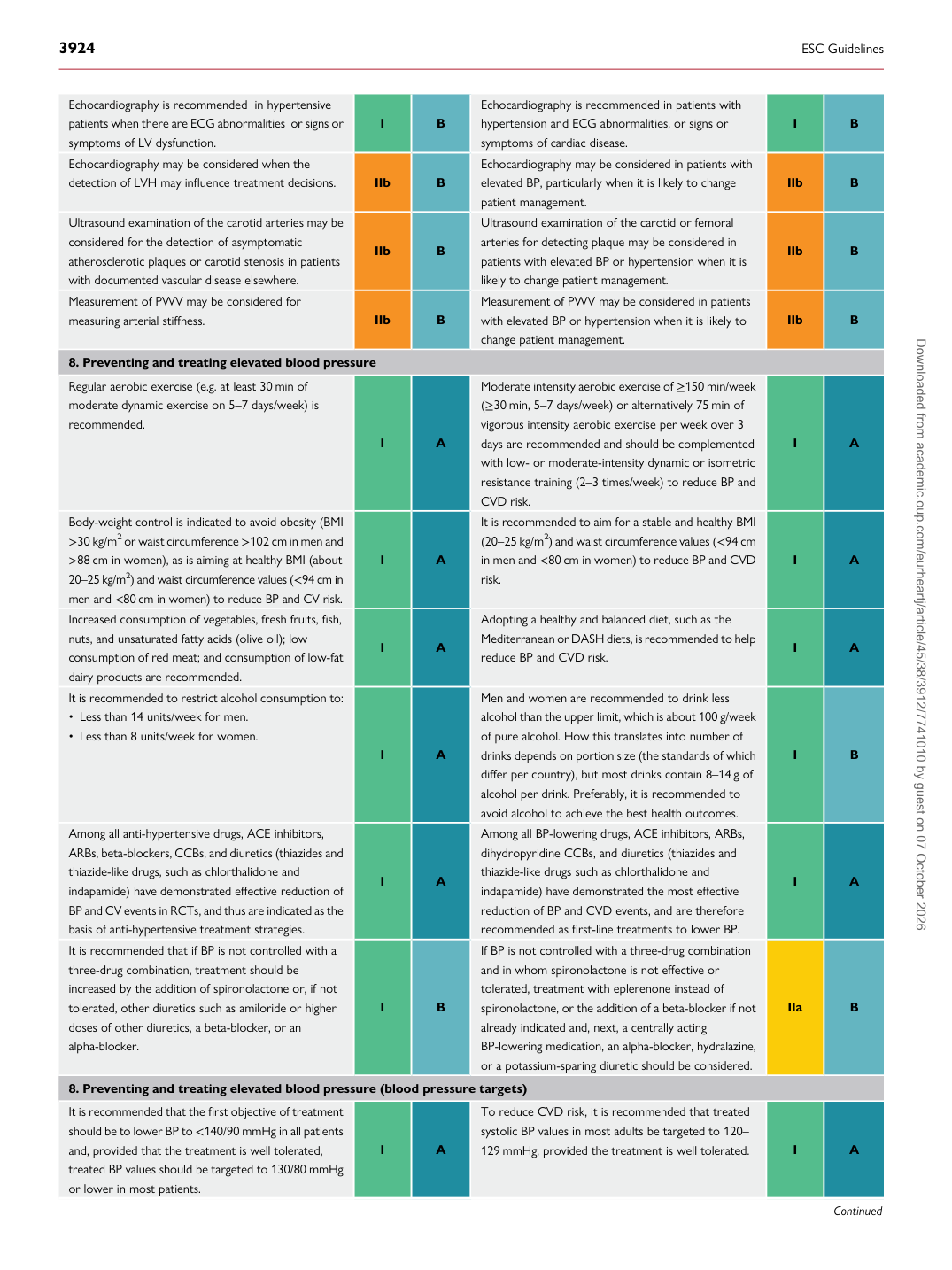
Echocardiography is recommended  in hypertensive patients when there are ECG abnormalities  or signs or symptoms of LV dysfunction. I B Echocardiography is recommended in patients with

hypertension and ECG abnormalities, or signs or symptoms of cardiac disease. I B

Echocardiography may be considered when the detection of LVH may influence treatment decisions. IIb B Echocardiography may be considered in patients with

elevated BP, particularly when it is likely to change patient management. IIb B

Ultrasound examination of the carotid arteries may be considered for the detection of asymptomatic atherosclerotic plaques or carotid stenosis in patients with documented vascular disease elsewhere. IIb B Ultrasound examination of the carotid or femoral arteries for detecting plaque may be considered in

patients with elevated BP or hypertension when it is likely to change patient management. IIb B

Measurement of PWV may be considered for measuring arterial stiffness. IIb B Measurement of PWV may be considered in patients

with elevated BP or hypertension when it is likely to change patient management. IIb B

8 Preventing and treating elevated blood pressure

Regular aerobic exercise (e.g. at least 30 min of moderate dynamic exercise on 5–7 days/week) is recommended.

I A Moderate intensity aerobic exercise of ≥150 min/week

(≥30 min, 5–7 days/week) or alternatively 75 min of vigorous intensity aerobic exercise per week over 3 days are recommended and should be complemented with low- or moderate-intensity dynamic or isometric resistance training (2–3 times/week) to reduce BP and CVD risk. I A

Body-weight control is indicated to avoid obesity (BMI >30 kg/m2 or waist circumference >102 cm in men and >88 cm in women), as is aiming at healthy BMI (about 20–25 kg/m2) and waist circumference values (<94 cm in men and <80 cm in women) to reduce BP and CV risk. I A It is recommended to aim for a stable and healthy BMI

(20–25 kg/m2) and waist circumference values (<94 cm in men and <80 cm in women) to reduce BP and CVD risk. I A

Increased consumption of vegetables, fresh fruits, fish, nuts, and unsaturated fatty acids (olive oil); low consumption of red meat; and consumption of low-fat dairy products are recommended. I A Adopting a healthy and balanced diet, such as the

Mediterranean or DASH diets, is recommended to help reduce BP and CVD risk. I A

It is recommended to restrict alcohol consumption to: • Less than 14 units/week for men. • Less than 8 units/week for women. I A Men and women are recommended to drink less

alcohol than the upper limit, which is about 100 g/week of pure alcohol. How this translates into number of drinks depends on portion size (the standards of which differ per country), but most drinks contain 8–14 g of alcohol per drink. Preferably, it is recommended to avoid alcohol to achieve the best health outcomes. I B

Among all anti-hypertensive drugs, ACE inhibitors, ARBs, beta-blockers, CCBs, and diuretics (thiazides and thiazide-like drugs, such as chlorthalidone and indapamide) have demonstrated effective reduction of BP and CV events in RCTs, and thus are indicated as the basis of anti-hypertensive treatment strategies. I A Among all BP-lowering drugs, ACE inhibitors, ARBs, dihydropyridine CCBs, and diuretics (thiazides and

thiazide-like drugs such as chlorthalidone and indapamide) have demonstrated the most effective reduction of BP and CVD events, and are therefore recommended as first-line treatments to lower BP. I A

It is recommended that if BP is not controlled with a three-drug combination, treatment should be increased by the addition of spironolactone or, if not tolerated, other diuretics such as amiloride or higher doses of other diuretics, a beta-blocker, or an alpha-blocker. I B If BP is not controlled with a three-drug combination

and in whom spironolactone is not effective or tolerated, treatment with eplerenone instead of spironolactone, or the addition of a beta-blocker if not already indicated and, next, a centrally acting BP-lowering medication, an alpha-blocker, hydralazine, or a potassium-sparing diuretic should be considered. IIa B

8 Preventing and treating elevated blood pressure (blood pressure targets)

It is recommended that the first objective of treatment should be to lower BP to <140/90 mmHg in all patients and, provided that the treatment is well tolerated, treated BP values should be targeted to 130/80 mmHg or lower in most patients. I A To reduce CVD risk, it is recommended that treated

systolic BP values in most adults be targeted to 120– 129 mmHg, provided the treatment is well tolerated. I A

Continued Downloaded from academic.oup.com/eurheartj/article/45/38/3912/7741010 by guest on 07 October 2026