p.12 抽出テキスト
11 Patient-centred care in hypertension

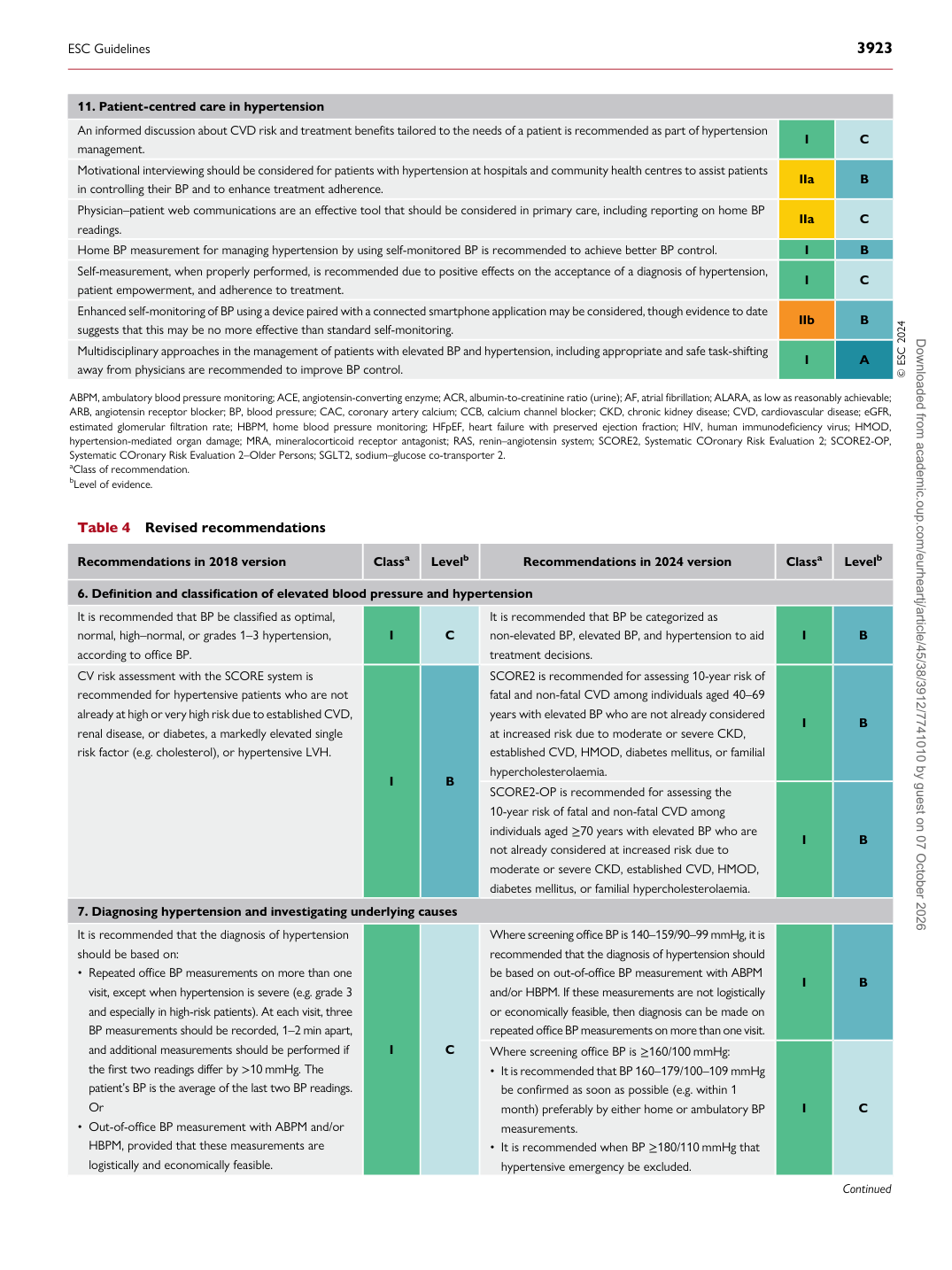
An informed discussion about CVD risk and treatment benefits tailored to the needs of a patient is recommended as part of hypertension management. I C Motivational interviewing should be considered for patients with hypertension at hospitals and community health centres to assist patients in controlling their BP and to enhance treatment adherence. IIa B Physician–patient web communications are an effective tool that should be considered in primary care, including reporting on home BP readings. IIa C Home BP measurement for managing hypertension by using self-monitored BP is recommended to achieve better BP control. I B Self-measurement, when properly performed, is recommended due to positive effects on the acceptance of a diagnosis of hypertension, patient empowerment, and adherence to treatment. I C Enhanced self-monitoring of BP using a device paired with a connected smartphone application may be considered, though evidence to date suggests that this may be no more effective than standard self-monitoring. IIb B Multidisciplinary approaches in the management of patients with elevated BP and hypertension, including appropriate and safe task-shifting away from physicians are recommended to improve BP control. I A © ESC 2024

ABPM, ambulatory blood pressure monitoring; ACE, angiotensin-converting enzyme; ACR, albumin-to-creatinine ratio (urine); AF, atrial fibrillation; ALARA, as low as reasonably achievable; ARB, angiotensin receptor blocker; BP, blood pressure; CAC, coronary artery calcium; CCB, calcium channel blocker; CKD, chronic kidney disease; CVD, cardiovascular disease; eGFR, estimated glomerular filtration rate; HBPM, home blood pressure monitoring; HFpEF, heart failure with preserved ejection fraction; HIV, human immunodeficiency virus; HMOD, hypertension-mediated organ damage; MRA, mineralocorticoid receptor antagonist; RAS, renin–angiotensin system; SCORE2, Systematic COronary Risk Evaluation 2; SCORE2-OP, Systematic COronary Risk Evaluation 2–Older Persons; SGLT2, sodium–glucose co-transporter 2. aClass of recommendation. bLevel of evidence.

Table 4 Revised recommendations

Recommendations in 2018 version Classa Levelb Recommendations in 2024 version Classa Levelb

6 Definition and classification of elevated blood pressure and hypertension

It is recommended that BP be classified as optimal, normal, high–normal, or grades 1–3 hypertension, according to office BP. I C It is recommended that BP be categorized as

non-elevated BP, elevated BP, and hypertension to aid treatment decisions. I B

CV risk assessment with the SCORE system is recommended for hypertensive patients who are not already at high or very high risk due to established CVD, renal disease, or diabetes, a markedly elevated single risk factor (e.g. cholesterol), or hypertensive LVH.

I B SCORE2 is recommended for assessing 10-year risk of

fatal and non-fatal CVD among individuals aged 40–69 years with elevated BP who are not already considered at increased risk due to moderate or severe CKD, established CVD, HMOD, diabetes mellitus, or familial hypercholesterolaemia. I B SCORE2-OP is recommended for assessing the 10-year risk of fatal and non-fatal CVD among individuals aged ≥70 years with elevated BP who are not already considered at increased risk due to moderate or severe CKD, established CVD, HMOD, diabetes mellitus, or familial hypercholesterolaemia. I B

7 Diagnosing hypertension and investigating underlying causes

It is recommended that the diagnosis of hypertension should be based on: • Repeated office BP measurements on more than one

visit, except when hypertension is severe (e.g. grade 3 and especially in high-risk patients). At each visit, three BP measurements should be recorded, 1–2 min apart, and additional measurements should be performed if the first two readings differ by >10 mmHg. The patient’s BP is the average of the last two BP readings. Or • Out-of-office BP measurement with ABPM and/or

HBPM, provided that these measurements are logistically and economically feasible. I C Where screening office BP is 140–159/90–99 mmHg, it is recommended that the diagnosis of hypertension should

be based on out-of-office BP measurement with ABPM and/or HBPM. If these measurements are not logistically or economically feasible, then diagnosis can be made on repeated office BP measurements on more than one visit. I B Where screening office BP is ≥160/100 mmHg: • It is recommended that BP 160–179/100–109 mmHg

be confirmed as soon as possible (e.g. within 1 month) preferably by either home or ambulatory BP measurements. • It is recommended when BP ≥180/110 mmHg that hypertensive emergency be excluded. I C

Continued

ESC Guidelines                                                                                                                                                                                          3923

Downloaded from academic.oup.com/eurheartj/article/45/38/3912/7741010 by guest on 07 October 2026