p.11 抽出テキスト
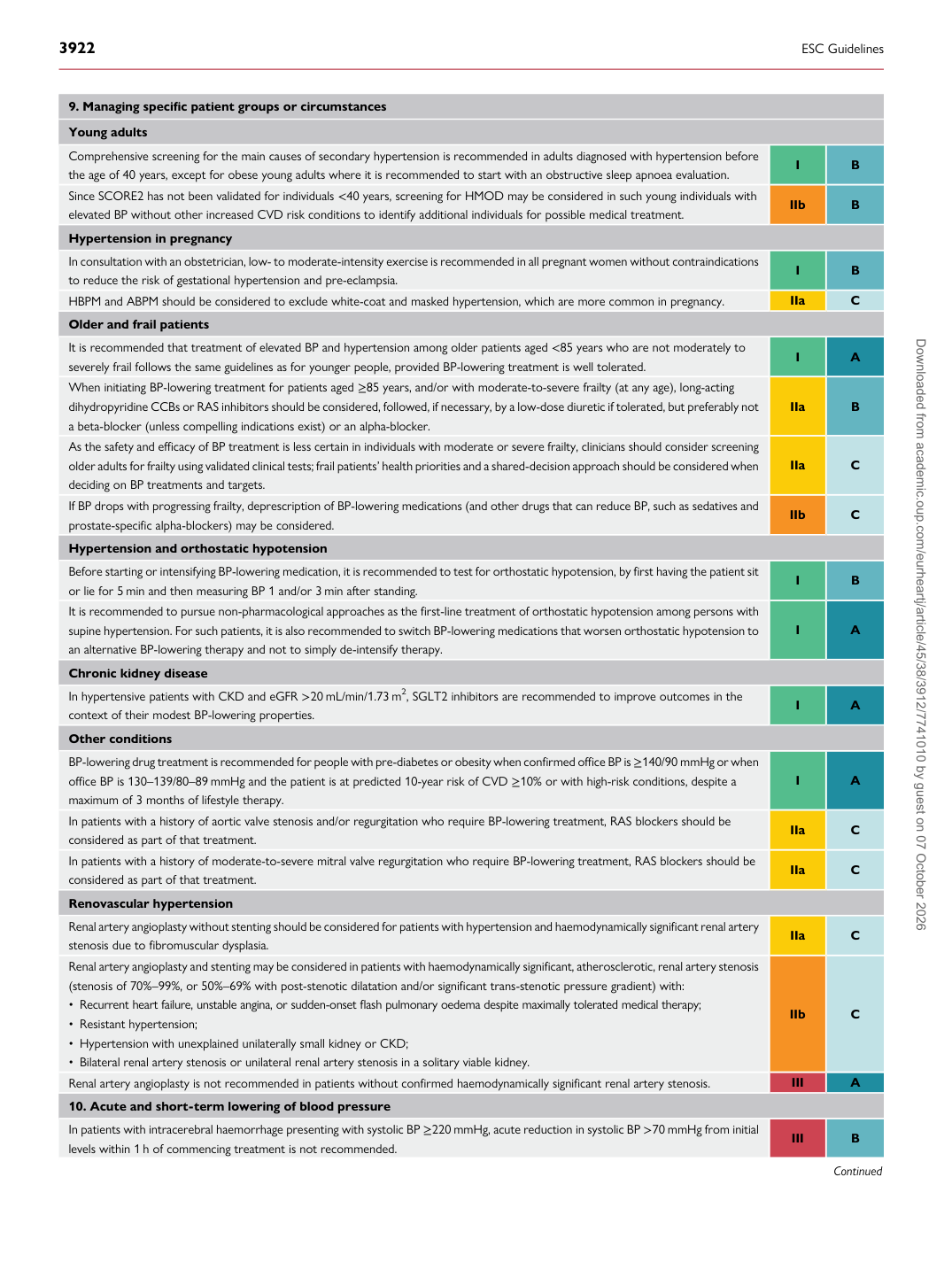
9 Managing specific patient groups or circumstances

Young adults Comprehensive screening for the main causes of secondary hypertension is recommended in adults diagnosed with hypertension before the age of 40 years, except for obese young adults where it is recommended to start with an obstructive sleep apnoea evaluation. I B Since SCORE2 has not been validated for individuals <40 years, screening for HMOD may be considered in such young individuals with elevated BP without other increased CVD risk conditions to identify additional individuals for possible medical treatment. IIb B Hypertension in pregnancy In consultation with an obstetrician, low- to moderate-intensity exercise is recommended in all pregnant women without contraindications to reduce the risk of gestational hypertension and pre-eclampsia. I B HBPM and ABPM should be considered to exclude white-coat and masked hypertension, which are more common in pregnancy. IIa C Older and frail patients It is recommended that treatment of elevated BP and hypertension among older patients aged <85 years who are not moderately to severely frail follows the same guidelines as for younger people, provided BP-lowering treatment is well tolerated. I A When initiating BP-lowering treatment for patients aged ≥85 years, and/or with moderate-to-severe frailty (at any age), long-acting dihydropyridine CCBs or RAS inhibitors should be considered, followed, if necessary, by a low-dose diuretic if tolerated, but preferably not a beta-blocker (unless compelling indications exist) or an alpha-blocker. IIa B As the safety and efficacy of BP treatment is less certain in individuals with moderate or severe frailty, clinicians should consider screening older adults for frailty using validated clinical tests; frail patients’ health priorities and a shared-decision approach should be considered when deciding on BP treatments and targets. IIa C If BP drops with progressing frailty, deprescription of BP-lowering medications (and other drugs that can reduce BP, such as sedatives and prostate-specific alpha-blockers) may be considered. IIb C Hypertension and orthostatic hypotension Before starting or intensifying BP-lowering medication, it is recommended to test for orthostatic hypotension, by first having the patient sit or lie for 5 min and then measuring BP 1 and/or 3 min after standing. I B It is recommended to pursue non-pharmacological approaches as the first-line treatment of orthostatic hypotension among persons with supine hypertension. For such patients, it is also recommended to switch BP-lowering medications that worsen orthostatic hypotension to an alternative BP-lowering therapy and not to simply de-intensify therapy. I A Chronic kidney disease In hypertensive patients with CKD and eGFR >20 mL/min/1.73 m2, SGLT2 inhibitors are recommended to improve outcomes in the context of their modest BP-lowering properties. I A Other conditions BP-lowering drug treatment is recommended for people with pre-diabetes or obesity when confirmed office BP is ≥140/90 mmHg or when office BP is 130–139/80–89 mmHg and the patient is at predicted 10-year risk of CVD ≥10% or with high-risk conditions, despite a maximum of 3 months of lifestyle therapy. I A In patients with a history of aortic valve stenosis and/or regurgitation who require BP-lowering treatment, RAS blockers should be considered as part of that treatment. IIa C In patients with a history of moderate-to-severe mitral valve regurgitation who require BP-lowering treatment, RAS blockers should be considered as part of that treatment. IIa C Renovascular hypertension Renal artery angioplasty without stenting should be considered for patients with hypertension and haemodynamically significant renal artery stenosis due to fibromuscular dysplasia. IIa C Renal artery angioplasty and stenting may be considered in patients with haemodynamically significant, atherosclerotic, renal artery stenosis (stenosis of 70%–99%, or 50%–69% with post-stenotic dilatation and/or significant trans-stenotic pressure gradient) with: • Recurrent heart failure, unstable angina, or sudden-onset flash pulmonary oedema despite maximally tolerated medical therapy; • Resistant hypertension; • Hypertension with unexplained unilaterally small kidney or CKD; • Bilateral renal artery stenosis or unilateral renal artery stenosis in a solitary viable kidney. IIb C Renal artery angioplasty is not recommended in patients without confirmed haemodynamically significant renal artery stenosis. III A

10 Acute and short-term lowering of blood pressure

In patients with intracerebral haemorrhage presenting with systolic BP ≥220 mmHg, acute reduction in systolic BP >70 mmHg from initial levels within 1 h of commencing treatment is not recommended. III B

Continued Downloaded from academic.oup.com/eurheartj/article/45/38/3912/7741010 by guest on 07 October 2026