p.91 抽出テキスト
10 Evidence tables

Evidence tables are available at European Heart Journal online.

11 Data availability statement

No new data were generated or analysed in support of this research.

12 Author information

Author/task force Member Affiliations: Konstantinos C. Koskinas, Department of Cardiology, Bern University Hospital— INSELSPITAL, University of Bern, Bern, Switzerland; Xavier Rossello, Cardiology Department Hospital Universitari Son Espases, Palma de Mallorca, Spain, Health Research Institute of the Balearic Islands (IdISBa), Universitat de les Illes Balears (UIB), Palma de Mallorca, Spain, and Clinical Research Department, Centro Nacional de Investigaciones Cardiovasculares (CNIC), Madrid, Spain; Marianna Adamo, Department of Medical and Surgical Specialties, Radiological Sciences and Public Health, Institute of Cardiology, ASST Spedali Civili di Brescia and University of Brescia, Brescia, Italy; James Ainslie, ESC Patient Forum, Sophia Antipolis, France; Adrian Paul Banning, Oxford Heart Centre, Oxford University Hospitals, Oxford, United Kingdom; Andrzej Budaj, Department of Cardiology, Centre of Postgraduate Medical Education, Warsaw, Poland; Ronny R. Buechel, Department of Nuclear Medicine, Cardiac Imaging, University and University Hospital Zurich, Zurich, Switzerland; Giovanni Alfonso Chiariello, Department of Cardiovascular Sciences, Fondazione Policlinico Universitario Agostino Gemelli IRCCS, Rome, Italy, and Università Cattolica del Sacro Cuore, Rome, Italy; Alaide Chieffo, Vita Salute San Raffaele University, Milan, Italy, and Interventional Cardiology Unit, IRCCS San Raffaele Scientific Institute, Milan, Italy; Ruxandra Maria Christodorescu, Department V Internal Medicine, University of Medicine and Pharmacy V Babes, Timisoara, Romania, and Research

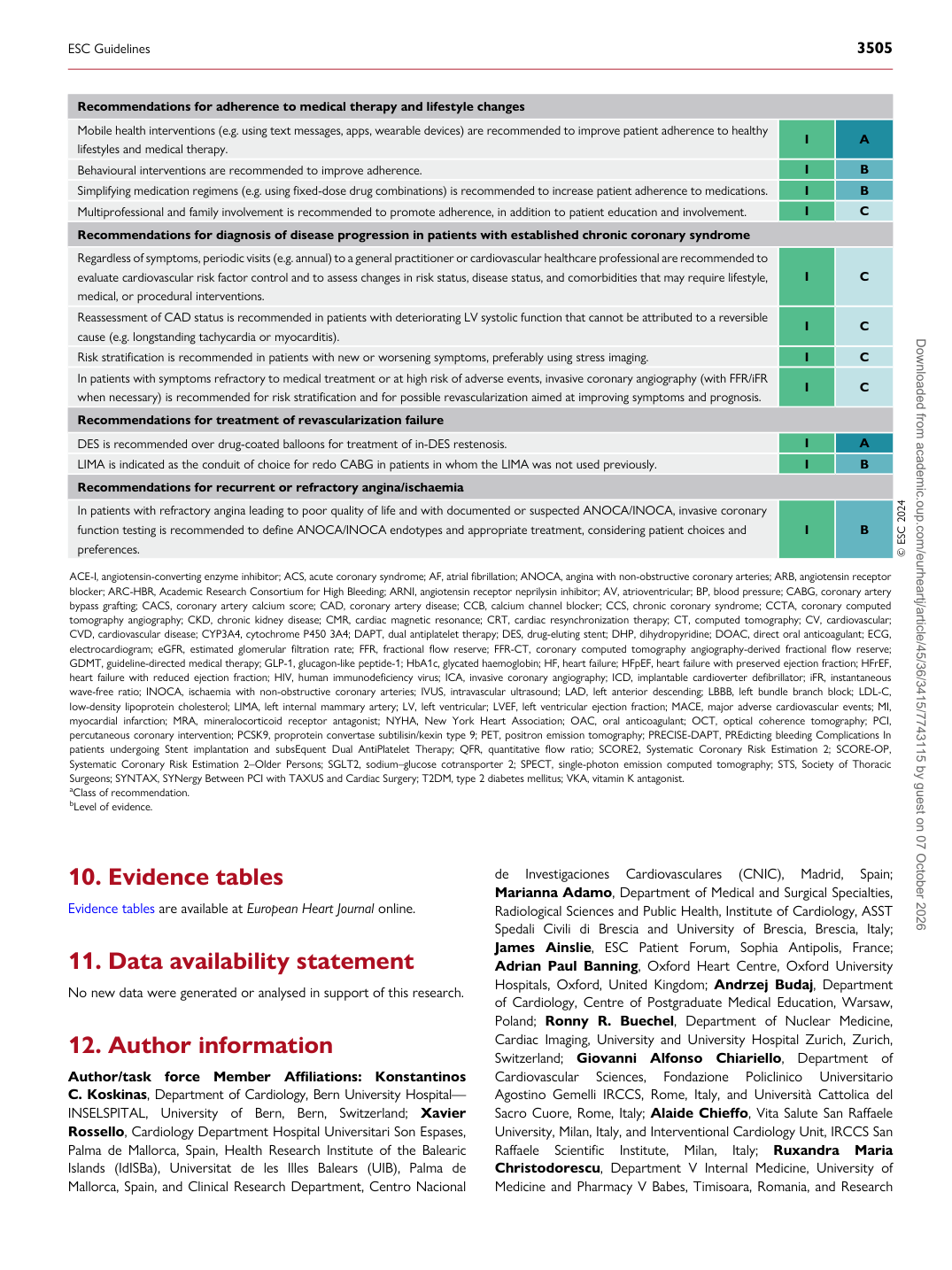
Recommendations for adherence to medical therapy and lifestyle changes Mobile health interventions (e.g. using text messages, apps, wearable devices) are recommended to improve patient adherence to healthy lifestyles and medical therapy. I A Behavioural interventions are recommended to improve adherence. I B Simplifying medication regimens (e.g. using fixed-dose drug combinations) is recommended to increase patient adherence to medications. I B Multiprofessional and family involvement is recommended to promote adherence, in addition to patient education and involvement. I C Recommendations for diagnosis of disease progression in patients with established chronic coronary syndrome Regardless of symptoms, periodic visits (e.g. annual) to a general practitioner or cardiovascular healthcare professional are recommended to evaluate cardiovascular risk factor control and to assess changes in risk status, disease status, and comorbidities that may require lifestyle, medical, or procedural interventions. I C Reassessment of CAD status is recommended in patients with deteriorating LV systolic function that cannot be attributed to a reversible cause (e.g. longstanding tachycardia or myocarditis). I C Risk stratification is recommended in patients with new or worsening symptoms, preferably using stress imaging. I C In patients with symptoms refractory to medical treatment or at high risk of adverse events, invasive coronary angiography (with FFR/iFR when necessary) is recommended for risk stratification and for possible revascularization aimed at improving symptoms and prognosis. I C Recommendations for treatment of revascularization failure DES is recommended over drug-coated balloons for treatment of in-DES restenosis. I A LIMA is indicated as the conduit of choice for redo CABG in patients in whom the LIMA was not used previously. I B Recommendations for recurrent or refractory angina/ischaemia In patients with refractory angina leading to poor quality of life and with documented or suspected ANOCA/INOCA, invasive coronary function testing is recommended to define ANOCA/INOCA endotypes and appropriate treatment, considering patient choices and preferences. I B © ESC 2024

ACE-I, angiotensin-converting enzyme inhibitor; ACS, acute coronary syndrome; AF, atrial fibrillation; ANOCA, angina with non-obstructive coronary arteries; ARB, angiotensin receptor blocker; ARC-HBR, Academic Research Consortium for High Bleeding; ARNI, angiotensin receptor neprilysin inhibitor; AV, atrioventricular; BP, blood pressure; CABG, coronary artery bypass grafting; CACS, coronary artery calcium score; CAD, coronary artery disease; CCB, calcium channel blocker; CCS, chronic coronary syndrome; CCTA, coronary computed tomography angiography; CKD, chronic kidney disease; CMR, cardiac magnetic resonance; CRT, cardiac resynchronization therapy; CT, computed tomography; CV, cardiovascular; CVD, cardiovascular disease; CYP3A4, cytochrome P450 3A4; DAPT, dual antiplatelet therapy; DES, drug-eluting stent; DHP, dihydropyridine; DOAC, direct oral anticoagulant; ECG, electrocardiogram; eGFR, estimated glomerular filtration rate; FFR, fractional flow reserve; FFR-CT, coronary computed tomography angiography-derived fractional flow reserve; GDMT, guideline-directed medical therapy; GLP-1, glucagon-like peptide-1; HbA1c, glycated haemoglobin; HF, heart failure; HFpEF, heart failure with preserved ejection fraction; HFrEF, heart failure with reduced ejection fraction; HIV, human immunodeficiency virus; ICA, invasive coronary angiography; ICD, implantable cardioverter defibrillator; iFR, instantaneous wave-free ratio; INOCA, ischaemia with non-obstructive coronary arteries; IVUS, intravascular ultrasound; LAD, left anterior descending; LBBB, left bundle branch block; LDL-C, low-density lipoprotein cholesterol; LIMA, left internal mammary artery; LV, left ventricular; LVEF, left ventricular ejection fraction; MACE, major adverse cardiovascular events; MI, myocardial infarction; MRA, mineralocorticoid receptor antagonist; NYHA, New York Heart Association; OAC, oral anticoagulant; OCT, optical coherence tomography; PCI, percutaneous coronary intervention; PCSK9, proprotein convertase subtilisin/kexin type 9; PET, positron emission tomography; PRECISE-DAPT, PREdicting bleeding Complications In patients undergoing Stent implantation and subsEquent Dual AntiPlatelet Therapy; QFR, quantitative flow ratio; SCORE2, Systematic Coronary Risk Estimation 2; SCORE-OP, Systematic Coronary Risk Estimation 2–Older Persons; SGLT2, sodium–glucose cotransporter 2; SPECT, single-photon emission computed tomography; STS, Society of Thoracic Surgeons; SYNTAX, SYNergy Between PCI with TAXUS and Cardiac Surgery; T2DM, type 2 diabetes mellitus; VKA, vitamin K antagonist. aClass of recommendation. bLevel of evidence.

ESC Guidelines                                                                                                                                                                                          3505

Downloaded from academic.oup.com/eurheartj/article/45/36/3415/7743115 by guest on 07 October 2026