p.90 抽出テキスト
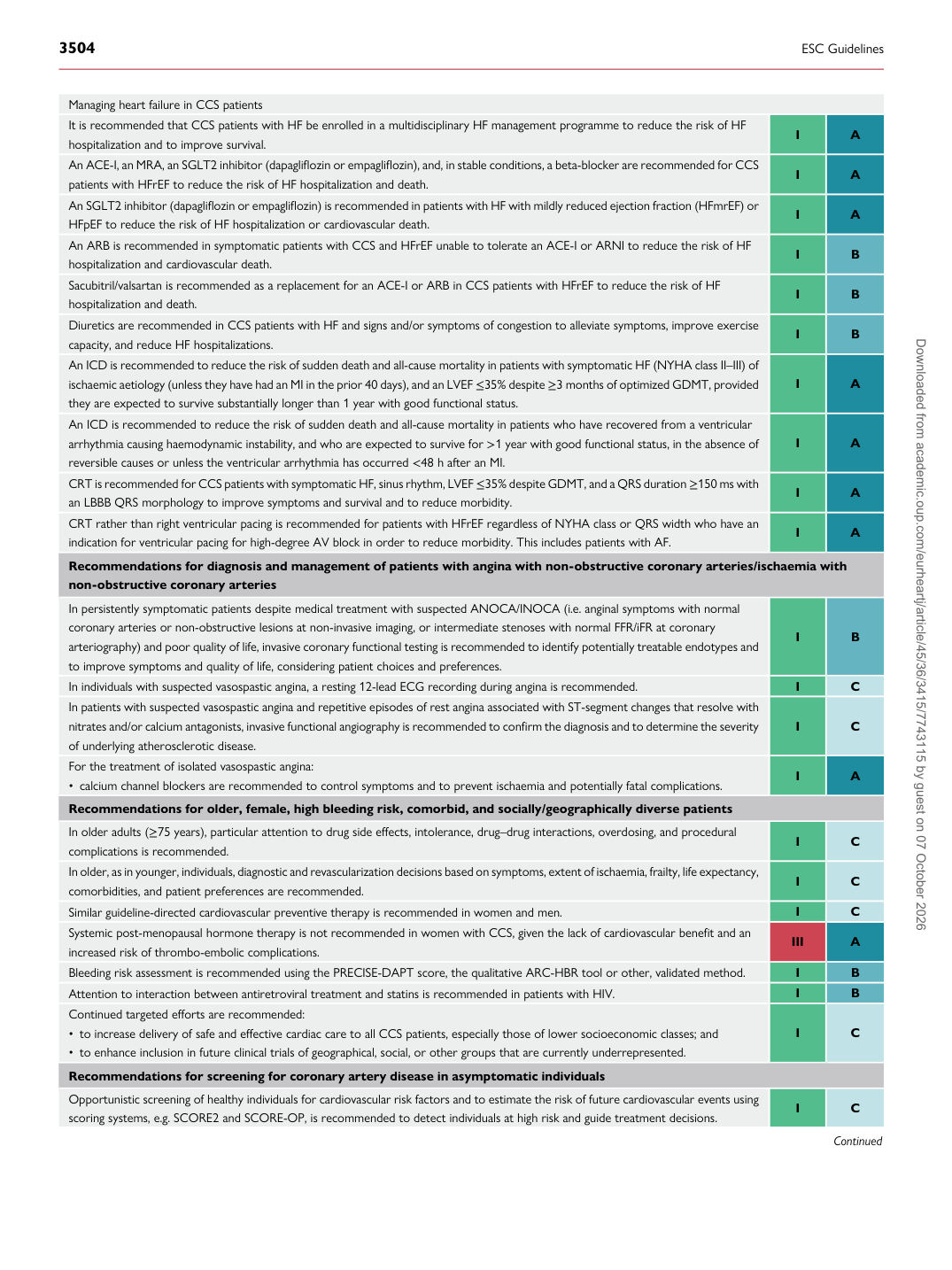
Managing heart failure in CCS patients It is recommended that CCS patients with HF be enrolled in a multidisciplinary HF management programme to reduce the risk of HF hospitalization and to improve survival. I A An ACE-I, an MRA, an SGLT2 inhibitor (dapagliflozin or empagliflozin), and, in stable conditions, a beta-blocker are recommended for CCS patients with HFrEF to reduce the risk of HF hospitalization and death. I A An SGLT2 inhibitor (dapagliflozin or empagliflozin) is recommended in patients with HF with mildly reduced ejection fraction (HFmrEF) or HFpEF to reduce the risk of HF hospitalization or cardiovascular death. I A An ARB is recommended in symptomatic patients with CCS and HFrEF unable to tolerate an ACE-I or ARNI to reduce the risk of HF hospitalization and cardiovascular death. I B Sacubitril/valsartan is recommended as a replacement for an ACE-I or ARB in CCS patients with HFrEF to reduce the risk of HF hospitalization and death. I B Diuretics are recommended in CCS patients with HF and signs and/or symptoms of congestion to alleviate symptoms, improve exercise capacity, and reduce HF hospitalizations. I B An ICD is recommended to reduce the risk of sudden death and all-cause mortality in patients with symptomatic HF (NYHA class II–III) of ischaemic aetiology (unless they have had an MI in the prior 40 days), and an LVEF ≤35% despite ≥3 months of optimized GDMT, provided they are expected to survive substantially longer than 1 year with good functional status. I A An ICD is recommended to reduce the risk of sudden death and all-cause mortality in patients who have recovered from a ventricular arrhythmia causing haemodynamic instability, and who are expected to survive for >1 year with good functional status, in the absence of reversible causes or unless the ventricular arrhythmia has occurred <48 h after an MI. I A CRT is recommended for CCS patients with symptomatic HF, sinus rhythm, LVEF ≤35% despite GDMT, and a QRS duration ≥150 ms with an LBBB QRS morphology to improve symptoms and survival and to reduce morbidity. I A CRT rather than right ventricular pacing is recommended for patients with HFrEF regardless of NYHA class or QRS width who have an indication for ventricular pacing for high-degree AV block in order to reduce morbidity. This includes patients with AF. I A Recommendations for diagnosis and management of patients with angina with non-obstructive coronary arteries/ischaemia with non-obstructive coronary arteries In persistently symptomatic patients despite medical treatment with suspected ANOCA/INOCA (i.e. anginal symptoms with normal coronary arteries or non-obstructive lesions at non-invasive imaging, or intermediate stenoses with normal FFR/iFR at coronary arteriography) and poor quality of life, invasive coronary functional testing is recommended to identify potentially treatable endotypes and to improve symptoms and quality of life, considering patient choices and preferences. I B In individuals with suspected vasospastic angina, a resting 12-lead ECG recording during angina is recommended. I C In patients with suspected vasospastic angina and repetitive episodes of rest angina associated with ST-segment changes that resolve with nitrates and/or calcium antagonists, invasive functional angiography is recommended to confirm the diagnosis and to determine the severity of underlying atherosclerotic disease. I C For the treatment of isolated vasospastic angina: • calcium channel blockers are recommended to control symptoms and to prevent ischaemia and potentially fatal complications. I A Recommendations for older, female, high bleeding risk, comorbid, and socially/geographically diverse patients In older adults (≥75 years), particular attention to drug side effects, intolerance, drug–drug interactions, overdosing, and procedural complications is recommended. I C In older, as in younger, individuals, diagnostic and revascularization decisions based on symptoms, extent of ischaemia, frailty, life expectancy, comorbidities, and patient preferences are recommended. I C Similar guideline-directed cardiovascular preventive therapy is recommended in women and men. I C Systemic post-menopausal hormone therapy is not recommended in women with CCS, given the lack of cardiovascular benefit and an increased risk of thrombo-embolic complications. III A Bleeding risk assessment is recommended using the PRECISE-DAPT score, the qualitative ARC-HBR tool or other, validated method. I B Attention to interaction between antiretroviral treatment and statins is recommended in patients with HIV. I B Continued targeted efforts are recommended: • to increase delivery of safe and effective cardiac care to all CCS patients, especially those of lower socioeconomic classes; and • to enhance inclusion in future clinical trials of geographical, social, or other groups that are currently underrepresented. I C Recommendations for screening for coronary artery disease in asymptomatic individuals Opportunistic screening of healthy individuals for cardiovascular risk factors and to estimate the risk of future cardiovascular events using scoring systems, e.g. SCORE2 and SCORE-OP, is recommended to detect individuals at high risk and guide treatment decisions. I C

Continued Downloaded from academic.oup.com/eurheartj/article/45/36/3415/7743115 by guest on 07 October 2026