p.89 抽出テキスト
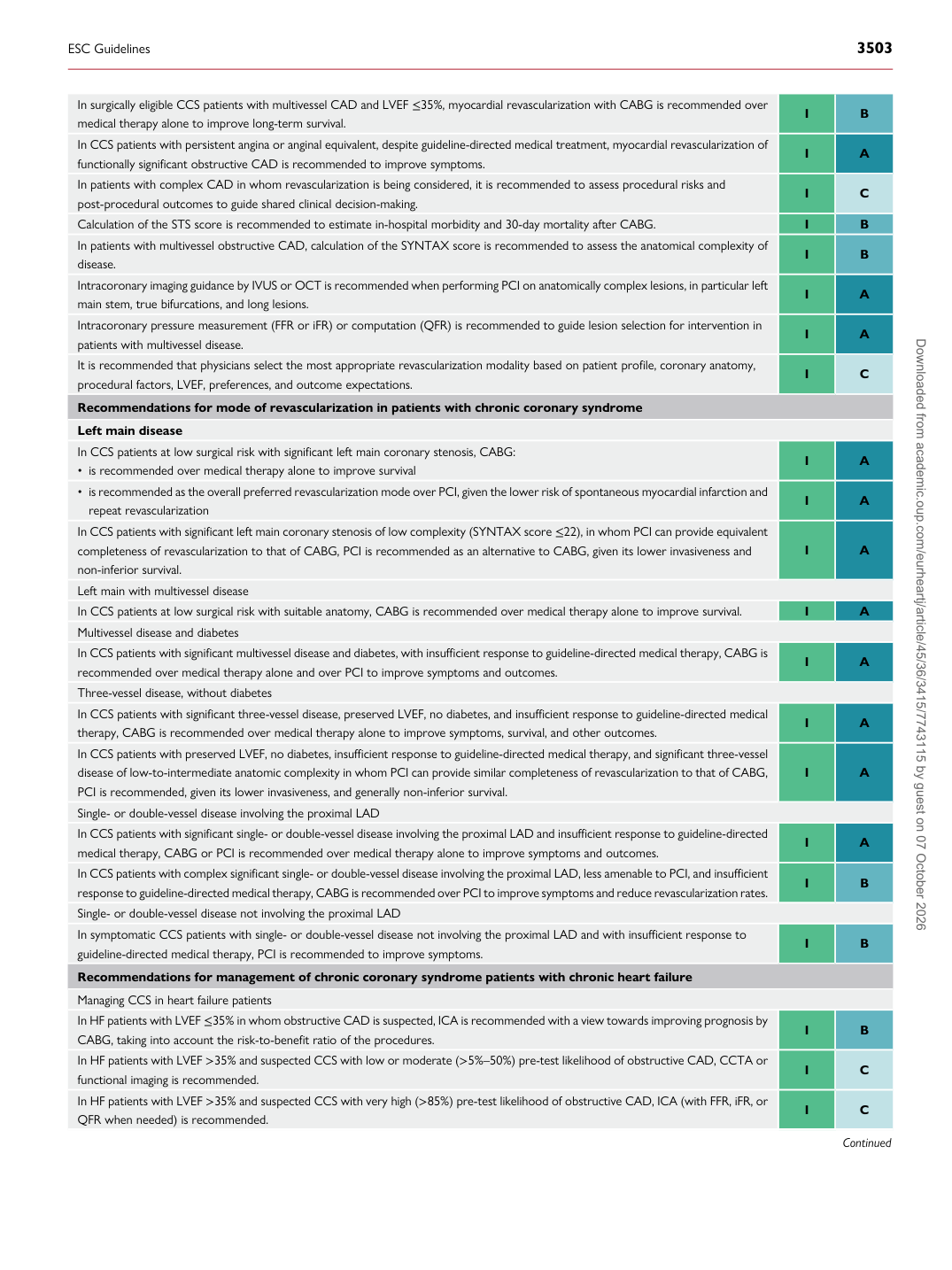
In surgically eligible CCS patients with multivessel CAD and LVEF ≤35%, myocardial revascularization with CABG is recommended over medical therapy alone to improve long-term survival. I B In CCS patients with persistent angina or anginal equivalent, despite guideline-directed medical treatment, myocardial revascularization of functionally significant obstructive CAD is recommended to improve symptoms. I A In patients with complex CAD in whom revascularization is being considered, it is recommended to assess procedural risks and post-procedural outcomes to guide shared clinical decision-making. I C Calculation of the STS score is recommended to estimate in-hospital morbidity and 30-day mortality after CABG. I B In patients with multivessel obstructive CAD, calculation of the SYNTAX score is recommended to assess the anatomical complexity of disease. I B Intracoronary imaging guidance by IVUS or OCT is recommended when performing PCI on anatomically complex lesions, in particular left main stem, true bifurcations, and long lesions. I A Intracoronary pressure measurement (FFR or iFR) or computation (QFR) is recommended to guide lesion selection for intervention in patients with multivessel disease. I A It is recommended that physicians select the most appropriate revascularization modality based on patient profile, coronary anatomy, procedural factors, LVEF, preferences, and outcome expectations. I C Recommendations for mode of revascularization in patients with chronic coronary syndrome Left main disease In CCS patients at low surgical risk with significant left main coronary stenosis, CABG: • is recommended over medical therapy alone to improve survival I A • is recommended as the overall preferred revascularization mode over PCI, given the lower risk of spontaneous myocardial infarction and

repeat revascularization I A In CCS patients with significant left main coronary stenosis of low complexity (SYNTAX score ≤22), in whom PCI can provide equivalent completeness of revascularization to that of CABG, PCI is recommended as an alternative to CABG, given its lower invasiveness and non-inferior survival. I A Left main with multivessel disease In CCS patients at low surgical risk with suitable anatomy, CABG is recommended over medical therapy alone to improve survival. I A Multivessel disease and diabetes In CCS patients with significant multivessel disease and diabetes, with insufficient response to guideline-directed medical therapy, CABG is recommended over medical therapy alone and over PCI to improve symptoms and outcomes. I A Three-vessel disease, without diabetes In CCS patients with significant three-vessel disease, preserved LVEF, no diabetes, and insufficient response to guideline-directed medical therapy, CABG is recommended over medical therapy alone to improve symptoms, survival, and other outcomes. I A In CCS patients with preserved LVEF, no diabetes, insufficient response to guideline-directed medical therapy, and significant three-vessel disease of low-to-intermediate anatomic complexity in whom PCI can provide similar completeness of revascularization to that of CABG, PCI is recommended, given its lower invasiveness, and generally non-inferior survival. I A Single- or double-vessel disease involving the proximal LAD In CCS patients with significant single- or double-vessel disease involving the proximal LAD and insufficient response to guideline-directed medical therapy, CABG or PCI is recommended over medical therapy alone to improve symptoms and outcomes. I A In CCS patients with complex significant single- or double-vessel disease involving the proximal LAD, less amenable to PCI, and insufficient response to guideline-directed medical therapy, CABG is recommended over PCI to improve symptoms and reduce revascularization rates. I B Single- or double-vessel disease not involving the proximal LAD In symptomatic CCS patients with single- or double-vessel disease not involving the proximal LAD and with insufficient response to guideline-directed medical therapy, PCI is recommended to improve symptoms. I B Recommendations for management of chronic coronary syndrome patients with chronic heart failure Managing CCS in heart failure patients In HF patients with LVEF ≤35% in whom obstructive CAD is suspected, ICA is recommended with a view towards improving prognosis by CABG, taking into account the risk-to-benefit ratio of the procedures. I B In HF patients with LVEF >35% and suspected CCS with low or moderate (>5%–50%) pre-test likelihood of obstructive CAD, CCTA or functional imaging is recommended. I C In HF patients with LVEF >35% and suspected CCS with very high (>85%) pre-test likelihood of obstructive CAD, ICA (with FFR, iFR, or QFR when needed) is recommended. I C

Continued

ESC Guidelines                                                                                                                                                                                          3503

Downloaded from academic.oup.com/eurheartj/article/45/36/3415/7743115 by guest on 07 October 2026