p.88 抽出テキスト
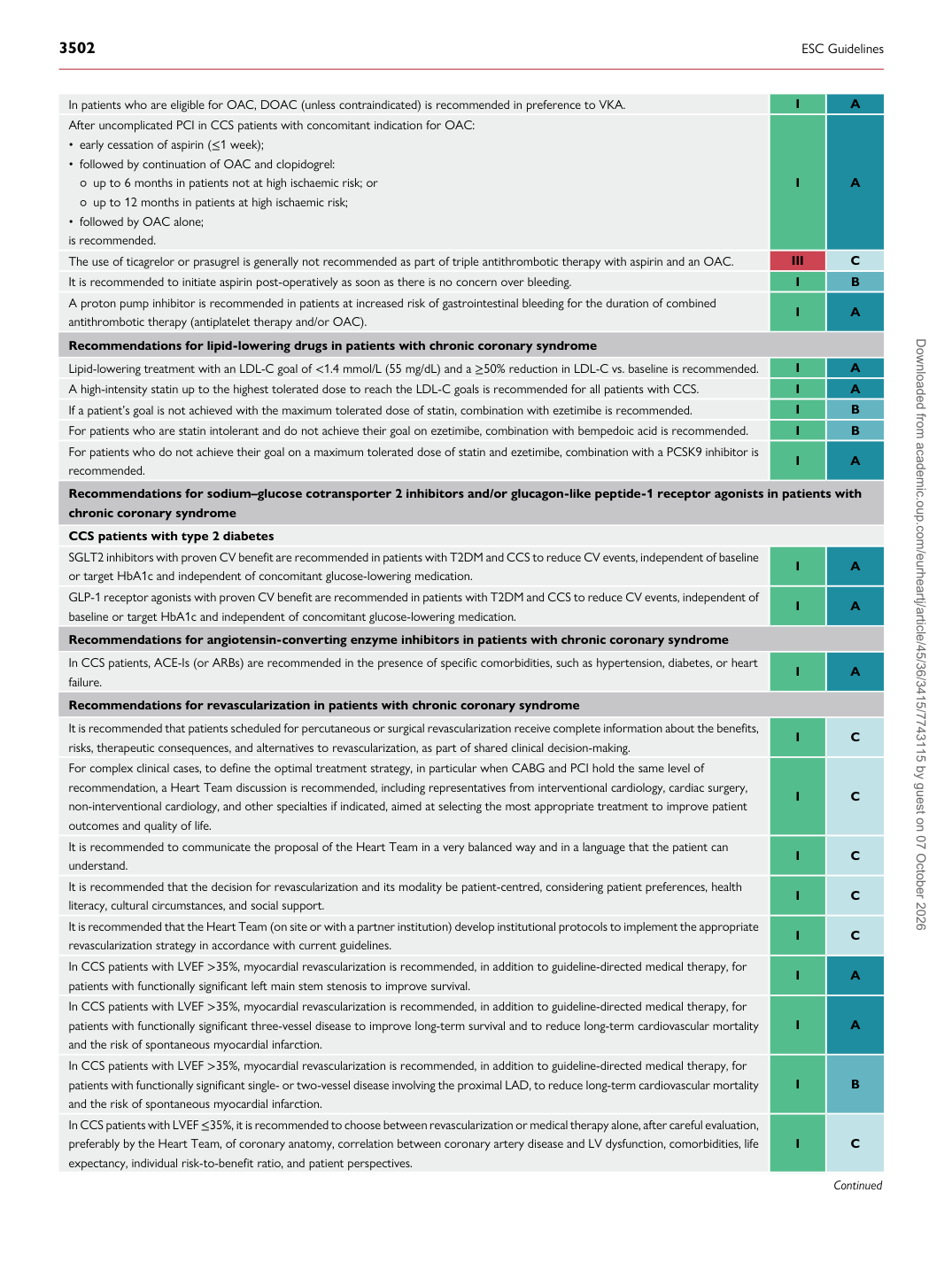
In patients who are eligible for OAC, DOAC (unless contraindicated) is recommended in preference to VKA. I A After uncomplicated PCI in CCS patients with concomitant indication for OAC: • early cessation of aspirin (≤1 week); • followed by continuation of OAC and clopidogrel:

⚬up to 6 months in patients not at high ischaemic risk; or ⚬up to 12 months in patients at high ischaemic risk; • followed by OAC alone; is recommended. I A The use of ticagrelor or prasugrel is generally not recommended as part of triple antithrombotic therapy with aspirin and an OAC. III C It is recommended to initiate aspirin post-operatively as soon as there is no concern over bleeding. I B A proton pump inhibitor is recommended in patients at increased risk of gastrointestinal bleeding for the duration of combined antithrombotic therapy (antiplatelet therapy and/or OAC). I A Recommendations for lipid-lowering drugs in patients with chronic coronary syndrome Lipid-lowering treatment with an LDL-C goal of <1.4 mmol/L (55 mg/dL) and a ≥50% reduction in LDL-C vs. baseline is recommended. I A A high-intensity statin up to the highest tolerated dose to reach the LDL-C goals is recommended for all patients with CCS. I A If a patient’s goal is not achieved with the maximum tolerated dose of statin, combination with ezetimibe is recommended. I B For patients who are statin intolerant and do not achieve their goal on ezetimibe, combination with bempedoic acid is recommended. I B For patients who do not achieve their goal on a maximum tolerated dose of statin and ezetimibe, combination with a PCSK9 inhibitor is recommended. I A Recommendations for sodium–glucose cotransporter 2 inhibitors and/or glucagon-like peptide-1 receptor agonists in patients with chronic coronary syndrome CCS patients with type 2 diabetes SGLT2 inhibitors with proven CV benefit are recommended in patients with T2DM and CCS to reduce CV events, independent of baseline or target HbA1c and independent of concomitant glucose-lowering medication. I A GLP-1 receptor agonists with proven CV benefit are recommended in patients with T2DM and CCS to reduce CV events, independent of baseline or target HbA1c and independent of concomitant glucose-lowering medication. I A Recommendations for angiotensin-converting enzyme inhibitors in patients with chronic coronary syndrome In CCS patients, ACE-Is (or ARBs) are recommended in the presence of specific comorbidities, such as hypertension, diabetes, or heart failure. I A Recommendations for revascularization in patients with chronic coronary syndrome It is recommended that patients scheduled for percutaneous or surgical revascularization receive complete information about the benefits, risks, therapeutic consequences, and alternatives to revascularization, as part of shared clinical decision-making. I C For complex clinical cases, to define the optimal treatment strategy, in particular when CABG and PCI hold the same level of recommendation, a Heart Team discussion is recommended, including representatives from interventional cardiology, cardiac surgery, non-interventional cardiology, and other specialties if indicated, aimed at selecting the most appropriate treatment to improve patient outcomes and quality of life. I C It is recommended to communicate the proposal of the Heart Team in a very balanced way and in a language that the patient can understand. I C It is recommended that the decision for revascularization and its modality be patient-centred, considering patient preferences, health literacy, cultural circumstances, and social support. I C It is recommended that the Heart Team (on site or with a partner institution) develop institutional protocols to implement the appropriate revascularization strategy in accordance with current guidelines. I C In CCS patients with LVEF >35%, myocardial revascularization is recommended, in addition to guideline-directed medical therapy, for patients with functionally significant left main stem stenosis to improve survival. I A In CCS patients with LVEF >35%, myocardial revascularization is recommended, in addition to guideline-directed medical therapy, for patients with functionally significant three-vessel disease to improve long-term survival and to reduce long-term cardiovascular mortality and the risk of spontaneous myocardial infarction. I A In CCS patients with LVEF >35%, myocardial revascularization is recommended, in addition to guideline-directed medical therapy, for patients with functionally significant single- or two-vessel disease involving the proximal LAD, to reduce long-term cardiovascular mortality and the risk of spontaneous myocardial infarction. I B In CCS patients with LVEF ≤35%, it is recommended to choose between revascularization or medical therapy alone, after careful evaluation, preferably by the Heart Team, of coronary anatomy, correlation between coronary artery disease and LV dysfunction, comorbidities, life expectancy, individual risk-to-benefit ratio, and patient perspectives. I C

Continued Downloaded from academic.oup.com/eurheartj/article/45/36/3415/7743115 by guest on 07 October 2026