p.87 抽出テキスト
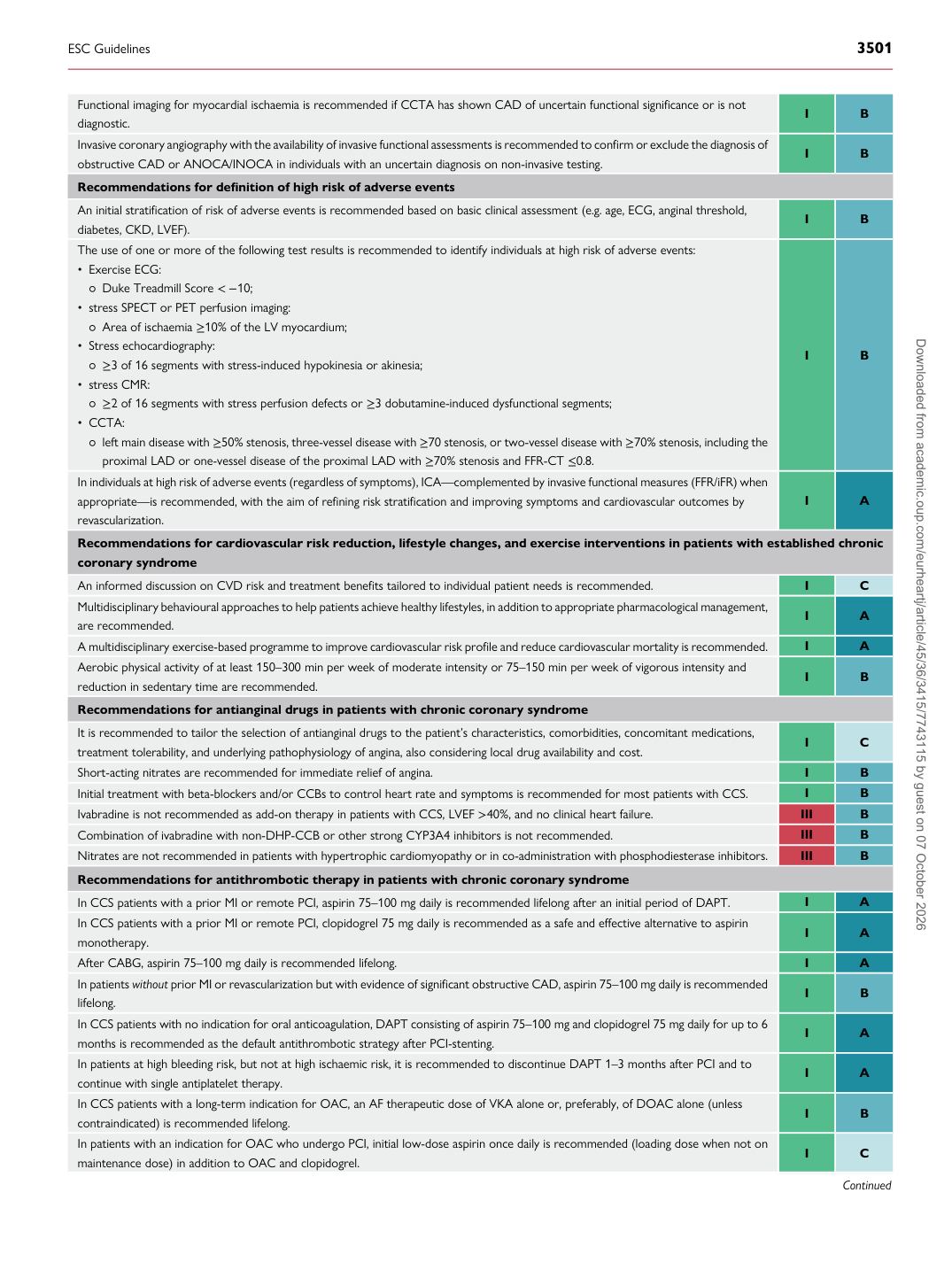
Functional imaging for myocardial ischaemia is recommended if CCTA has shown CAD of uncertain functional significance or is not diagnostic. I B Invasive coronary angiography with the availability of invasive functional assessments is recommended to confirm or exclude the diagnosis of obstructive CAD or ANOCA/INOCA in individuals with an uncertain diagnosis on non-invasive testing. I B Recommendations for definition of high risk of adverse events An initial stratification of risk of adverse events is recommended based on basic clinical assessment (e.g. age, ECG, anginal threshold, diabetes, CKD, LVEF). I B The use of one or more of the following test results is recommended to identify individuals at high risk of adverse events: • Exercise ECG:

⚬Duke Treadmill Score < −10; • stress SPECT or PET perfusion imaging: ⚬Area of ischaemia ≥10% of the LV myocardium; • Stress echocardiography: ⚬≥3 of 16 segments with stress-induced hypokinesia or akinesia; • stress CMR:

⚬≥2 of 16 segments with stress perfusion defects or ≥3 dobutamine-induced dysfunctional segments; • CCTA: ⚬left main disease with ≥50% stenosis, three-vessel disease with ≥70 stenosis, or two-vessel disease with ≥70% stenosis, including the

proximal LAD or one-vessel disease of the proximal LAD with ≥70% stenosis and FFR-CT ≤0.8. I B In individuals at high risk of adverse events (regardless of symptoms), ICA—complemented by invasive functional measures (FFR/iFR) when appropriate—is recommended, with the aim of refining risk stratification and improving symptoms and cardiovascular outcomes by revascularization. I A Recommendations for cardiovascular risk reduction, lifestyle changes, and exercise interventions in patients with established chronic coronary syndrome An informed discussion on CVD risk and treatment benefits tailored to individual patient needs is recommended. I C Multidisciplinary behavioural approaches to help patients achieve healthy lifestyles, in addition to appropriate pharmacological management, are recommended. I A A multidisciplinary exercise-based programme to improve cardiovascular risk profile and reduce cardiovascular mortality is recommended. I A Aerobic physical activity of at least 150–300 min per week of moderate intensity or 75–150 min per week of vigorous intensity and reduction in sedentary time are recommended. I B Recommendations for antianginal drugs in patients with chronic coronary syndrome It is recommended to tailor the selection of antianginal drugs to the patient’s characteristics, comorbidities, concomitant medications, treatment tolerability, and underlying pathophysiology of angina, also considering local drug availability and cost. I C Short-acting nitrates are recommended for immediate relief of angina. I B Initial treatment with beta-blockers and/or CCBs to control heart rate and symptoms is recommended for most patients with CCS. I B Ivabradine is not recommended as add-on therapy in patients with CCS, LVEF >40%, and no clinical heart failure. III B Combination of ivabradine with non-DHP-CCB or other strong CYP3A4 inhibitors is not recommended. III B Nitrates are not recommended in patients with hypertrophic cardiomyopathy or in co-administration with phosphodiesterase inhibitors. III B Recommendations for antithrombotic therapy in patients with chronic coronary syndrome In CCS patients with a prior MI or remote PCI, aspirin 75–100 mg daily is recommended lifelong after an initial period of DAPT. I A In CCS patients with a prior MI or remote PCI, clopidogrel 75 mg daily is recommended as a safe and effective alternative to aspirin monotherapy. I A After CABG, aspirin 75–100 mg daily is recommended lifelong. I A In patients without prior MI or revascularization but with evidence of significant obstructive CAD, aspirin 75–100 mg daily is recommended lifelong. I B In CCS patients with no indication for oral anticoagulation, DAPT consisting of aspirin 75–100 mg and clopidogrel 75 mg daily for up to 6 months is recommended as the default antithrombotic strategy after PCI-stenting. I A In patients at high bleeding risk, but not at high ischaemic risk, it is recommended to discontinue DAPT 1–3 months after PCI and to continue with single antiplatelet therapy. I A In CCS patients with a long-term indication for OAC, an AF therapeutic dose of VKA alone or, preferably, of DOAC alone (unless contraindicated) is recommended lifelong. I B In patients with an indication for OAC who undergo PCI, initial low-dose aspirin once daily is recommended (loading dose when not on maintenance dose) in addition to OAC and clopidogrel. I C

Continued

ESC Guidelines                                                                                                                                                                                          3501

Downloaded from academic.oup.com/eurheartj/article/45/36/3415/7743115 by guest on 07 October 2026