p.86 抽出テキスト
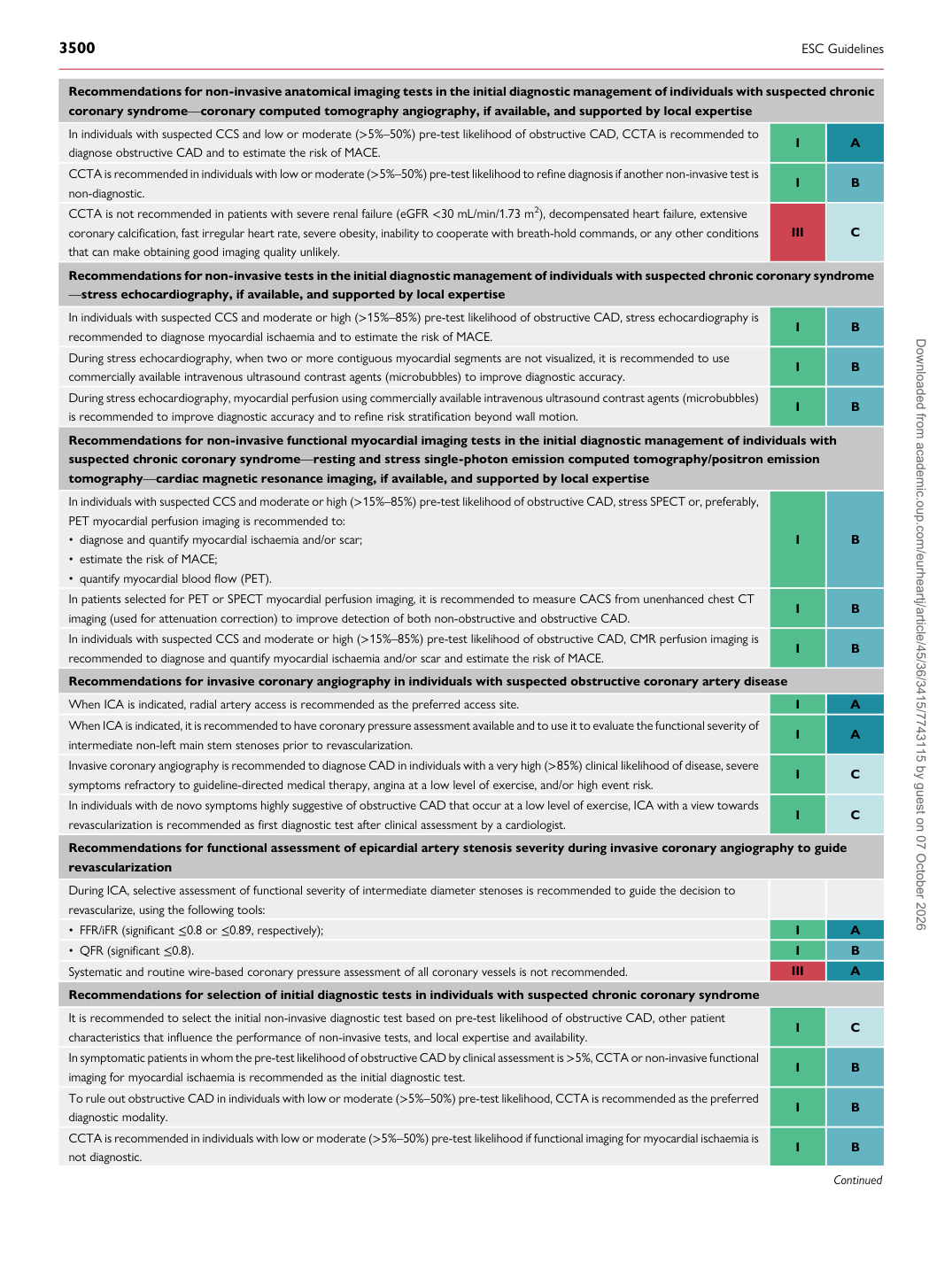
Recommendations for non-invasive anatomical imaging tests in the initial diagnostic management of individuals with suspected chronic coronary syndrome—coronary computed tomography angiography, if available, and supported by local expertise In individuals with suspected CCS and low or moderate (>5%–50%) pre-test likelihood of obstructive CAD, CCTA is recommended to diagnose obstructive CAD and to estimate the risk of MACE. I A CCTA is recommended in individuals with low or moderate (>5%–50%) pre-test likelihood to refine diagnosis if another non-invasive test is non-diagnostic. I B CCTA is not recommended in patients with severe renal failure (eGFR <30 mL/min/1.73 m2), decompensated heart failure, extensive coronary calcification, fast irregular heart rate, severe obesity, inability to cooperate with breath-hold commands, or any other conditions that can make obtaining good imaging quality unlikely. III C Recommendations for non-invasive tests in the initial diagnostic management of individuals with suspected chronic coronary syndrome —stress echocardiography, if available, and supported by local expertise In individuals with suspected CCS and moderate or high (>15%–85%) pre-test likelihood of obstructive CAD, stress echocardiography is recommended to diagnose myocardial ischaemia and to estimate the risk of MACE. I B During stress echocardiography, when two or more contiguous myocardial segments are not visualized, it is recommended to use commercially available intravenous ultrasound contrast agents (microbubbles) to improve diagnostic accuracy. I B During stress echocardiography, myocardial perfusion using commercially available intravenous ultrasound contrast agents (microbubbles) is recommended to improve diagnostic accuracy and to refine risk stratification beyond wall motion. I B Recommendations for non-invasive functional myocardial imaging tests in the initial diagnostic management of individuals with suspected chronic coronary syndrome—resting and stress single-photon emission computed tomography/positron emission tomography—cardiac magnetic resonance imaging, if available, and supported by local expertise In individuals with suspected CCS and moderate or high (>15%–85%) pre-test likelihood of obstructive CAD, stress SPECT or, preferably, PET myocardial perfusion imaging is recommended to: • diagnose and quantify myocardial ischaemia and/or scar; • estimate the risk of MACE; • quantify myocardial blood flow (PET). I B In patients selected for PET or SPECT myocardial perfusion imaging, it is recommended to measure CACS from unenhanced chest CT imaging (used for attenuation correction) to improve detection of both non-obstructive and obstructive CAD. I B In individuals with suspected CCS and moderate or high (>15%–85%) pre-test likelihood of obstructive CAD, CMR perfusion imaging is recommended to diagnose and quantify myocardial ischaemia and/or scar and estimate the risk of MACE. I B Recommendations for invasive coronary angiography in individuals with suspected obstructive coronary artery disease When ICA is indicated, radial artery access is recommended as the preferred access site. I A When ICA is indicated, it is recommended to have coronary pressure assessment available and to use it to evaluate the functional severity of intermediate non-left main stem stenoses prior to revascularization. I A Invasive coronary angiography is recommended to diagnose CAD in individuals with a very high (>85%) clinical likelihood of disease, severe symptoms refractory to guideline-directed medical therapy, angina at a low level of exercise, and/or high event risk. I C In individuals with de novo symptoms highly suggestive of obstructive CAD that occur at a low level of exercise, ICA with a view towards revascularization is recommended as first diagnostic test after clinical assessment by a cardiologist. I C Recommendations for functional assessment of epicardial artery stenosis severity during invasive coronary angiography to guide revascularization During ICA, selective assessment of functional severity of intermediate diameter stenoses is recommended to guide the decision to revascularize, using the following tools: • FFR/iFR (significant ≤0.8 or ≤0.89, respectively); I A • QFR (significant ≤0.8). I B Systematic and routine wire-based coronary pressure assessment of all coronary vessels is not recommended. III A Recommendations for selection of initial diagnostic tests in individuals with suspected chronic coronary syndrome It is recommended to select the initial non-invasive diagnostic test based on pre-test likelihood of obstructive CAD, other patient characteristics that influence the performance of non-invasive tests, and local expertise and availability. I C In symptomatic patients in whom the pre-test likelihood of obstructive CAD by clinical assessment is >5%, CCTA or non-invasive functional imaging for myocardial ischaemia is recommended as the initial diagnostic test. I B To rule out obstructive CAD in individuals with low or moderate (>5%–50%) pre-test likelihood, CCTA is recommended as the preferred diagnostic modality. I B CCTA is recommended in individuals with low or moderate (>5%–50%) pre-test likelihood if functional imaging for myocardial ischaemia is not diagnostic. I B

Continued Downloaded from academic.oup.com/eurheartj/article/45/36/3415/7743115 by guest on 07 October 2026