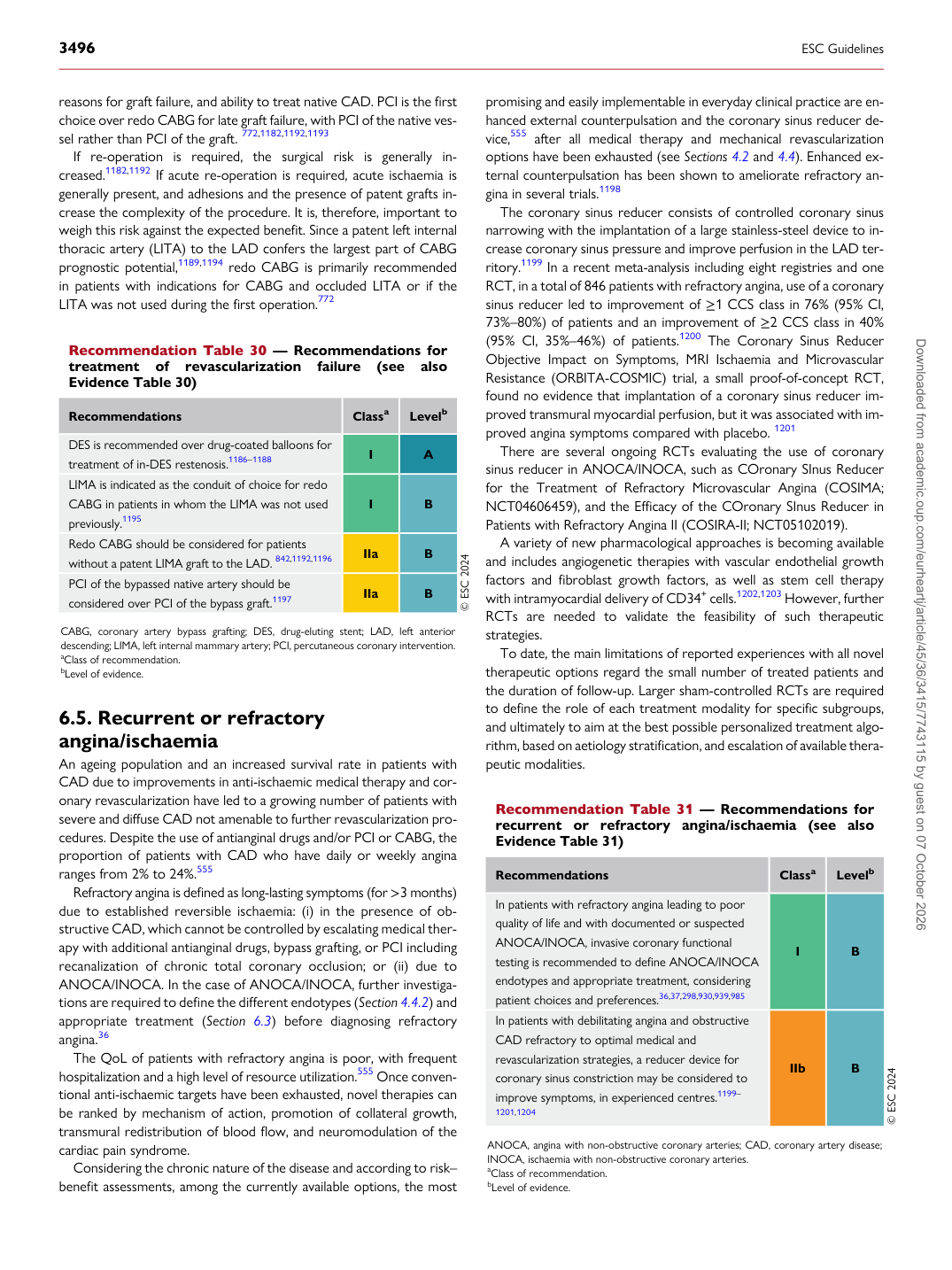
p.82 抽出テキスト
reasons for graft failure, and ability to treat native CAD. PCI is the first choice over redo CABG for late graft failure, with PCI of the native vessel rather than PCI of the graft. 772,1182,1192,1193 If re-operation is required, the surgical risk is generally increased.1182,1192 If acute re-operation is required, acute ischaemia is generally present, and adhesions and the presence of patent grafts increase the complexity of the procedure. It is, therefore, important to weigh this risk against the expected benefit. Since a patent left internal thoracic artery (LITA) to the LAD confers the largest part of CABG prognostic potential,1189,1194 redo CABG is primarily recommended in patients with indications for CABG and occluded LITA or if the LITA was not used during the first operation.772

6.5 Recurrent or refractory

angina/ischaemia An ageing population and an increased survival rate in patients with CAD due to improvements in anti-ischaemic medical therapy and coronary revascularization have led to a growing number of patients with severe and diffuse CAD not amenable to further revascularization procedures. Despite the use of antianginal drugs and/or PCI or CABG, the proportion of patients with CAD who have daily or weekly angina ranges from 2% to 24%.555 Refractory angina is defined as long-lasting symptoms (for >3 months) due to established reversible ischaemia: (i) in the presence of obstructive CAD, which cannot be controlled by escalating medical therapy with additional antianginal drugs, bypass grafting, or PCI including recanalization of chronic total coronary occlusion; or (ii) due to ANOCA/INOCA. In the case of ANOCA/INOCA, further investigations are required to define the different endotypes (Section 4.4.2) and appropriate treatment (Section 6.3) before diagnosing refractory angina.36 The QoL of patients with refractory angina is poor, with frequent hospitalization and a high level of resource utilization.555 Once conventional anti-ischaemic targets have been exhausted, novel therapies can be ranked by mechanism of action, promotion of collateral growth, transmural redistribution of blood flow, and neuromodulation of the cardiac pain syndrome. Considering the chronic nature of the disease and according to risk– benefit assessments, among the currently available options, the most promising and easily implementable in everyday clinical practice are enhanced external counterpulsation and the coronary sinus reducer device,555 after all medical therapy and mechanical revascularization options have been exhausted (see Sections 4.2 and 4.4). Enhanced external counterpulsation has been shown to ameliorate refractory angina in several trials.1198

The coronary sinus reducer consists of controlled coronary sinus narrowing with the implantation of a large stainless-steel device to increase coronary sinus pressure and improve perfusion in the LAD territory.1199 In a recent meta-analysis including eight registries and one RCT, in a total of 846 patients with refractory angina, use of a coronary sinus reducer led to improvement of ≥1 CCS class in 76% (95% CI, 73%–80%) of patients and an improvement of ≥2 CCS class in 40% (95% CI, 35%–46%) of patients.1200 The Coronary Sinus Reducer Objective Impact on Symptoms, MRI Ischaemia and Microvascular Resistance (ORBITA-COSMIC) trial, a small proof-of-concept RCT, found no evidence that implantation of a coronary sinus reducer improved transmural myocardial perfusion, but it was associated with improved angina symptoms compared with placebo. 1201 There are several ongoing RCTs evaluating the use of coronary sinus reducer in ANOCA/INOCA, such as COronary SInus Reducer for the Treatment of Refractory Microvascular Angina (COSIMA; NCT04606459), and the Efficacy of the COronary SInus Reducer in Patients with Refractory Angina II (COSIRA-II; NCT05102019). A variety of new pharmacological approaches is becoming available and includes angiogenetic therapies with vascular endothelial growth factors and fibroblast growth factors, as well as stem cell therapy with intramyocardial delivery of CD34+ cells.1202,1203 However, further RCTs are needed to validate the feasibility of such therapeutic strategies. To date, the main limitations of reported experiences with all novel therapeutic options regard the small number of treated patients and the duration of follow-up. Larger sham-controlled RCTs are required to define the role of each treatment modality for specific subgroups, and ultimately to aim at the best possible personalized treatment algorithm, based on aetiology stratification, and escalation of available therapeutic modalities.

Recommendation Table 30 — Recommendations for treatment of revascularization failure (see also Evidence Table 30)

Recommendations Classa Levelb

DES is recommended over drug-coated balloons for treatment of in-DES restenosis.1186–1188 I A LIMA is indicated as the conduit of choice for redo CABG in patients in whom the LIMA was not used previously.1195 I B Redo CABG should be considered for patients without a patent LIMA graft to the LAD. 842,1192,1196 IIa B PCI of the bypassed native artery should be considered over PCI of the bypass graft.1197 IIa B © ESC 2024

CABG, coronary artery bypass grafting; DES, drug-eluting stent; LAD, left anterior descending; LIMA, left internal mammary artery; PCI, percutaneous coronary intervention. aClass of recommendation. bLevel of evidence.

Recommendation Table 31 — Recommendations for recurrent or refractory angina/ischaemia (see also Evidence Table 31)

Recommendations Classa Levelb

In patients with refractory angina leading to poor quality of life and with documented or suspected ANOCA/INOCA, invasive coronary functional testing is recommended to define ANOCA/INOCA endotypes and appropriate treatment, considering patient choices and preferences.36,37,298,930,939,985 I B In patients with debilitating angina and obstructive CAD refractory to optimal medical and revascularization strategies, a reducer device for coronary sinus constriction may be considered to improve symptoms, in experienced centres.1199– 1201,1204 IIb B © ESC 2024

ANOCA, angina with non-obstructive coronary arteries; CAD, coronary artery disease; INOCA, ischaemia with non-obstructive coronary arteries. aClass of recommendation. bLevel of evidence. Downloaded from academic.oup.com/eurheartj/article/45/36/3415/7743115 by guest on 07 October 2026