p.80 抽出テキスト
6.3.3 Non-invasive diagnostic testing

All non-invasive diagnostic testing, including CCTA, stress SPECT, or PET myocardial perfusion imaging, stress echocardiography, and stress CMR have been shown to provide prognostic information in patients with established CAD.296,1180,1181 Anatomical imaging with CCTA has the advantage of providing information on left main disease and graft patency. Stress imaging provides information on the degree of ischaemia, which helps guide an appropriate management plan. For example, symptomatic patients with moderate-to-severe myocardial ischaemia despite GDMT will usually undergo additional revascularization. In patients with known ANOCA/INOCA, non-invasive imaging with stress SPECT or PET myocardial perfusion imaging, stress CMR, or stress echocardiography remain first-line investigations, although the diagnostic yield may be low;927 however, the current standard remains invasive coronary functional testing.

4

5 6 1

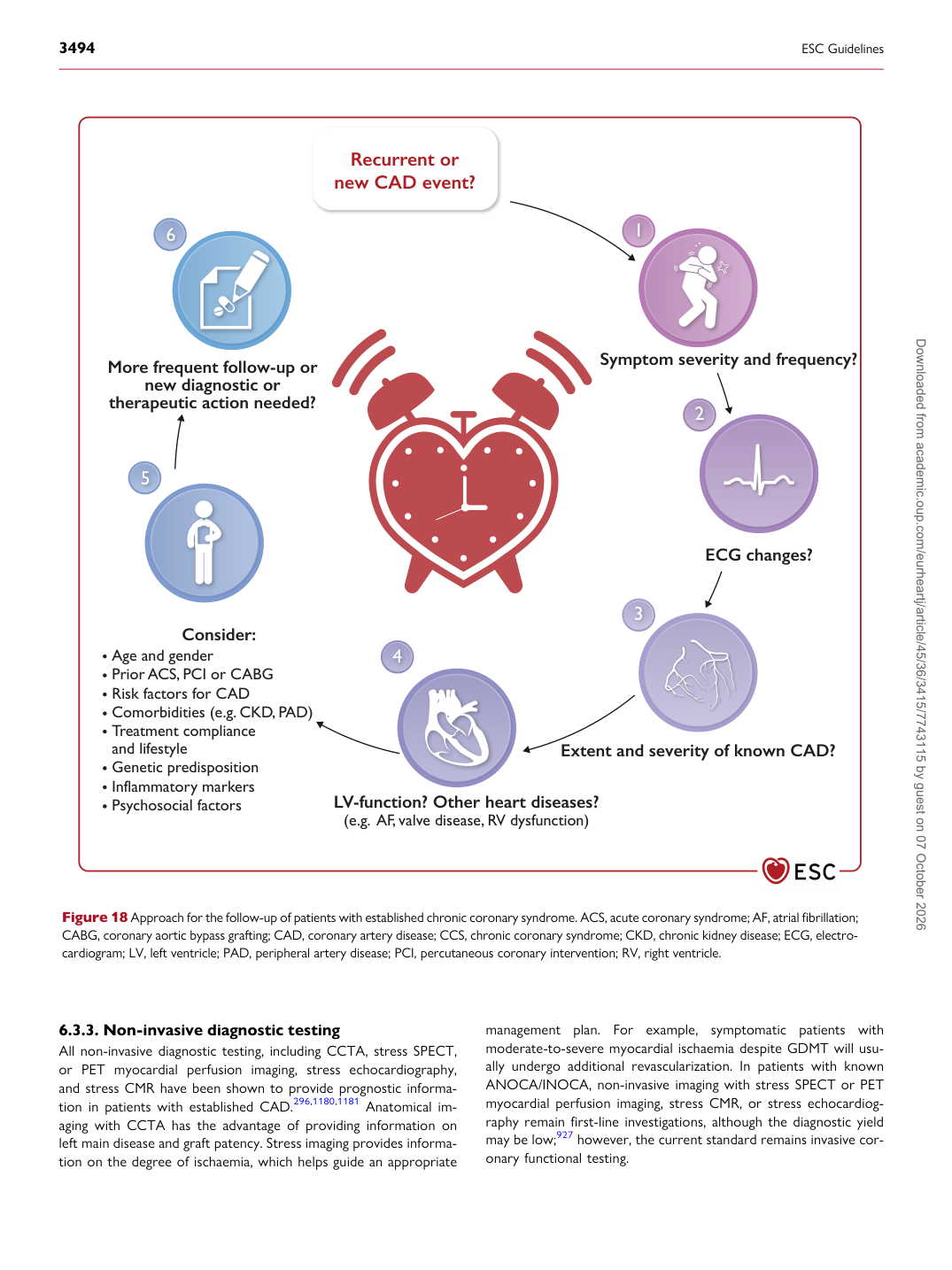
Symptom severity and frequency? More frequent follow-up or

new diagnostic or therapeutic action needed?

3

Extent and severity of known CAD?

Consider:

LV-function? Other heart diseases?

(e.g.  AF, valve disease, RV dysfunction)

Age and gender Prior ACS, PCI or CABG Risk factors for CAD Comorbidities (e.g. CKD, PAD) Recurrent or new CAD event? Treatment compliance and lifestyle Genetic predisposition Inflammatory markers Psychosocial factors 2 ECG changes?

Figure 18 Approach for the follow-up of patients with established chronic coronary syndrome. ACS, acute coronary syndrome; AF, atrial fibrillation; CABG, coronary aortic bypass grafting; CAD, coronary artery disease; CCS, chronic coronary syndrome; CKD, chronic kidney disease; ECG, electrocardiogram; LV, left ventricle; PAD, peripheral artery disease; PCI, percutaneous coronary intervention; RV, right ventricle. Downloaded from academic.oup.com/eurheartj/article/45/36/3415/7743115 by guest on 07 October 2026