p.8 抽出テキスト
TWILIGHT Ticagrelor with Aspirin or Alone in High-Risk Patients after Coronary Intervention vFFR Vessel fractional flow reserve VKA Vitamin K antagonist VSA Vasospastic angina VTE Venous thrombo-embolism WARRIOR Women’s IschemiA Trial to Reduce Events in Non-ObstRuctIve CORonary Artery Disease WOMEN What is the Optimal Method for Ischemia Evaluation of Women X-ECG Exercise ECG testing

1 Preamble

Guidelines evaluate and summarize available evidence with the aim of assisting health professionals in proposing the best diagnostic or therapeutic approach for an individual patient with a given condition. Guidelines are intended for use by health professionals, and the European Society of Cardiology (ESC) makes its guidelines freely available. ESC Guidelines do not override the individual responsibility of health professionals to make appropriate and accurate decisions in consideration of each patient’s health condition and in consultation with that patient or the patient’s caregiver where appropriate and/or necessary. It is also the health professional’s responsibility to verify the rules and regulations applicable in each country to drugs and devices at the time of prescription and to respect the ethical rules of their profession. ESC Guidelines represent the official position of the ESC on a given topic and are regularly updated when warranted by new evidence. ESC Policies and Procedures for formulating and issuing ESC Guidelines can be found on the ESC website (https://www.escardio.org/Guidelines/ Clinical-Practice-Guidelines/Guidelines-development/Writing-ESC-Gui delines). These guidelines update and replace the previous version from 2019 and partly replace the myocardial revascularization guidelines from 2018.

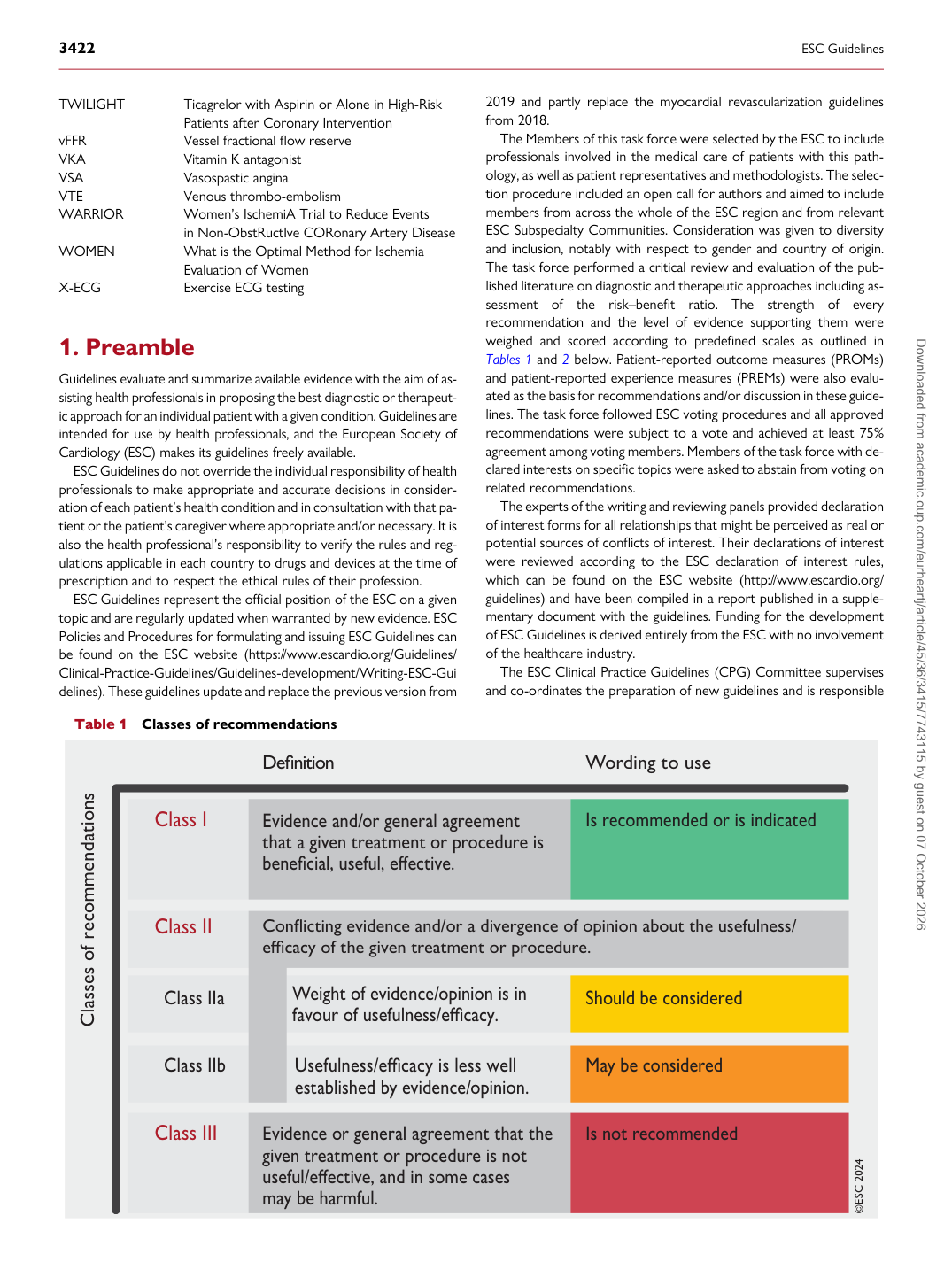
The Members of this task force were selected by the ESC to include professionals involved in the medical care of patients with this pathology, as well as patient representatives and methodologists. The selection procedure included an open call for authors and aimed to include members from across the whole of the ESC region and from relevant ESC Subspecialty Communities. Consideration was given to diversity and inclusion, notably with respect to gender and country of origin. The task force performed a critical review and evaluation of the published literature on diagnostic and therapeutic approaches including assessment of the risk–benefit ratio. The strength of every recommendation and the level of evidence supporting them were weighed and scored according to predefined scales as outlined in Tables 1 and 2 below. Patient-reported outcome measures (PROMs) and patient-reported experience measures (PREMs) were also evaluated as the basis for recommendations and/or discussion in these guidelines. The task force followed ESC voting procedures and all approved recommendations were subject to a vote and achieved at least 75% agreement among voting members. Members of the task force with declared interests on specific topics were asked to abstain from voting on related recommendations. The experts of the writing and reviewing panels provided declaration of interest forms for all relationships that might be perceived as real or potential sources of conflicts of interest. Their declarations of interest were reviewed according to the ESC declaration of interest rules, which can be found on the ESC website (http://www.escardio.org/ guidelines) and have been compiled in a report published in a supplementary document with the guidelines. Funding for the development of ESC Guidelines is derived entirely from the ESC with no involvement of the healthcare industry. The ESC Clinical Practice Guidelines (CPG) Committee supervises and co-ordinates the preparation of new guidelines and is responsible

Table 1 Classes of recommendations

©ESC 2024

Classes of recommendations Class I Evidence and/or general agreement that a given treatment or procedure is beneficial, useful, effective.

Conflicting evidence and/or a divergence of opinion about the usefulness/ efficacy of the given treatment or procedure.

Is recommended or is indicated

Wording to use Definition

Class III Evidence or general agreement that the given treatment or procedure is not useful/effective, and in some cases may be harmful. Is not recommended

Class IIb Usefulness/efficacy is less well established by evidence/opinion. May be considered

Class IIa Weight of evidence/opinion is in favour of usefulness/efficacy. Should be considered

Class II

© ESC 2024 Downloaded from academic.oup.com/eurheartj/article/45/36/3415/7743115 by guest on 07 October 2026