p.78 抽出テキスト
combined with other behaviour-change strategies.491 A systematic review of CCS patients that used activity trackers combined with feedback by healthcare professionals (most also giving lifestyle education) showed a significant increase in peak VO2 in studies using an accelerometer (but not a pedometer) compared with non-users. The overall effect across studies reduced MACE and improved QoL.1148 Similarly, smartphone and tablet computer apps have been shown to increase physical activity (minutes per week or steps per day) among people with CVD (1543 participants, most of them with CCS). This effect was largest in small studies focused on physical activity only, participants ≥60 years old, and duration of up to 3 months.1149 Adherence to the apps was 20% to 85% and tended to wane over time. Of note, the implementation of digital and mHealth should not be at odds with a less digital-oriented care for those unfamiliar with new technologies (e.g. elderly people).

6.2.1.4 How to assess adherence

Addressing lifestyle behaviour and medication adherence in a nonjudgemental way at clinical encounters is important to identify barriers and offer tailored solutions to promote healthier actions. The encounter can be useful to review patient self-monitoring records (digital or written), accelerometer data, and diaries, or validated questionnaires on physical activity.

6.2.2 Adherence to medical therapy

Guideline-directed medications are key to the effective management of CCS and prevention of subsequent cardiovascular events, but dependent on patient adherence and persistence with treatment. Despite robust evidence of benefits in terms of mortality and morbidity,1150 adherence remains suboptimal.1151 Although adherence is usually higher in RCTs, approximately 28% of CCS patients in the ISCHEMIA trial were non-adherent to prescribed medications at baseline.1152 Non-adherence was associated with significantly worse health status regardless of randomization to the conservative or invasive strategy.1152 Medication adherence can be intentional or unintentional, and can be adversely affected by polypharmacy, complex drug regimens, high cost, and side effects.

6.2.2.1 Strategies to improve medication adherence

Improving adherence to medications has proved challenging.1153 One systematic review and meta-analysis (771 studies to 2015) found that interventions that were behaviourally focused, e.g. linking medicationtaking to existing habits, were more effective than those that were cognitively focused.1154 A systematic review of 17 trials of adherence for secondary CVD prevention found that a short message service, a fixed-dose combination pill, and a community health worker-based intervention (one trial each) increased adherence compared with usual care.1155 Behavioural and mixed behavioural/educational interventions improved adherence in older adults with multiple medications (low-quality evidence), with little evidence for educational-only interventions.1156 Drug reminder packaging—i.e. incorporating the date and time for the medication to be taken in a package (pre-filled containers)—can act as a prompt, with some evidence that it increases pills taken and improves diastolic BP and HbA1c levels.1157 Treating depression is important, as depression was associated with reduced adequate and optimal adherence to recommended medications 12 months post-PCI in an analysis of 124 443 patients.1158 Simplifying medication regimens using fixed-dose polypills has been shown to increase adherence.1159–1162 The SECURE trial demonstrated that patients 6 months post-MI randomized to a polypill containing aspirin, ramipril, and atorvastatin had significantly lower MACE and were more likely to have high adherence at 6 and 24 months compared with the usual care group.1163

6.2.2.2 mHealth strategies for medication adherence

A review of mobile phone text messaging found promising, if limited, evidence that such messaging could improve medication adherence up to 12 months after acute coronary events.1164 Similarly, another review of 24 studies of text messages and/or apps found robust evidence for adherence to pharmacological therapy.1146 A pilot trial of 135 non-adherent patients with hypertension and/or diabetes randomized patients to a highly tailored digital intervention (text messages and interactive voice response) or usual care for 12 weeks. Medication adherence was significantly improved in the intervention group, along with improvements in systolic BP and HbA1c, compared with the control group.1165

6.3 Diagnosis of disease progression

Long-term follow-up of patients with CCS who have either established CAD (prior acute MI, revascularization, known CAD) or nonobstructive CAD includes surveillance for disease progression. However, current literature is sparse regarding mode, frequency, and duration. Follow-up of patients is based on their clinical condition, which includes cardiovascular risk factors, residual symptoms, cardiac complications [such as post-infarction LV remodelling and dysfunction, associated mitral regurgitation (mostly functional), known HF, significant arrhythmias], and non-cardiac comorbidities like PAD, stroke, and renal dysfunction. The main goal of follow-up is to determine the patient’s risk of developing new cardiac events through risk stratification and to identify symptoms suggestive of CAD progression. A second goal is

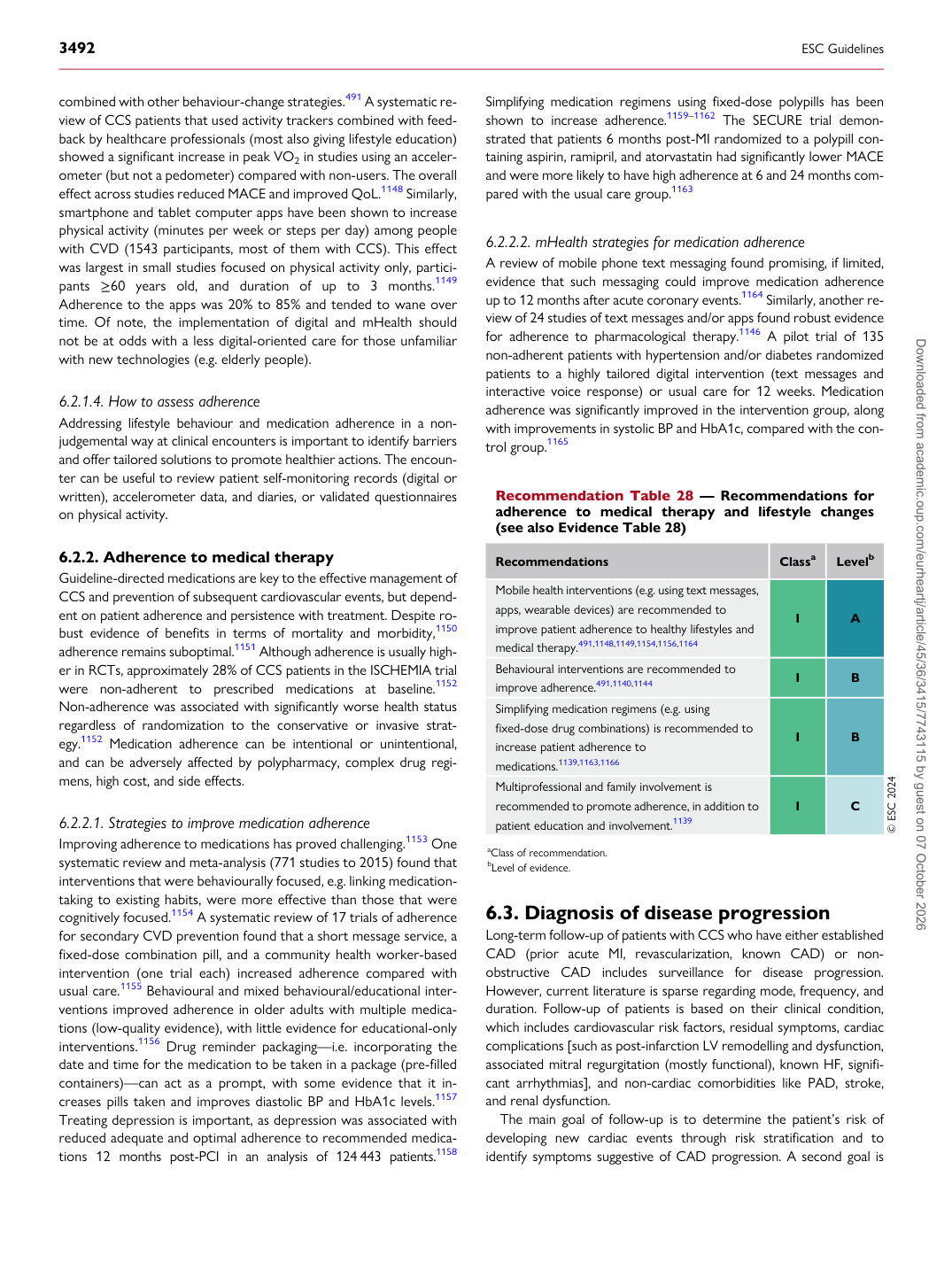
Recommendation Table 28 — Recommendations for adherence to medical therapy and lifestyle changes (see also Evidence Table 28)

Recommendations Classa Levelb

Mobile health interventions (e.g. using text messages, apps, wearable devices) are recommended to improve patient adherence to healthy lifestyles and medical therapy.491,1148,1149,1154,1156,1164 I A Behavioural interventions are recommended to improve adherence.491,1140,1144 I B Simplifying medication regimens (e.g. using fixed-dose drug combinations) is recommended to increase patient adherence to medications.1139,1163,1166 I B Multiprofessional and family involvement is recommended to promote adherence, in addition to patient education and involvement.1139 I C © ESC 2024 aClass of recommendation. bLevel of evidence. Downloaded from academic.oup.com/eurheartj/article/45/36/3415/7743115 by guest on 07 October 2026