p.76 抽出テキスト
of behaviour. Habits and environmental cues primarily govern behaviours, so education and information alone are seldom enough.1140 Factors such as psychological state and low health literacy (associated with depression and worse behavioural risk factors) also impact the ability to make changes.1141,1142

6.2.1.2 How to change behaviour and support healthy lifestyles

A multidisciplinary approach and behavioural counselling can improve adherence. A systematic review and meta-analysis of 12 RCTs of nurse-led patient-centred interventions for secondary prevention found greater adherence to smoking cessation and physical activity, and better control of total cholesterol (with medication titration), but no improvements in dietary habits, BP, blood glucose, or survival.1143 A systematic review of behavioural counselling found that medium- to high-contact counselling resulted in 20% lower risk of CVD events, lower BP, and decreased LDL-C and adiposity in adults with CVD risk factors.1144 Incorporating cardiovascular visual images into risk-factor discussions is effective in reducing subsequent 10-year risk assessment and individual risk factors.445

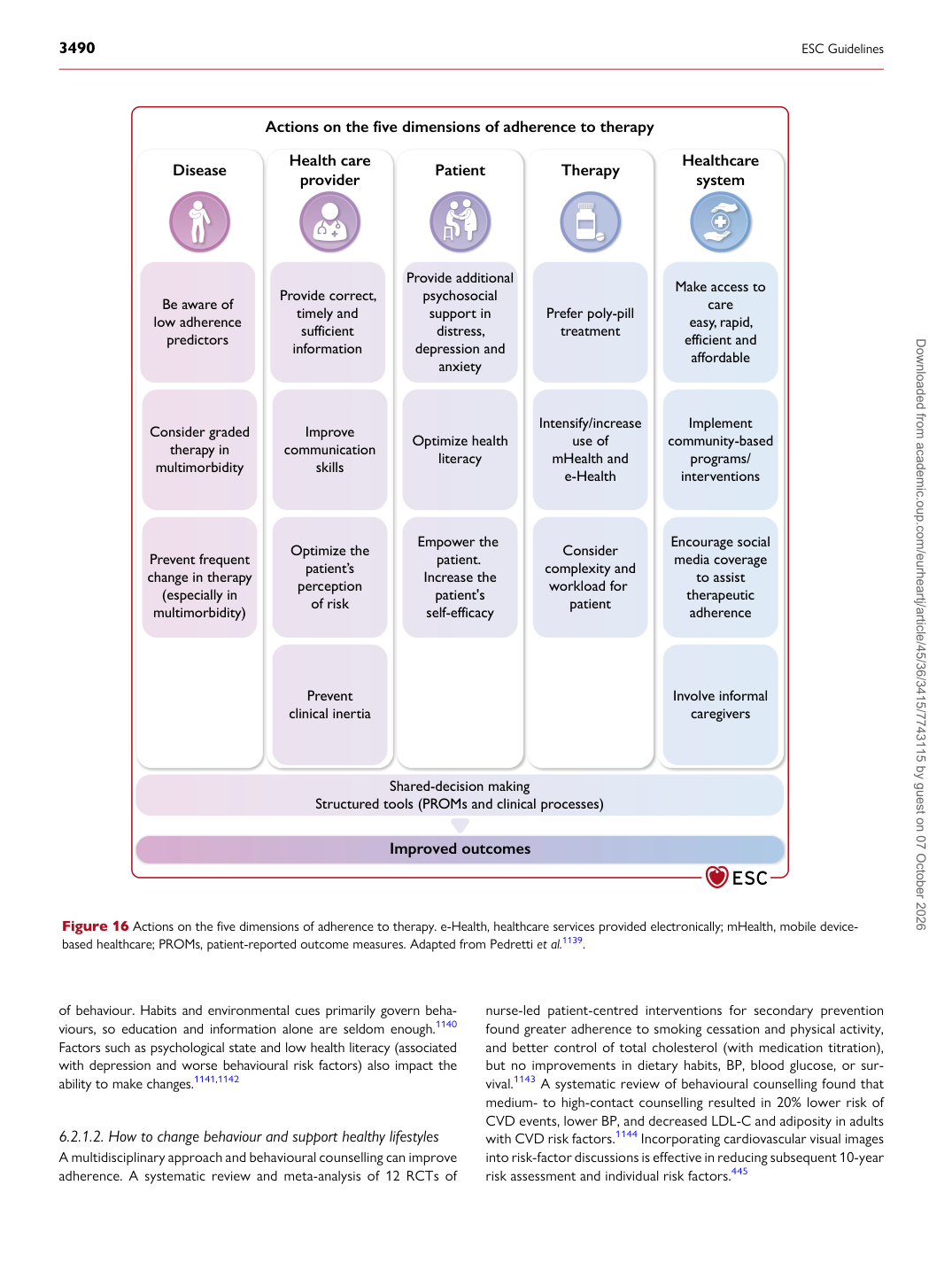
Actions on the five dimensions of adherence to therapy

Disease

Be aware of low adherence

predictors

Consider graded therapy in multimorbidity

Prevent frequent change in therapy (especially in multimorbidity) Health care

provider

Provide correct,

timely and sufficient information

Improve communication

skills

Optimize the patient’s perception

of risk

Prevent clinical inertia Patient

Provide additional

psychosocial support in distress, depression and

anxiety

Optimize health

literacy

Empower the patient. Increase the patient's self-efficacy Therapy

Prefer poly-pill

treatment

Intensify/increase

use of mHealth and

e-Health

Consider complexity and workload for

patient Healthcare

system

Make access to

care easy, rapid, efficient and affordable

Implement community-based

programs/ interventions

Encourage social media coverage

to assist therapeutic adherence

Involve informal

caregivers

Shared-decision making Structured tools (PROMs and clinical processes)

Improved outcomes

Figure 16 Actions on the five dimensions of adherence to therapy. e-Health, healthcare services provided electronically; mHealth, mobile devicebased healthcare; PROMs, patient-reported outcome measures. Adapted from Pedretti et al.1139. Downloaded from academic.oup.com/eurheartj/article/45/36/3415/7743115 by guest on 07 October 2026