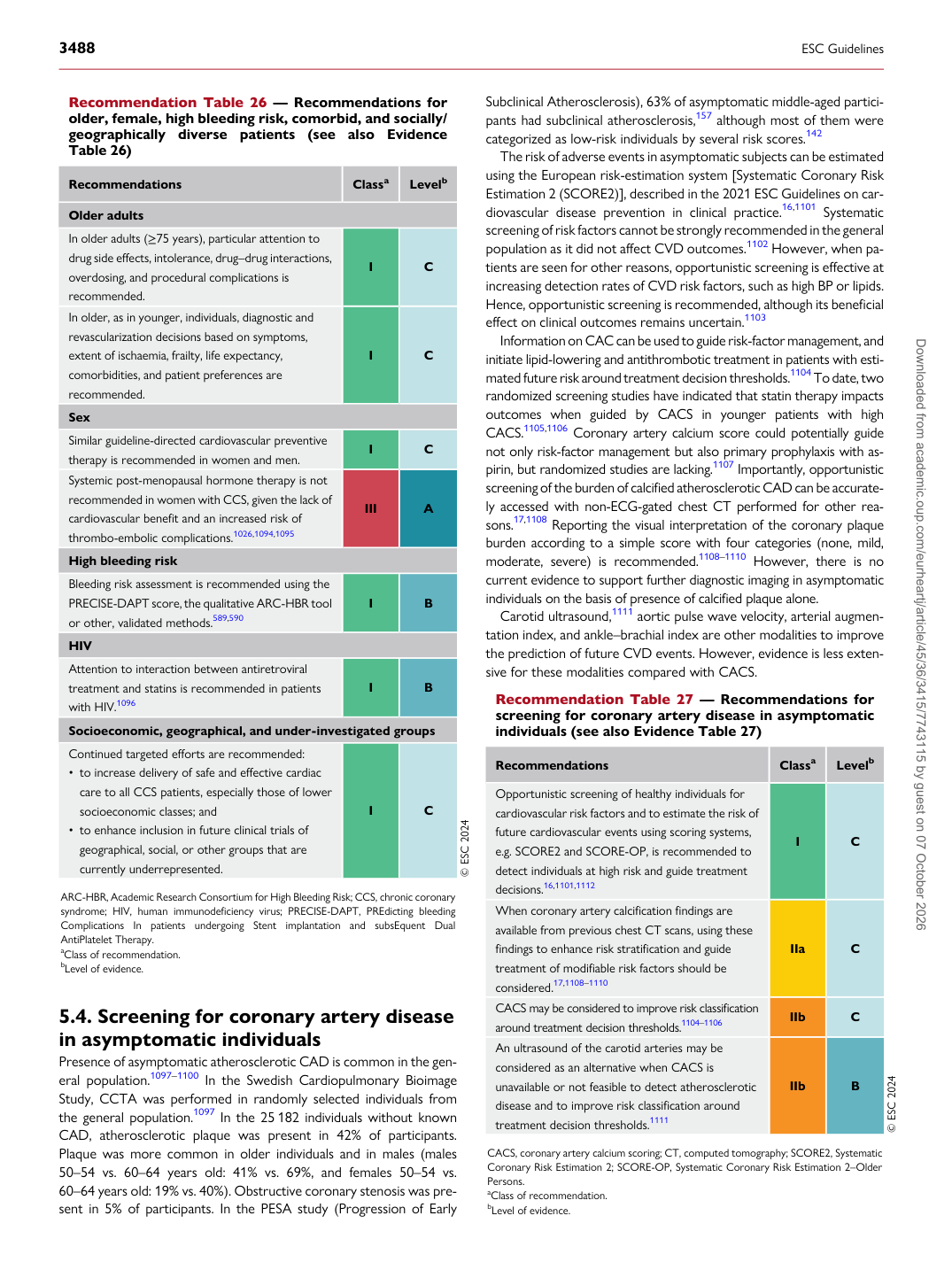
p.74 抽出テキスト
5.4 Screening for coronary artery disease

in asymptomatic individuals Presence of asymptomatic atherosclerotic CAD is common in the general population.1097–1100 In the Swedish Cardiopulmonary Bioimage Study, CCTA was performed in randomly selected individuals from the general population.1097 In the 25 182 individuals without known CAD, atherosclerotic plaque was present in 42% of participants. Plaque was more common in older individuals and in males (males 50–54 vs. 60–64 years old: 41% vs. 69%, and females 50–54 vs. 60–64 years old: 19% vs. 40%). Obstructive coronary stenosis was present in 5% of participants. In the PESA study (Progression of Early Subclinical Atherosclerosis), 63% of asymptomatic middle-aged participants had subclinical atherosclerosis,157 although most of them were categorized as low-risk individuals by several risk scores.142

The risk of adverse events in asymptomatic subjects can be estimated using the European risk-estimation system [Systematic Coronary Risk Estimation 2 (SCORE2)], described in the 2021 ESC Guidelines on cardiovascular disease prevention in clinical practice.16,1101 Systematic screening of risk factors cannot be strongly recommended in the general population as it did not affect CVD outcomes.1102 However, when patients are seen for other reasons, opportunistic screening is effective at increasing detection rates of CVD risk factors, such as high BP or lipids. Hence, opportunistic screening is recommended, although its beneficial effect on clinical outcomes remains uncertain.1103 Information on CAC can be used to guide risk-factor management, and initiate lipid-lowering and antithrombotic treatment in patients with estimated future risk around treatment decision thresholds.1104 To date, two randomized screening studies have indicated that statin therapy impacts outcomes when guided by CACS in younger patients with high CACS.1105,1106 Coronary artery calcium score could potentially guide not only risk-factor management but also primary prophylaxis with aspirin, but randomized studies are lacking.1107 Importantly, opportunistic screening of the burden of calcified atherosclerotic CAD can be accurately accessed with non-ECG-gated chest CT performed for other reasons.17,1108 Reporting the visual interpretation of the coronary plaque burden according to a simple score with four categories (none, mild, moderate, severe) is recommended.1108–1110 However, there is no current evidence to support further diagnostic imaging in asymptomatic individuals on the basis of presence of calcified plaque alone. Carotid ultrasound,1111 aortic pulse wave velocity, arterial augmentation index, and ankle–brachial index are other modalities to improve the prediction of future CVD events. However, evidence is less extensive for these modalities compared with CACS.

Recommendation Table 26 — Recommendations for older, female, high bleeding risk, comorbid, and socially/ geographically diverse patients (see also Evidence Table 26)

Recommendations Classa Levelb

Older adults In older adults (≥75 years), particular attention to drug side effects, intolerance, drug–drug interactions, overdosing, and procedural complications is recommended. I C In older, as in younger, individuals, diagnostic and revascularization decisions based on symptoms, extent of ischaemia, frailty, life expectancy, comorbidities, and patient preferences are recommended. I C Sex Similar guideline-directed cardiovascular preventive therapy is recommended in women and men. I C Systemic post-menopausal hormone therapy is not recommended in women with CCS, given the lack of cardiovascular benefit and an increased risk of thrombo-embolic complications.1026,1094,1095 III A High bleeding risk Bleeding risk assessment is recommended using the PRECISE-DAPT score, the qualitative ARC-HBR tool or other, validated methods.589,590 I B HIV Attention to interaction between antiretroviral treatment and statins is recommended in patients with HIV.1096 I B Socioeconomic, geographical, and under-investigated groups Continued targeted efforts are recommended: • to increase delivery of safe and effective cardiac

care to all CCS patients, especially those of lower socioeconomic classes; and • to enhance inclusion in future clinical trials of

geographical, social, or other groups that are currently underrepresented. I C © ESC 2024

ARC-HBR, Academic Research Consortium for High Bleeding Risk; CCS, chronic coronary syndrome; HIV, human immunodeficiency virus; PRECISE-DAPT, PREdicting bleeding Complications In patients undergoing Stent implantation and subsEquent Dual AntiPlatelet Therapy. aClass of recommendation. bLevel of evidence. Recommendation Table 27 — Recommendations for screening for coronary artery disease in asymptomatic individuals (see also Evidence Table 27)

Recommendations Classa Levelb

Opportunistic screening of healthy individuals for cardiovascular risk factors and to estimate the risk of future cardiovascular events using scoring systems, e.g. SCORE2 and SCORE-OP, is recommended to detect individuals at high risk and guide treatment decisions.16,1101,1112 I C When coronary artery calcification findings are available from previous chest CT scans, using these findings to enhance risk stratification and guide treatment of modifiable risk factors should be considered.17,1108–1110 IIa C CACS may be considered to improve risk classification around treatment decision thresholds.1104–1106 IIb C An ultrasound of the carotid arteries may be considered as an alternative when CACS is unavailable or not feasible to detect atherosclerotic disease and to improve risk classification around treatment decision thresholds.1111 IIb B © ESC 2024

CACS, coronary artery calcium scoring; CT, computed tomography; SCORE2, Systematic Coronary Risk Estimation 2; SCORE-OP, Systematic Coronary Risk Estimation 2–Older Persons. aClass of recommendation. bLevel of evidence. Downloaded from academic.oup.com/eurheartj/article/45/36/3415/7743115 by guest on 07 October 2026