p.71 抽出テキスト
5.3 Other specific patient groups

5.3.1. Older adults Between 2015 and 2050, the proportion of the world’s population aged >60 years is set to nearly double to 22%. Ageing predisposes patients to a high incidence and prevalence of CAD, in both men and women. Typically, in the context of CVD, older patients are defined as those ≥75 years of age;1 it should be noted, however, that such age cut-offs are relatively arbitrary, and biological age influences this threshold in clinical practice. Clinical characteristics of the older adult population are heterogeneous, with frailty, comorbidity, cognitive function, and health-related QoL playing important roles in guiding clinical care and as predictors of adverse outcomes.1001–1005 Older patients often present with symptoms other than angina, which may delay the diagnosis of CCS.1004 Ageing is often accompanied by both comorbidities and frailty, and consequently leads to potentially excessive polypharmacy.531 In making treatment decisions, clinicians should take into account the limited external validity of RCTs for older adults.36 Older people are often underrepresented in RCTs as a consequence of exclusion criteria and under-recruitment,531,1006,1007 though they have been shown to have a higher underlying risk for cardiovascular outcomes.1008 The treatment of CCS in older adults is complicated by a higher vulnerability to complications for both conservative and invasive strategies, such as bleeding, renal failure, and neurological impairments, all of which require special attention. The use of DES, compared with bare-metal stents, in combination with a short duration of DAPT, is associated with significant safety and efficacy benefits in older adults.1009 Frailty is of utmost importance in the clinical decision-making.1010

5.3.2 Sex differences in chronic coronary syndromes

Ischaemic heart disease is the leading cause of mortality for women, yet they have been historically underrepresented in RCTs.1011–1013 Differences in symptom presentation, in the accuracy of diagnostic tests for obstructive CAD, and other factors that lead to differential triage, evaluation, or early treatment of women with myocardial ischaemia

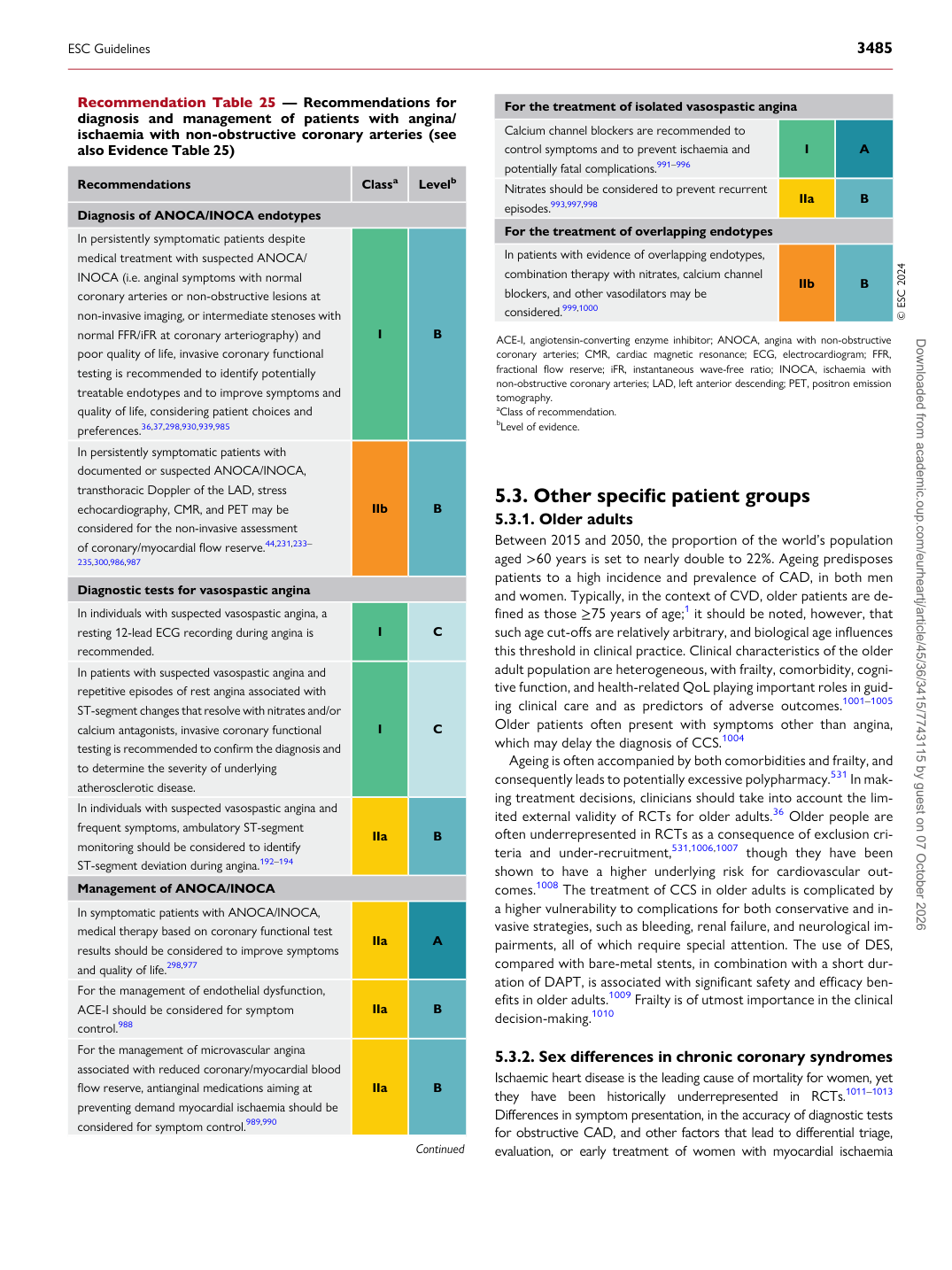
Recommendation Table 25 — Recommendations for diagnosis and management of patients with angina/ ischaemia with non-obstructive coronary arteries (see also Evidence Table 25)

Recommendations Classa Levelb

Diagnosis of ANOCA/INOCA endotypes In persistently symptomatic patients despite medical treatment with suspected ANOCA/ INOCA (i.e. anginal symptoms with normal coronary arteries or non-obstructive lesions at non-invasive imaging, or intermediate stenoses with normal FFR/iFR at coronary arteriography) and poor quality of life, invasive coronary functional testing is recommended to identify potentially treatable endotypes and to improve symptoms and quality of life, considering patient choices and preferences.36,37,298,930,939,985 I B In persistently symptomatic patients with documented or suspected ANOCA/INOCA, transthoracic Doppler of the LAD, stress echocardiography, CMR, and PET may be considered for the non-invasive assessment of coronary/myocardial flow reserve.44,231,233– 235,300,986,987 IIb B

Diagnostic tests for vasospastic angina In individuals with suspected vasospastic angina, a resting 12-lead ECG recording during angina is recommended. I C In patients with suspected vasospastic angina and repetitive episodes of rest angina associated with ST-segment changes that resolve with nitrates and/or calcium antagonists, invasive coronary functional testing is recommended to confirm the diagnosis and to determine the severity of underlying atherosclerotic disease. I C In individuals with suspected vasospastic angina and frequent symptoms, ambulatory ST-segment monitoring should be considered to identify ST-segment deviation during angina.192–194 IIa B Management of ANOCA/INOCA In symptomatic patients with ANOCA/INOCA, medical therapy based on coronary functional test results should be considered to improve symptoms and quality of life.298,977 IIa A For the management of endothelial dysfunction, ACE-I should be considered for symptom control.988 IIa B For the management of microvascular angina associated with reduced coronary/myocardial blood flow reserve, antianginal medications aiming at preventing demand myocardial ischaemia should be considered for symptom control.989,990 IIa B

Continued For the treatment of isolated vasospastic angina

Calcium channel blockers are recommended to control symptoms and to prevent ischaemia and potentially fatal complications.991–996 I A Nitrates should be considered to prevent recurrent episodes.993,997,998 IIa B For the treatment of overlapping endotypes In patients with evidence of overlapping endotypes, combination therapy with nitrates, calcium channel blockers, and other vasodilators may be considered.999,1000 IIb B © ESC 2024

ACE-I, angiotensin-converting enzyme inhibitor; ANOCA, angina with non-obstructive coronary arteries; CMR, cardiac magnetic resonance; ECG, electrocardiogram; FFR, fractional flow reserve; iFR, instantaneous wave-free ratio; INOCA, ischaemia with non-obstructive coronary arteries; LAD, left anterior descending; PET, positron emission tomography. aClass of recommendation. bLevel of evidence.

ESC Guidelines                                                                                                                                                                                          3485

Downloaded from academic.oup.com/eurheartj/article/45/36/3415/7743115 by guest on 07 October 2026