p.69 抽出テキスト
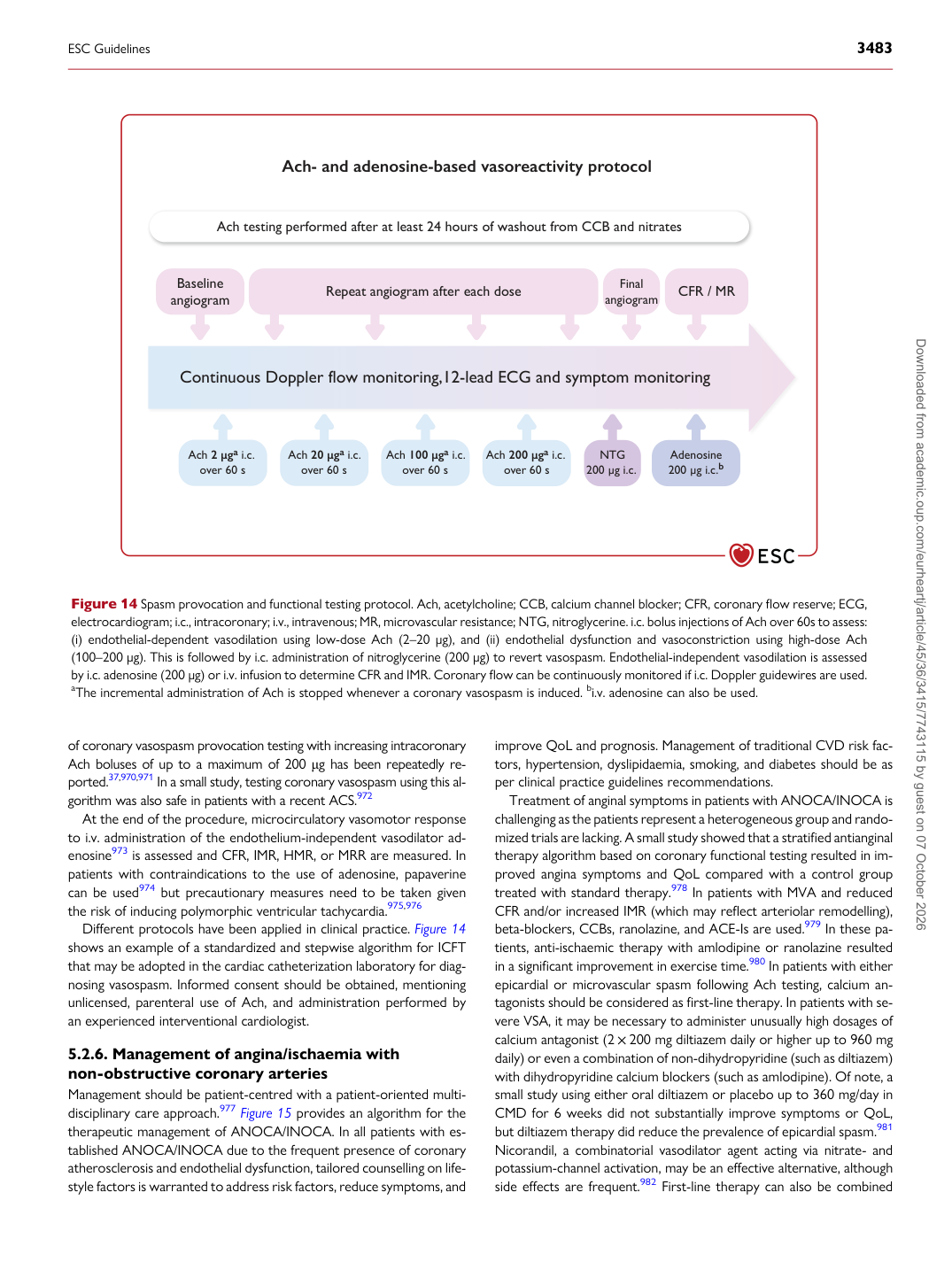
of coronary vasospasm provocation testing with increasing intracoronary Ach boluses of up to a maximum of 200 μg has been repeatedly reported.37,970,971 In a small study, testing coronary vasospasm using this algorithm was also safe in patients with a recent ACS.972 At the end of the procedure, microcirculatory vasomotor response to i.v. administration of the endothelium-independent vasodilator adenosine973 is assessed and CFR, IMR, HMR, or MRR are measured. In patients with contraindications to the use of adenosine, papaverine can be used974 but precautionary measures need to be taken given the risk of inducing polymorphic ventricular tachycardia.975,976 Different protocols have been applied in clinical practice. Figure 14 shows an example of a standardized and stepwise algorithm for ICFT that may be adopted in the cardiac catheterization laboratory for diagnosing vasospasm. Informed consent should be obtained, mentioning unlicensed, parenteral use of Ach, and administration performed by an experienced interventional cardiologist.

5.2.6 Management of angina/ischaemia with

non-obstructive coronary arteries Management should be patient-centred with a patient-oriented multidisciplinary care approach.977 Figure 15 provides an algorithm for the therapeutic management of ANOCA/INOCA. In all patients with established ANOCA/INOCA due to the frequent presence of coronary atherosclerosis and endothelial dysfunction, tailored counselling on lifestyle factors is warranted to address risk factors, reduce symptoms, and improve QoL and prognosis. Management of traditional CVD risk factors, hypertension, dyslipidaemia, smoking, and diabetes should be as per clinical practice guidelines recommendations.

Treatment of anginal symptoms in patients with ANOCA/INOCA is challenging as the patients represent a heterogeneous group and randomized trials are lacking. A small study showed that a stratified antianginal therapy algorithm based on coronary functional testing resulted in improved angina symptoms and QoL compared with a control group treated with standard therapy.978 In patients with MVA and reduced CFR and/or increased IMR (which may reflect arteriolar remodelling), beta-blockers, CCBs, ranolazine, and ACE-Is are used.979 In these patients, anti-ischaemic therapy with amlodipine or ranolazine resulted in a significant improvement in exercise time.980 In patients with either epicardial or microvascular spasm following Ach testing, calcium antagonists should be considered as first-line therapy. In patients with severe VSA, it may be necessary to administer unusually high dosages of calcium antagonist (2 × 200 mg diltiazem daily or higher up to 960 mg daily) or even a combination of non-dihydropyridine (such as diltiazem) with dihydropyridine calcium blockers (such as amlodipine). Of note, a small study using either oral diltiazem or placebo up to 360 mg/day in CMD for 6 weeks did not substantially improve symptoms or QoL, but diltiazem therapy did reduce the prevalence of epicardial spasm.981 Nicorandil, a combinatorial vasodilator agent acting via nitrate- and potassium-channel activation, may be an effective alternative, although side effects are frequent.982 First-line therapy can also be combined

Ach 2 μga i.c.

over 60 s Ach 20 μga i.c.

over 60 s Ach 100 μga i.c.

over 60 s Ach 200 μga i.c.

over 60 s Adenosine 200 μg i.c.b

Continuous Doppler flow monitoring,12-lead ECG and symptom monitoring

Ach testing performed after at least 24 hours of washout from CCB and nitrates

Repeat angiogram after each dose

NTG 200 μg i.c.

Final angiogram Baseline angiogram CFR / MR

Ach- and adenosine-based vasoreactivity protocol

Figure 14 Spasm provocation and functional testing protocol. Ach, acetylcholine; CCB, calcium channel blocker; CFR, coronary flow reserve; ECG, electrocardiogram; i.c., intracoronary; i.v., intravenous; MR, microvascular resistance; NTG, nitroglycerine. i.c. bolus injections of Ach over 60s to assess: (i) endothelial-dependent vasodilation using low-dose Ach (2–20 μg), and (ii) endothelial dysfunction and vasoconstriction using high-dose Ach (100–200 μg). This is followed by i.c. administration of nitroglycerine (200 μg) to revert vasospasm. Endothelial-independent vasodilation is assessed by i.c. adenosine (200 μg) or i.v. infusion to determine CFR and IMR. Coronary flow can be continuously monitored if i.c. Doppler guidewires are used. aThe incremental administration of Ach is stopped whenever a coronary vasospasm is induced. bi.v. adenosine can also be used.

ESC Guidelines                                                                                                                                                                                          3483

Downloaded from academic.oup.com/eurheartj/article/45/36/3415/7743115 by guest on 07 October 2026