p.68 抽出テキスト
bradycardia effect of Ach can be antagonized by atropine. The effect of Ach is short in contrast to the prolonged effect of ergonovine, which was previously used for the provocation of coronary vasospasm.969 The diagnosis of MVA and VSA due to microvascular or macrovascular vasospasm is made according to established criteria.41,73,932 The test is considered positive for macrovascular spasm if symptoms occur, accompanied by ischaemic ECG changes and an angiographic ≥90% reduction of the coronary lumen. If the lumen reduction is <90%, the diagnosis of microvascular spasm is made. The vasospastic effect of Ach is rapidly transient and can, if needed, be reversed by intracoronary administration of nitroglycerine, which also allows assessment of endothelium-independent epicardial coronary vasodilation. The safety

CCS likely

ANOCA/INOCA

Initial clinical evaluation

History including risk factors Exclude non-cardiac symptoms Physical exam ECG

Functional imaging (PET, MRI, stress echo, SPECT) Coronary microvascular

dysfunction and/or Myocardial ischaemia

and

Further cardiac evaluation

Treat for ANOCA-INOCA and evaluate symptoms

Invasive coronary functional testing if persisting symptoms

Sequential testing (in any order):

FFR, iFR: distal pressure drop ~ focal or diffuse epicardial atherosclerosis?

Anatomical imaging (CCTA)

Endotheliumindependent Endothelium-

dependent

Adenosine CFR <2.5 IMR >25 HMR >2.5 Ach Low dose 2–20 μg i.c.

Abnormal vasodilation?

Epicardial Microvascular

Ach High dose 100–200 μg i.c. Ach High dose 100–200 μg i.c.

Abnormal vasoconstriction?

No apparent or non-obstructive CAD

[Obstructive CAD    GDMT ± ICA]

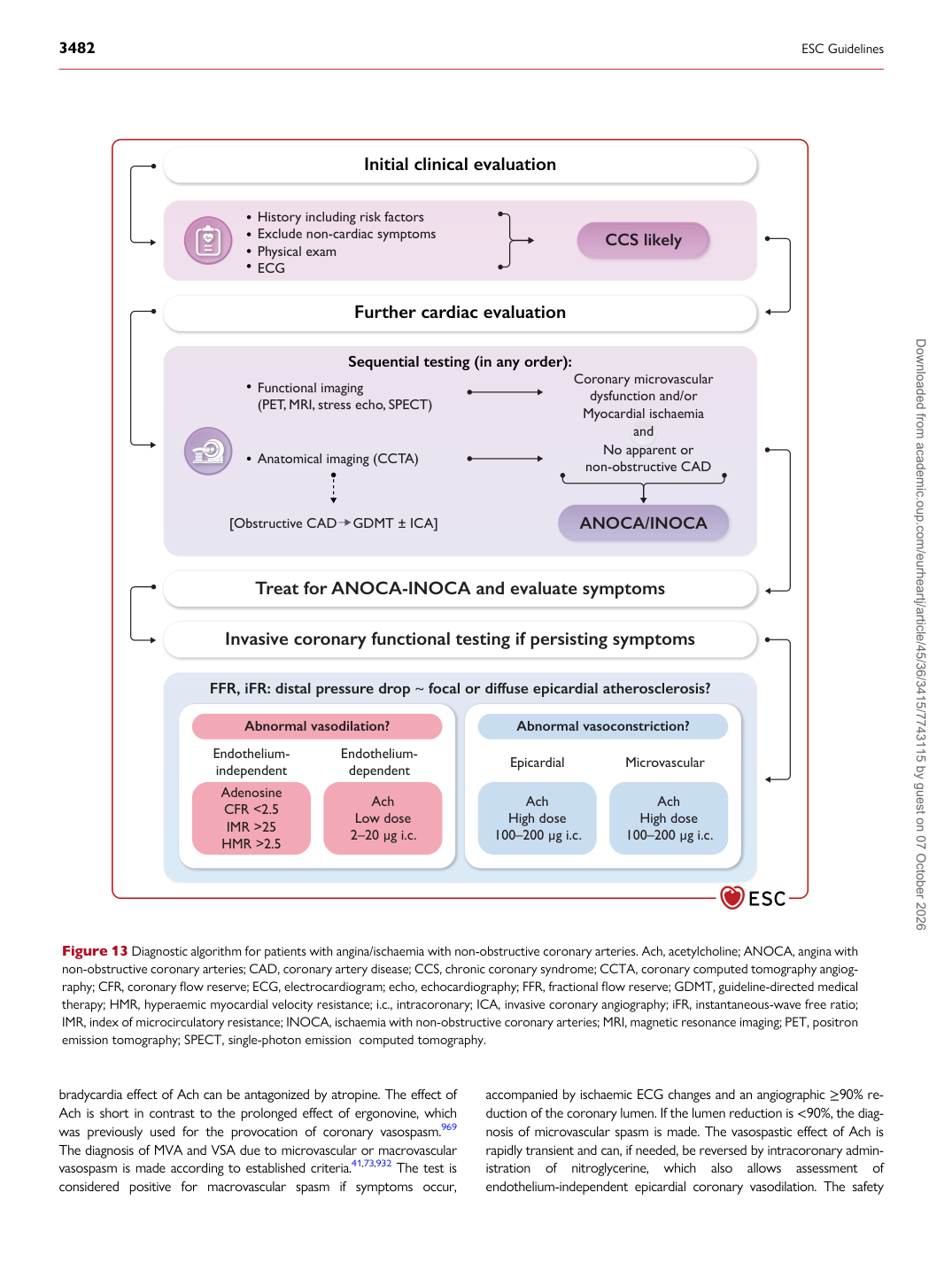
Figure 13 Diagnostic algorithm for patients with angina/ischaemia with non-obstructive coronary arteries. Ach, acetylcholine; ANOCA, angina with non-obstructive coronary arteries; CAD, coronary artery disease; CCS, chronic coronary syndrome; CCTA, coronary computed tomography angiography; CFR, coronary flow reserve; ECG, electrocardiogram; echo, echocardiography; FFR, fractional flow reserve; GDMT, guideline-directed medical therapy; HMR, hyperaemic myocardial velocity resistance; i.c., intracoronary; ICA, invasive coronary angiography; iFR, instantaneous-wave free ratio; IMR, index of microcirculatory resistance; INOCA, ischaemia with non-obstructive coronary arteries; MRI, magnetic resonance imaging; PET, positron emission tomography; SPECT, single-photon emission  computed tomography. Downloaded from academic.oup.com/eurheartj/article/45/36/3415/7743115 by guest on 07 October 2026