p.66 抽出テキスト
5.2.2.1 Microvascular angina

Microvascular angina is the clinical manifestation of myocardial ischaemia caused by structural or functional changes in the coronary microvasculature (leading to impaired CFR and/or reduced microcirculatory conductance) and/or abnormal vasoconstriction of coronary arterioles (causing dynamic arteriolar obstruction).932,933 Both vascular dysfunction mechanisms may co-exist and contribute to MVA. The prevalence of MVA was 26% in a study of patients with non-obstructive CAD who had a CFVR below 2 when assessed by transthoracic Doppler echocardiography.934 Studies assessing CMD invasively or by PET with different cut-offs have found that 39% to 54% had CMD.935,936 The threshold for CMD varies between studies and depending on the techniques used (PET, CMR, thermodilution, or Doppler); the threshold is a CFR of <2.0–2.5.36,39 A thermodilution CFR of <2.0 has low sensitivity for identifying CMD, but using the same threshold as for Doppler (<2.5) results in reasonable diagnostic accuracy.937

Smoking, age, diabetes, hypertension, and dyslipidaemia are associated with CMD.934,935,938 Other studies have shown that diabetes was uncommon among patients with angina and non-obstructive CAD, while hypertension and dyslipidaemia were relatively more prevalent.939,940 Inflammatory conditions such as systemic lupus erythematosus (SLE) and rheumatoid arthritis appear to be associated with MVA and are not infrequently encountered in patients with angina.941 Inflammatory diseases occur more often in women after menopause than in men, which may contribute to the sex differences in MVA.942–944 Last, but not least, there is increasing evidence that psychosocial stress is involved in coronary vasomotor disorders.945,946

Obstructive CAD

Coronary risk

factors Detectable demand

ischaemia INOCA

ANOCA

50–70% 30–50% Ischaemiaa

Abnormal vasodilation

(CFR <2.5)

Vasospasm on Ach

Endothelial dysfunction

Non-obstructive or no apparent CAD 30–50% 50–70% 25% 50% 60%

80%

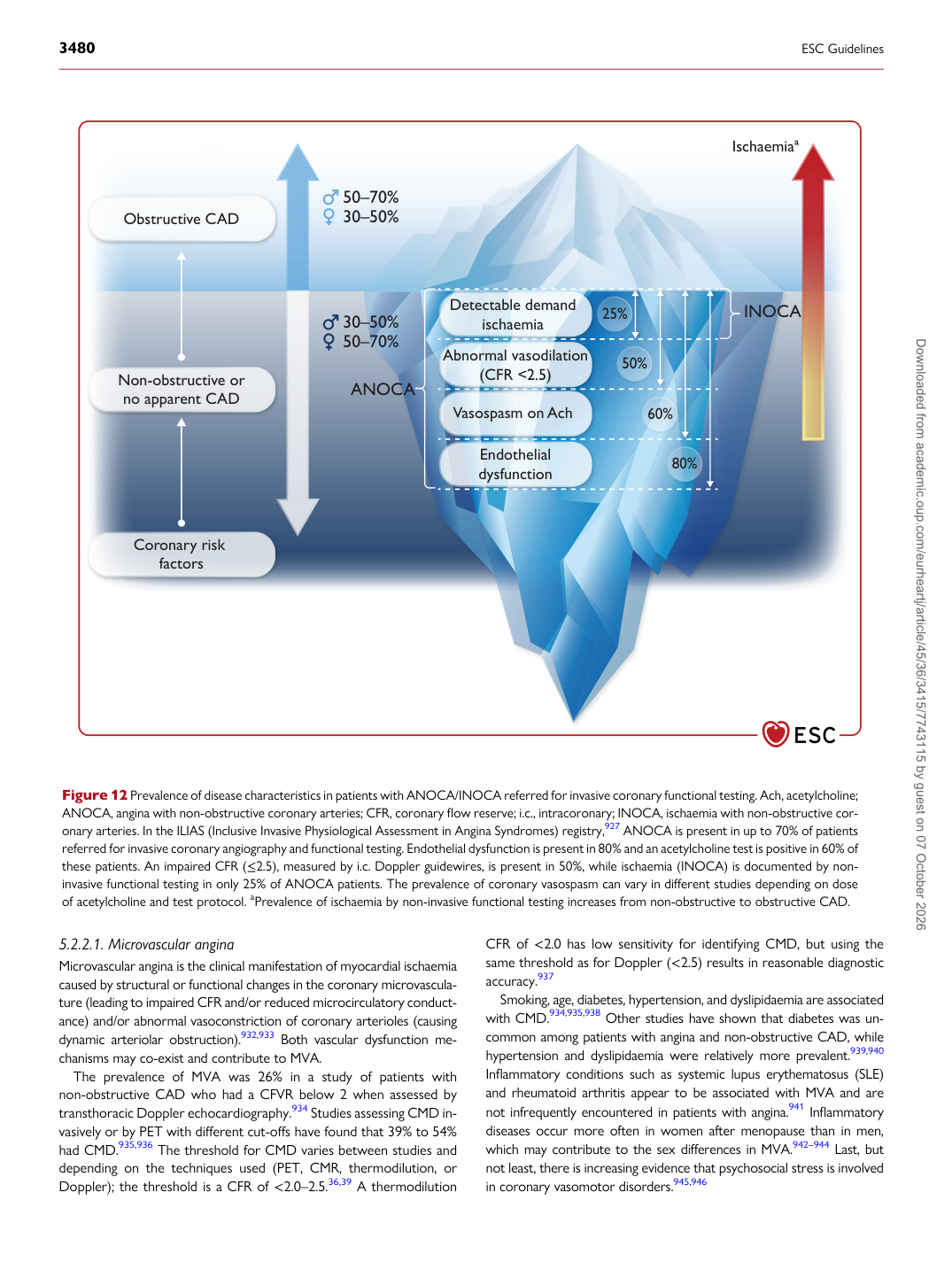
Figure 12 Prevalence of disease characteristics in patients with ANOCA/INOCA referred for invasive coronary functional testing. Ach, acetylcholine; ANOCA, angina with non-obstructive coronary arteries; CFR, coronary flow reserve; i.c., intracoronary; INOCA, ischaemia with non-obstructive coronary arteries. In the ILIAS (Inclusive Invasive Physiological Assessment in Angina Syndromes) registry,927 ANOCA is present in up to 70% of patients referred for invasive coronary angiography and functional testing. Endothelial dysfunction is present in 80% and an acetylcholine test is positive in 60% of these patients. An impaired CFR (≤2.5), measured by i.c. Doppler guidewires, is present in 50%, while ischaemia (INOCA) is documented by noninvasive functional testing in only 25% of ANOCA patients. The prevalence of coronary vasospasm can vary in different studies depending on dose of acetylcholine and test protocol. aPrevalence of ischaemia by non-invasive functional testing increases from non-obstructive to obstructive CAD. Downloaded from academic.oup.com/eurheartj/article/45/36/3415/7743115 by guest on 07 October 2026