p.65 抽出テキスト
5.2 Angina/ischaemia with

non-obstructive coronary arteries 5.2.1. Definition A large proportion of patients undergoing coronary angiography because of angina do not have obstructive epicardial coronary arteries (ANOCA). In these patients, the prevalence of demonstrable ischaemia (INOCA) varies, depending on the stress test performed, between 10% and 30% (Figure 12).926–928 Angina/ischaemia with non-obstructive coronary arteries is more frequent among women (approximately 50% to 70%) than in men (30% to 50%) referred for ICA.7,929 The mismatch between blood supply and myocardial oxygen demands leading to angina and ischaemia in ANOCA/INOCA may be caused by CMD and/ or epicardial coronary artery spasm.36 However, these conditions are rarely correctly diagnosed, and, therefore, no tailored therapy is prescribed for these patients. As a consequence, these patients continue to experience recurrent angina with poor QoL, leading to repeated hospitalizations, unnecessary repeat coronary angiography, and adverse cardiovascular outcomes in the short and long term.36 5.2.2 Angina/ischaemia with non-obstructive

coronary arteries endotypes Invasive functional coronary testing using Ach and adenosine in individuals suspected of CCS and with non-obstructive coronary arteries enables the differentiation of the following endotypes: (i) endothelial dysfunction; (ii) impaired vasodilation (low coronary flow reserve and/ or high microvascular resistance); (iii) epicardial vasospastic angina; (iv) microvascular vasospastic angina; (v) endotype combinations; (vi) equivocal response, i.e. angina without fulfilling any endotype criteria.37,38 The prevalence of ANOCA and INOCA in relation to the presence of the endotypes is shown in Figure 12. Angina with non-obstructive coronary arteries occurs in up to 70% of the patients undergoing ICA, of whom 25% have documented ischaemia (INOCA). Among the patients who are tested with Ach, 80% show endothelial dysfunction, 60% have MVA/VSA, and 50% have an impaired CFR and/or high microvascular resistance.38,927,930,931 This emphasizes the importance of testing not only patients with INOCA but also all patients with ANOCA to determine the final endotype so that appropriate treatment can be initiated.

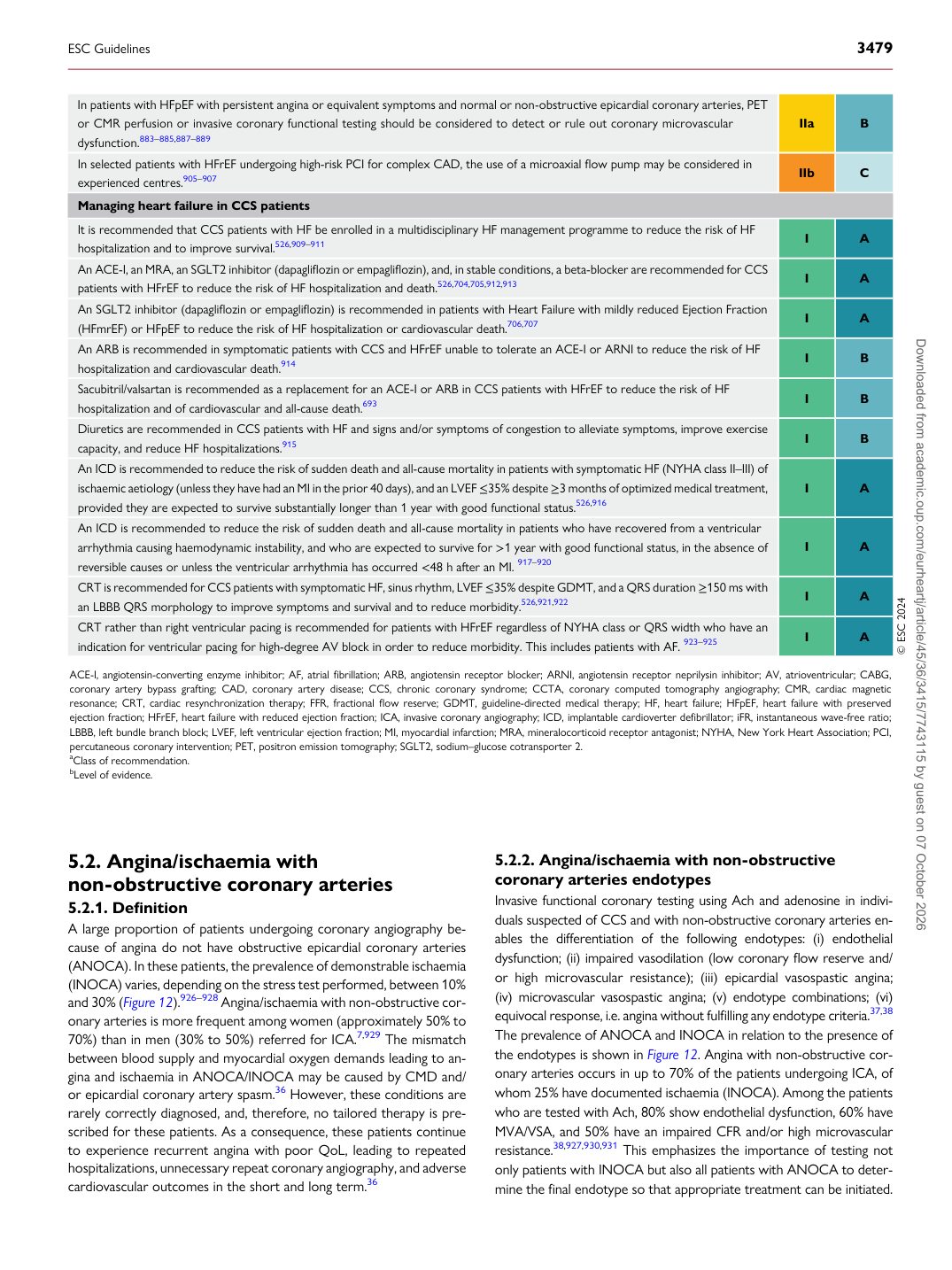
In patients with HFpEF with persistent angina or equivalent symptoms and normal or non-obstructive epicardial coronary arteries, PET or CMR perfusion or invasive coronary functional testing should be considered to detect or rule out coronary microvascular dysfunction.883–885,887–889 IIa B In selected patients with HFrEF undergoing high-risk PCI for complex CAD, the use of a microaxial flow pump may be considered in experienced centres.905–907 IIb C Managing heart failure in CCS patients It is recommended that CCS patients with HF be enrolled in a multidisciplinary HF management programme to reduce the risk of HF hospitalization and to improve survival.526,909–911 I A An ACE-I, an MRA, an SGLT2 inhibitor (dapagliflozin or empagliflozin), and, in stable conditions, a beta-blocker are recommended for CCS patients with HFrEF to reduce the risk of HF hospitalization and death.526,704,705,912,913 I A An SGLT2 inhibitor (dapagliflozin or empagliflozin) is recommended in patients with Heart Failure with mildly reduced Ejection Fraction (HFmrEF) or HFpEF to reduce the risk of HF hospitalization or cardiovascular death.706,707 I A An ARB is recommended in symptomatic patients with CCS and HFrEF unable to tolerate an ACE-I or ARNI to reduce the risk of HF hospitalization and cardiovascular death.914 I B Sacubitril/valsartan is recommended as a replacement for an ACE-I or ARB in CCS patients with HFrEF to reduce the risk of HF hospitalization and of cardiovascular and all-cause death.693 I B Diuretics are recommended in CCS patients with HF and signs and/or symptoms of congestion to alleviate symptoms, improve exercise capacity, and reduce HF hospitalizations.915 I B An ICD is recommended to reduce the risk of sudden death and all-cause mortality in patients with symptomatic HF (NYHA class II–III) of ischaemic aetiology (unless they have had an MI in the prior 40 days), and an LVEF ≤35% despite ≥3 months of optimized medical treatment, provided they are expected to survive substantially longer than 1 year with good functional status.526,916 I A An ICD is recommended to reduce the risk of sudden death and all-cause mortality in patients who have recovered from a ventricular arrhythmia causing haemodynamic instability, and who are expected to survive for >1 year with good functional status, in the absence of reversible causes or unless the ventricular arrhythmia has occurred <48 h after an MI. 917–920 I A CRT is recommended for CCS patients with symptomatic HF, sinus rhythm, LVEF ≤35% despite GDMT, and a QRS duration ≥150 ms with an LBBB QRS morphology to improve symptoms and survival and to reduce morbidity.526,921,922 I A CRT rather than right ventricular pacing is recommended for patients with HFrEF regardless of NYHA class or QRS width who have an indication for ventricular pacing for high-degree AV block in order to reduce morbidity. This includes patients with AF. 923–925 I A © ESC 2024

ACE-I, angiotensin-converting enzyme inhibitor; AF, atrial fibrillation; ARB, angiotensin receptor blocker; ARNI, angiotensin receptor neprilysin inhibitor; AV, atrioventricular; CABG, coronary artery bypass grafting; CAD, coronary artery disease; CCS, chronic coronary syndrome; CCTA, coronary computed tomography angiography; CMR, cardiac magnetic resonance; CRT, cardiac resynchronization therapy; FFR, fractional flow reserve; GDMT, guideline-directed medical therapy; HF, heart failure; HFpEF, heart failure with preserved ejection fraction; HFrEF, heart failure with reduced ejection fraction; ICA, invasive coronary angiography; ICD, implantable cardioverter defibrillator; iFR, instantaneous wave-free ratio; LBBB, left bundle branch block; LVEF, left ventricular ejection fraction; MI, myocardial infarction; MRA, mineralocorticoid receptor antagonist; NYHA, New York Heart Association; PCI, percutaneous coronary intervention; PET, positron emission tomography; SGLT2, sodium–glucose cotransporter 2. aClass of recommendation. bLevel of evidence.

ESC Guidelines                                                                                                                                                                                          3479

Downloaded from academic.oup.com/eurheartj/article/45/36/3415/7743115 by guest on 07 October 2026