p.64 抽出テキスト
5 Optimal assessment and

treatment of specific groups

5.1 Coronary artery disease and heart

failure About half of acute and chronic HF patients have an ischaemic aetiology.880,881 Over the last decades, the proportion of ischaemic HFrEF has decreased while that of HFpEF, defined according to the 2021 ESC Guidelines for the diagnosis and treatment of acute and chronic heart failure,526 has increased.882 The evaluation of inducible ischaemia is important in patients with HF, given the high prevalence of CAD.883–885 Moreover, patients with HFpEF may present MVA due to CMD.886 Indeed, CMD was observed in up to 75% of patients with HFpEF and was associated with worse diastolic relaxation velocities, as well as higher filling pressures, and an increased risk of adverse events.883–885,887–890 Clinical assessment alone may under-estimate the proportion of patients with obstructive or non-obstructive CAD, which can be found in up to 81% of HFpEF patients.887 Under-estimation of obstructive CAD leads to failure in identifying those patients who may benefit from revascularization. Conversely, in ANOCA patients with preserved LV function, a CFR of <2 was independently associated with diastolic dysfunction and future MACE, especially HFpEF events.891 This suggests that CMD and myocardial stiffness may contribute to HFpEF pathophysiology.892 In HFpEF patients, functional imaging should, therefore, be considered to detect CMD and epicardial CAD. Exercise or pharmacological stress echocardiography can be used for the assessment of inducible ischaemia and can also help in the differential diagnosis of HFpEF.893,894 Stress SPECT or PET can also be used for the detection of inducible ischaemia. Non-invasive stress testing can be difficult in patients with HF because of possible exercise intolerance. CCTA is recommended in patients with HF with a low-to-intermediate pre-test likelihood of obstructive CAD and those with equivocal non-invasive stress tests, provided there is no contraindication to contrast administration.894–898 In HFpEF patients, perfusion PET should be considered for the detection of CMD.891 In patients with HFrEF and moderate-to-severe inducible myocardial ischaemia, surgical revascularization improved long-term survival.54,315 The results of the REVIVED-BCIS2 trial seem to contradict these findings, as PCI did not reduce mortality or HF hospitalization in patients with severe LV systolic dysfunction (LVEF ≤ 35%) receiving optimal medical therapy.729 The same trial also revealed that viability testing did not offer any prognostic benefit.755 The role of myocardial revascularization and viability testing is further addressed in Section 4.4.2.

In HF patients with anginal (or equivalent) symptoms, despite optimized GDMT, CCTA or ICA is recommended to confirm the diagnosis of obstructive CAD and its severity. Over the past three decades, several landmark clinical trials have provided robust evidence on the prognostic benefit of pharmacological therapies in patients with HFrEF. In these patients, four drug classes [ACE-Is or angiotensin receptor neprilysin inhibitors (ARNIs),891 betablockers, mineralocorticoid receptor antagonists (MRAs), and SGLT2 inhibitors] are recommended for outcome improvement regardless of HF aetiology and comorbidities, including CAD.526 In patients with HFrEF, an ARB is recommended in patients who do not tolerate ACE-Is or ARNIs. Also, ivabradine should be considered in addition to the four pillars. It can be used as an alternative to betablockers, when contraindicated or not tolerated, or as additional antianginal therapy in patients with sinus rhythm and heart rate of >70 b.p.m.899 Other antianginal drugs (e.g. amlodipine, felodipine, nicorandil, trimetazidine, ranolazine, and nitrates) are effective for improving symptoms in patients with HFrEF.546,900–902 Diltiazem and verapamil increase HF-related events in patients with HFrEF and are contraindicated.526 In patients with LVEF ≤35% of ischaemic aetiology, an ICD is strongly recommended for primary prevention; in those with LVEF ≤35% and QRS >130 ms, CRT needs to be considered.526 Further details regarding the management of patients with HFrEF are reported in the 2021 ESC Guidelines for the diagnosis and treatment of acute and chronic heart failure.526 In patients with HFpEF, in addition to diuretics for treating congestion, SGLT2 inhibitors are now recommended for outcome improvement.709 Additionally, beta-blockers, long-acting nitrates, CCBs, ivabradine, ranolazine, trimetazidine, nicorandil, and their combinations should be considered in patients with HFpEF and CAD for angina relief, but without foreseen benefits on HF and coronary endpoints. Low-dose rivaroxaban may be considered in patients with CAD and HF, LVEF of >40%, and sinus rhythm when at high risk of stroke and with low haemorrhagic risk.526,903,904 Evidence and recommendations for myocardial revascularization in patients with HF are reported in Section 4.4.2. Notably, patients with advanced HF may be candidates for LV assistance devices and/or heart transplantation.526 During of high-risk PCI for complex CAD905 in patients with HFrEF, mechanical cardiac support, such as the microaxial flow pump, may minimize the risk of severe complications and provide haemodynamic stability, facilitating the achievement of complete revascularization.906,907

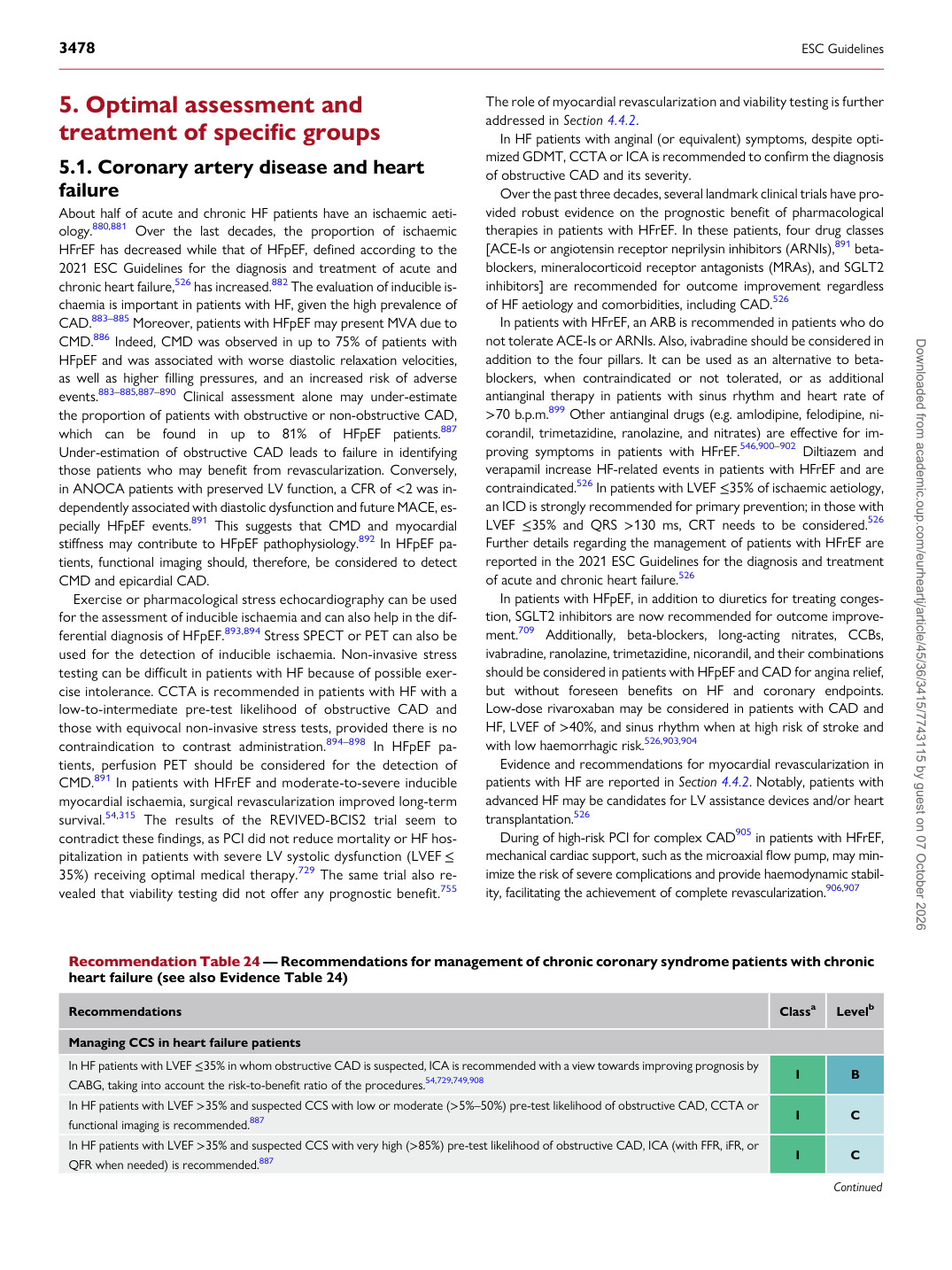
Recommendation Table 24 — Recommendations for management of chronic coronary syndrome patients with chronic heart failure (see also Evidence Table 24)

Recommendations Classa Levelb

Managing CCS in heart failure patients In HF patients with LVEF ≤35% in whom obstructive CAD is suspected, ICA is recommended with a view towards improving prognosis by CABG, taking into account the risk-to-benefit ratio of the procedures.54,729,749,908 I B In HF patients with LVEF >35% and suspected CCS with low or moderate (>5%–50%) pre-test likelihood of obstructive CAD, CCTA or functional imaging is recommended.887 I C In HF patients with LVEF >35% and suspected CCS with very high (>85%) pre-test likelihood of obstructive CAD, ICA (with FFR, iFR, or QFR when needed) is recommended.887 I C

Continued Downloaded from academic.oup.com/eurheartj/article/45/36/3415/7743115 by guest on 07 October 2026