p.63 抽出テキスト
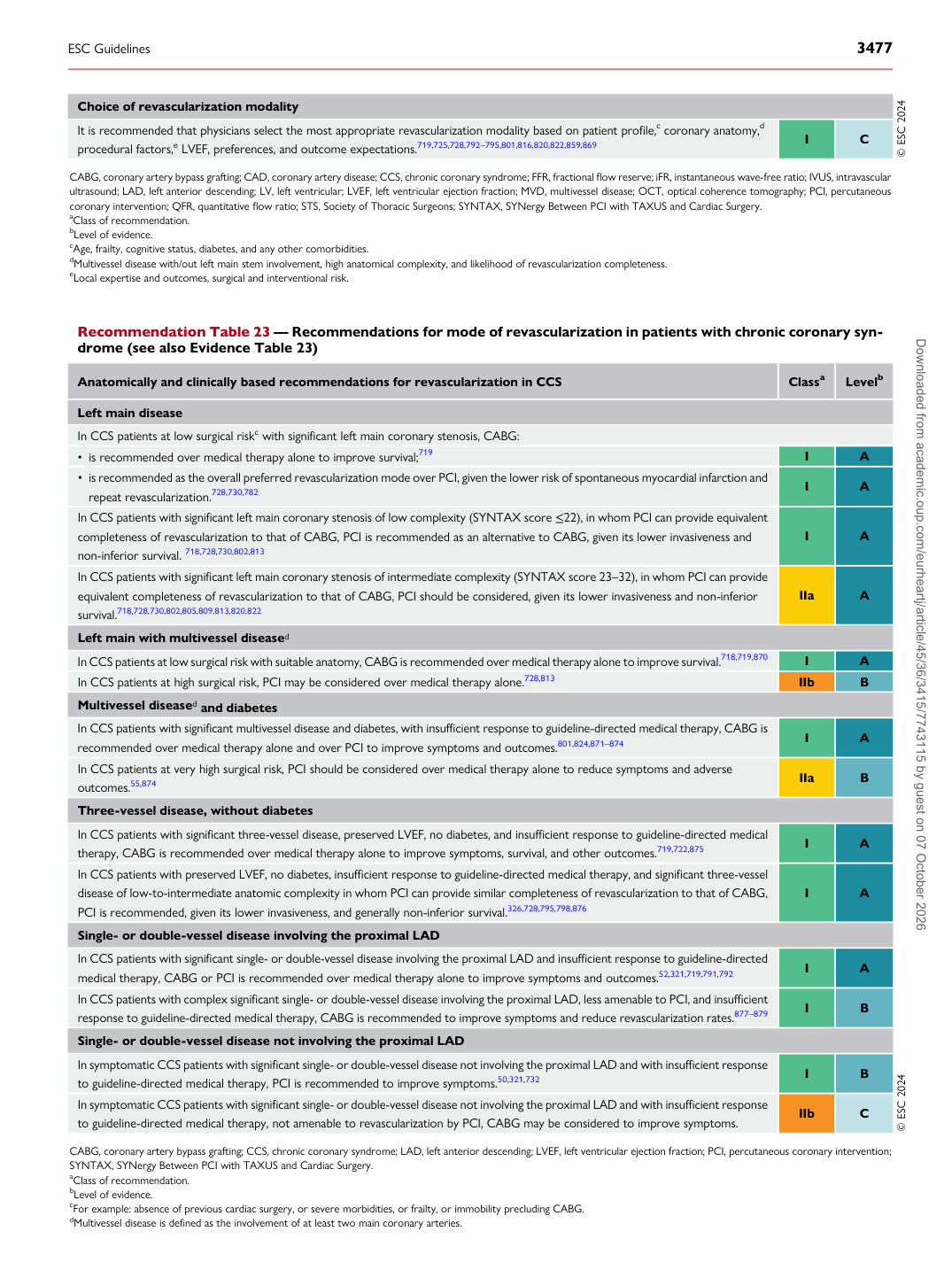
Choice of revascularization modality It is recommended that physicians select the most appropriate revascularization modality based on patient profile,c coronary anatomy,d procedural factors,e LVEF, preferences, and outcome expectations.719,725,728,792–795,801,816,820,822,859,869 I C © ESC 2024

CABG, coronary artery bypass grafting; CAD, coronary artery disease; CCS, chronic coronary syndrome; FFR, fractional flow reserve; iFR, instantaneous wave-free ratio; IVUS, intravascular ultrasound; LAD, left anterior descending; LV, left ventricular; LVEF, left ventricular ejection fraction; MVD, multivessel disease; OCT, optical coherence tomography; PCI, percutaneous coronary intervention; QFR, quantitative flow ratio; STS, Society of Thoracic Surgeons; SYNTAX, SYNergy Between PCI with TAXUS and Cardiac Surgery. aClass of recommendation. bLevel of evidence. cAge, frailty, cognitive status, diabetes, and any other comorbidities. dMultivessel disease with/out left main stem involvement, high anatomical complexity, and likelihood of revascularization completeness. eLocal expertise and outcomes, surgical and interventional risk.

Recommendation Table 23 — Recommendations for mode of revascularization in patients with chronic coronary syndrome (see also Evidence Table 23)

Anatomically and clinically based recommendations for revascularization in CCS Classa Levelb

Left main disease In CCS patients at low surgical riskc with significant left main coronary stenosis, CABG: • is recommended over medical therapy alone to improve survival;719 I A • is recommended as the overall preferred revascularization mode over PCI, given the lower risk of spontaneous myocardial infarction and

repeat revascularization.728,730,782 I A In CCS patients with significant left main coronary stenosis of low complexity (SYNTAX score ≤22), in whom PCI can provide equivalent completeness of revascularization to that of CABG, PCI is recommended as an alternative to CABG, given its lower invasiveness and non-inferior survival. 718,728,730,802,813 I A In CCS patients with significant left main coronary stenosis of intermediate complexity (SYNTAX score 23–32), in whom PCI can provide equivalent completeness of revascularization to that of CABG, PCI should be considered, given its lower invasiveness and non-inferior survival.718,728,730,802,805,809,813,820,822 IIa A Left main with multivessel diseased In CCS patients at low surgical risk with suitable anatomy, CABG is recommended over medical therapy alone to improve survival.718,719,870 I A In CCS patients at high surgical risk, PCI may be considered over medical therapy alone.728,813 IIb B Multivessel diseased and diabetes In CCS patients with significant multivessel disease and diabetes, with insufficient response to guideline-directed medical therapy, CABG is recommended over medical therapy alone and over PCI to improve symptoms and outcomes.801,824,871–874 I A In CCS patients at very high surgical risk, PCI should be considered over medical therapy alone to reduce symptoms and adverse outcomes.55,874 IIa B Three-vessel disease, without diabetes In CCS patients with significant three-vessel disease, preserved LVEF, no diabetes, and insufficient response to guideline-directed medical therapy, CABG is recommended over medical therapy alone to improve symptoms, survival, and other outcomes.719,722,875 I A In CCS patients with preserved LVEF, no diabetes, insufficient response to guideline-directed medical therapy, and significant three-vessel disease of low-to-intermediate anatomic complexity in whom PCI can provide similar completeness of revascularization to that of CABG, PCI is recommended, given its lower invasiveness, and generally non-inferior survival.326,728,795,798,876 I A Single- or double-vessel disease involving the proximal LAD In CCS patients with significant single- or double-vessel disease involving the proximal LAD and insufficient response to guideline-directed medical therapy, CABG or PCI is recommended over medical therapy alone to improve symptoms and outcomes.52,321,719,791,792 I A In CCS patients with complex significant single- or double-vessel disease involving the proximal LAD, less amenable to PCI, and insufficient response to guideline-directed medical therapy, CABG is recommended to improve symptoms and reduce revascularization rates.877–879 I B Single- or double-vessel disease not involving the proximal LAD In symptomatic CCS patients with significant single- or double-vessel disease not involving the proximal LAD and with insufficient response to guideline-directed medical therapy, PCI is recommended to improve symptoms.50,321,732 I B In symptomatic CCS patients with significant single- or double-vessel disease not involving the proximal LAD and with insufficient response to guideline-directed medical therapy, not amenable to revascularization by PCI, CABG may be considered to improve symptoms. IIb C © ESC 2024

CABG, coronary artery bypass grafting; CCS, chronic coronary syndrome; LAD, left anterior descending; LVEF, left ventricular ejection fraction; PCI, percutaneous coronary intervention; SYNTAX, SYNergy Between PCI with TAXUS and Cardiac Surgery. aClass of recommendation. bLevel of evidence. cFor example: absence of previous cardiac surgery, or severe morbidities, or frailty, or immobility precluding CABG. dMultivessel disease is defined as the involvement of at least two main coronary arteries.

ESC Guidelines                                                                                                                                                                                          3477

Downloaded from academic.oup.com/eurheartj/article/45/36/3415/7743115 by guest on 07 October 2026