p.62 抽出テキスト
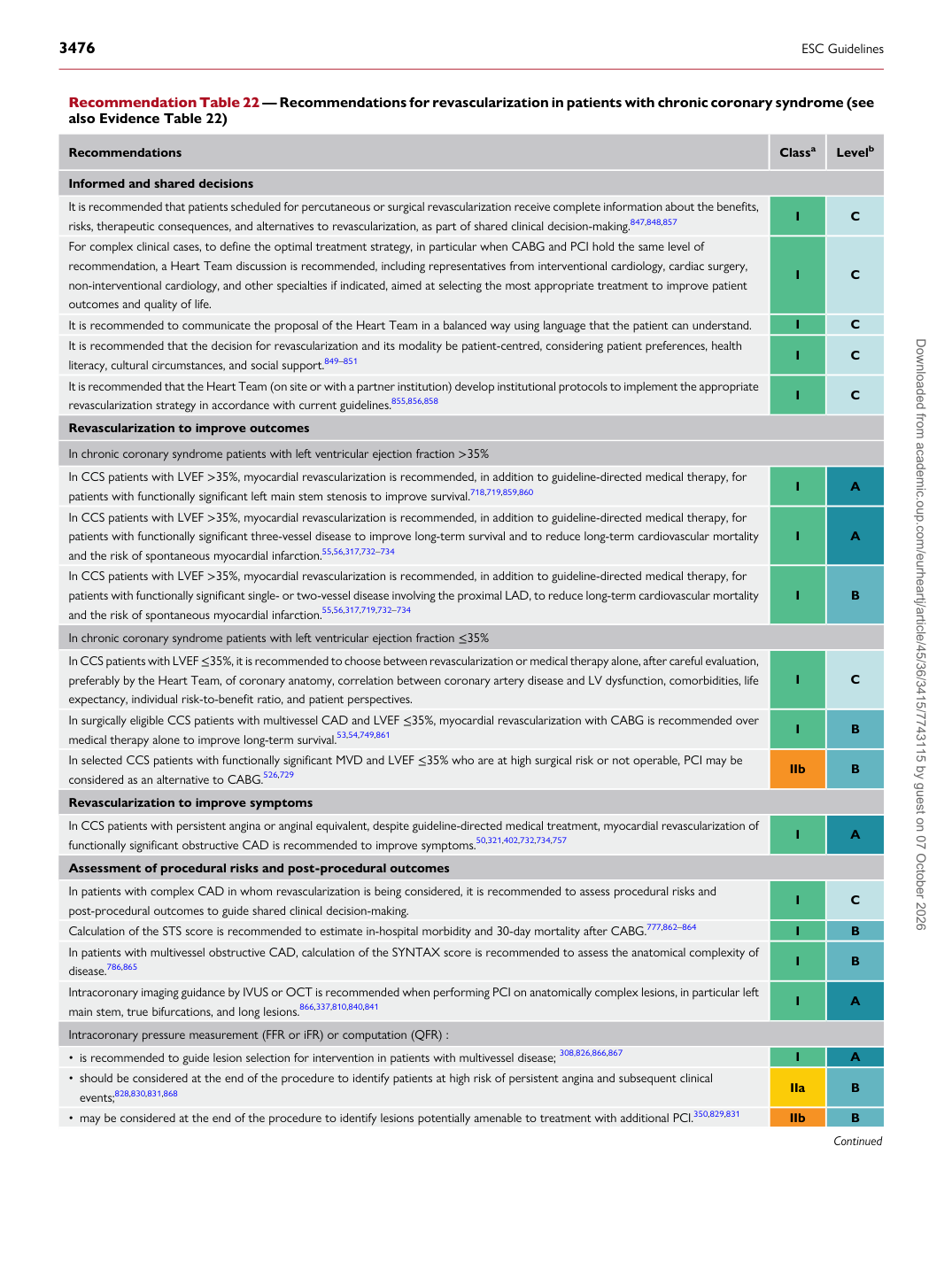
Recommendation Table 22 — Recommendations for revascularization in patients with chronic coronary syndrome (see also Evidence Table 22)

Recommendations Classa Levelb

Informed and shared decisions It is recommended that patients scheduled for percutaneous or surgical revascularization receive complete information about the benefits, risks, therapeutic consequences, and alternatives to revascularization, as part of shared clinical decision-making.847,848,857 I C For complex clinical cases, to define the optimal treatment strategy, in particular when CABG and PCI hold the same level of recommendation, a Heart Team discussion is recommended, including representatives from interventional cardiology, cardiac surgery, non-interventional cardiology, and other specialties if indicated, aimed at selecting the most appropriate treatment to improve patient outcomes and quality of life. I C It is recommended to communicate the proposal of the Heart Team in a balanced way using language that the patient can understand. I C It is recommended that the decision for revascularization and its modality be patient-centred, considering patient preferences, health literacy, cultural circumstances, and social support.849–851 I C It is recommended that the Heart Team (on site or with a partner institution) develop institutional protocols to implement the appropriate revascularization strategy in accordance with current guidelines.855,856,858 I C Revascularization to improve outcomes In chronic coronary syndrome patients with left ventricular ejection fraction >35% In CCS patients with LVEF >35%, myocardial revascularization is recommended, in addition to guideline-directed medical therapy, for patients with functionally significant left main stem stenosis to improve survival.718,719,859,860 I A In CCS patients with LVEF >35%, myocardial revascularization is recommended, in addition to guideline-directed medical therapy, for patients with functionally significant three-vessel disease to improve long-term survival and to reduce long-term cardiovascular mortality and the risk of spontaneous myocardial infarction.55,56,317,732–734 I A In CCS patients with LVEF >35%, myocardial revascularization is recommended, in addition to guideline-directed medical therapy, for patients with functionally significant single- or two-vessel disease involving the proximal LAD, to reduce long-term cardiovascular mortality and the risk of spontaneous myocardial infarction.55,56,317,719,732–734 I B In chronic coronary syndrome patients with left ventricular ejection fraction ≤35% In CCS patients with LVEF ≤35%, it is recommended to choose between revascularization or medical therapy alone, after careful evaluation, preferably by the Heart Team, of coronary anatomy, correlation between coronary artery disease and LV dysfunction, comorbidities, life expectancy, individual risk-to-benefit ratio, and patient perspectives. I C In surgically eligible CCS patients with multivessel CAD and LVEF ≤35%, myocardial revascularization with CABG is recommended over medical therapy alone to improve long-term survival.53,54,749,861 I B In selected CCS patients with functionally significant MVD and LVEF ≤35% who are at high surgical risk or not operable, PCI may be considered as an alternative to CABG.526,729 IIb B Revascularization to improve symptoms In CCS patients with persistent angina or anginal equivalent, despite guideline-directed medical treatment, myocardial revascularization of functionally significant obstructive CAD is recommended to improve symptoms.50,321,402,732,734,757 I A Assessment of procedural risks and post-procedural outcomes In patients with complex CAD in whom revascularization is being considered, it is recommended to assess procedural risks and post-procedural outcomes to guide shared clinical decision-making. I C Calculation of the STS score is recommended to estimate in-hospital morbidity and 30-day mortality after CABG.777,862–864 I B In patients with multivessel obstructive CAD, calculation of the SYNTAX score is recommended to assess the anatomical complexity of disease.786,865 I B Intracoronary imaging guidance by IVUS or OCT is recommended when performing PCI on anatomically complex lesions, in particular left main stem, true bifurcations, and long lesions.866,337,810,840,841 I A Intracoronary pressure measurement (FFR or iFR) or computation (QFR) : • is recommended to guide lesion selection for intervention in patients with multivessel disease; 308,826,866,867 I A • should be considered at the end of the procedure to identify patients at high risk of persistent angina and subsequent clinical

events;828,830,831,868 IIa B • may be considered at the end of the procedure to identify lesions potentially amenable to treatment with additional PCI.350,829,831 IIb B

Continued Downloaded from academic.oup.com/eurheartj/article/45/36/3415/7743115 by guest on 07 October 2026