p.55 抽出テキスト
cardiac arrest, non-fatal MI, non-fatal stroke, or unstable angina-driven revascularization occurred in 5.5% on colchicine vs. 7.1% on placebo (HR 0.77; 95% CI, 0.61–0.96; P = .02). Colchicine had favourable effects on each outcome component. All-cause mortality did not differ (43 vs. 44 events). Diarrhoea was reported in 9.7% vs. 8.9% (statistically nonsignificant); pneumonia, although not frequent, was recorded more often with colchicine than placebo (0.9% vs. 0.4%; P = .03). The LODOCO2 trial (Low-Dose Colchicine 2) randomized 5500 patients with atherosclerotic CAD who had been stable for at least 6 months to low-dose colchicine (0.5 mg daily) or placebo for a median of 2.4 years.715 The primary endpoint (cardiovascular death, spontaneous MI, ischaemic stroke, or ischaemia-driven revascularization) occurred in 6.8% on colchicine vs. 9.6% on placebo (HR 0.69; 95% CI, 0.57–0.83; P < .001). The main secondary endpoint (cardiovascular death, non-fatal MI, or non-fatal stroke) was reduced by 28% (4.2% on colchicine vs. 5.7% on placebo; HR 0.72; 95% CI, 0.57–0.92; P = .007). There were no significant differences in rates of pneumonia or GI disorders. The incidence of non-cardiovascular death was nominally higher, but not statistically significant (0.7 vs. 0.5 events per 100 person-years; HR 1.51; 95% CI, 0.99–2.31). A recent meta-analysis including over 12 000 patients with atherothrombotic CAD716 has estimated the treatment effects of colchicine vs. placebo for individual outcome components. Significantly lower risks were found for MI (RR, 0.76; 95% CI, 0.61–0.96), stroke (RR, 0.48; 95% CI, 0.30–0.77) and unstable angina-driven revascularization (RR, 0.61; 95% CI, 0.42–0.89), with no significant difference for cardiovascular death (RR, 0.73; 95% CI, 0.45–1.21), all-cause death (RR, 1.01; 95% CI, 0.71–1.43), or GI events (provided colchicine daily dose did not exceed 0.5 mg; RR, 1.02; 95% CI, 0.92–1.14). 4.4 Revascularization for chronic coronary

syndromes Invasive treatment of CAD with either CABG or PCI is historically described under the term revascularization. Although both procedures increase CFC365,366 and prevent myocardial ischaemia during exercise or emotional stress, they do not heal coronary atherosclerosis. Revascularization by both modalities improves angina-related health status.50,52,717 Randomized and meta-analytical evidence supports a survival benefit above medical therapy for CABG in patients with left main disease,718–721 as well as three-vessel disease,722 particularly in patients with LV dysfunction.719,723,724 Most of this evidence was obtained prior to the introduction of disease-modifying therapies such as ACE-Is/ ARBs and statins. Meta-analytical evidence suggests a potential benefit of PCI on cardiovascular survival,55,725,726 which, similarly to CABG, appears to be related to the prevention of MI.55,727 In general, among surgically eligible patients with multivessel disease, CABG is superior to PCI and to medical therapy, particularly in those with diabetes and higher coronary complexity.727,728 Recent evidence has generated controversy on (i) the value of routine early revascularization compared with optimal medical therapy alone,47,56,314,729 (ii) the value of PCI vs. CABG for complex CAD,326,730 and (iii) the value of ischaemia testing for decision-making in revascularization.315,317,726 At the same time, advances in interventional technologies and medications have expanded the application of PCI to more complex forms of CAD.731

4.4.1 Appropriate indication for myocardial

revascularization In CAD patients with moderate or severe inducible ischaemia but no left main disease nor LVEF of <35%, the largest-to-date ISCHEMIA trial, up to 5 years, did not show significant benefit of an initial invasive strategy over an initial conservative strategy for the primary endpoint of ischaemic cardiovascular events or death from any cause,47 triggering discussion about the role of initial angiography followed by revascularization when feasible, in this type of CCS patients, once optimal medical therapy has been established. The CLARIFY registry found that many CCS patients with angina experience a resolution of symptoms over time, often without changes in treatment or revascularization, and experience good outcomes.404 While these findings suggest that this type of CCS patients should initially receive conservative medical management, it is worth noting that patients who were randomly assigned to the invasive strategy in the ISCHEMIA trial experienced significantly lower rates of spontaneous MI and greater improvement in angina-related health status compared with those assigned to the conservative strategy.47,50 Furthermore, the ORBITA 2 trial demonstrated that patients with stable angina, who were receiving minimal or no antianginal medication and had objective evidence of ischaemia, experienced a lower angina symptom score following PCI treatment compared with a placebo procedure, indicating a better health status with respect to angina.52 Although initial conservative medical management of CCS patients is generally preferred, symptom improvement by revascularization should therefore not be neglected if patients remain symptomatic despite antianginal treatment. After publication of the ISCHEMIA trial results, several metaanalyses have reported similar overall survival and inevitably higher rates of procedural MI with routine revascularization, while confirming consistently greater freedom from spontaneous MI, unstable angina, and anginal symptoms after revascularization compared with GDMT alone.732–734 Of note, these meta-analyses showed some differences in methodology, in selected trials, and follow-up duration.

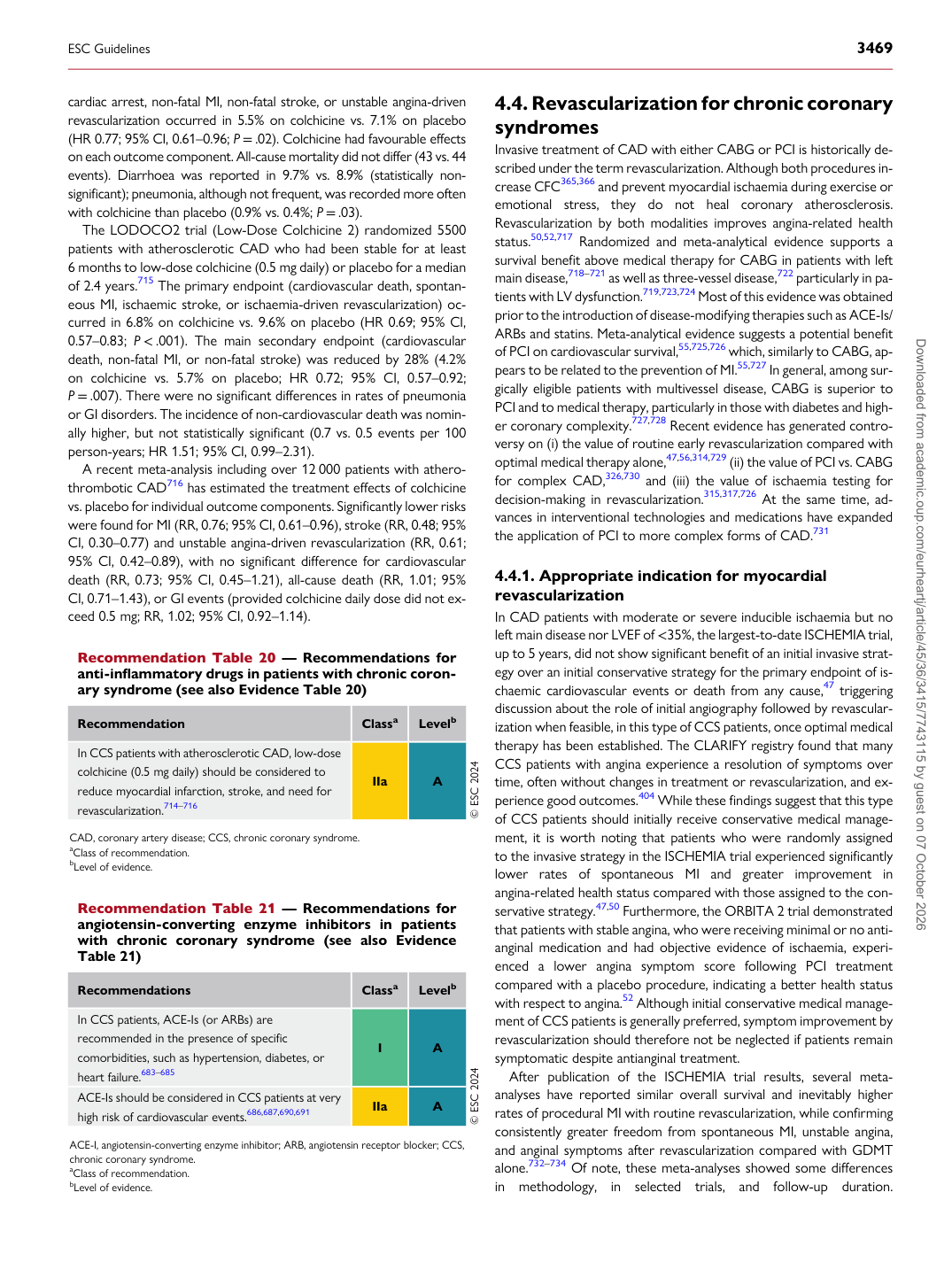
Recommendation Table 20 — Recommendations for anti-inflammatory drugs in patients with chronic coronary syndrome (see also Evidence Table 20)

Recommendation Classa Levelb

In CCS patients with atherosclerotic CAD, low-dose colchicine (0.5 mg daily) should be considered to reduce myocardial infarction, stroke, and need for revascularization.714–716 IIa A © ESC 2024

CAD, coronary artery disease; CCS, chronic coronary syndrome. aClass of recommendation. bLevel of evidence.

Recommendation Table 21 — Recommendations for angiotensin-converting enzyme inhibitors in patients with chronic coronary syndrome (see also Evidence Table 21)

Recommendations Classa Levelb

In CCS patients, ACE-Is (or ARBs) are recommended in the presence of specific comorbidities, such as hypertension, diabetes, or heart failure.683–685 I A ACE-Is should be considered in CCS patients at very high risk of cardiovascular events.686,687,690,691 IIa A © ESC 2024

ACE-I, angiotensin-converting enzyme inhibitor; ARB, angiotensin receptor blocker; CCS, chronic coronary syndrome. aClass of recommendation. bLevel of evidence.

ESC Guidelines                                                                                                                                                                                          3469

Downloaded from academic.oup.com/eurheartj/article/45/36/3415/7743115 by guest on 07 October 2026