p.54 抽出テキスト
with placebo, but not when compared with active control treatment.691 For this reason ACE-I therapy in CCS patients without HF or high cardiovascular risk is not generally recommended, unless required to meet BP targets. However, a new observational study showed that ACE-I/ARB therapy was associated with significant longterm survival benefit in patients post-PCI for STEMI/non-ST-segment elevation myocardial infarction (NSTEMI). This survival benefit is apparent in patients with both preserved and reduced LV function. These findings provide contemporary evidence to support the use of these agents in coronary patients who underwent PCI for STEMI/NSTEMI, irrespective of their baseline LV function.692 Sacubitril/valsartan contains an ARB and a prodrug of neprilysin inhibitor, which inhibits the degradation of endogenous natriuretic peptides. In patients with LVEF ≤35% (of ischaemic aetiology in 60%), sacubitril/valsartan proved to reduce HF hospitalization and cardiovascular death compared with ACE-I.693 Moreover, sacubitril/valsartan may decrease myocardial ischaemia because of its effect in reducing LV wall stress and improving coronary circulation. The risk of coronary events using sacubitril/valsartan compared with ACE-I was also significantly reduced on post-hoc analyses.694

4.3.4 Sodium–glucose cotransporter 2 inhibitors and

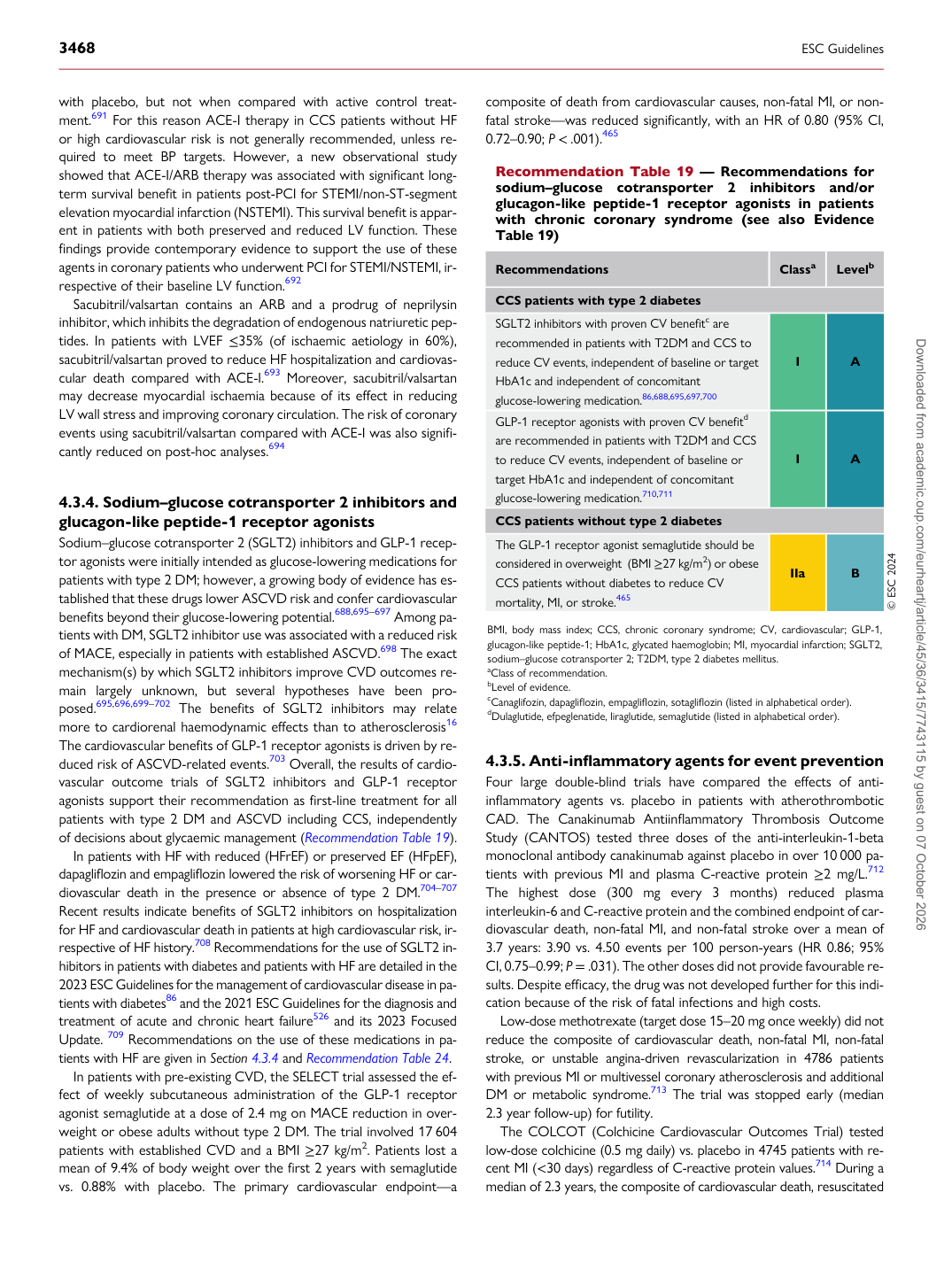
glucagon-like peptide-1 receptor agonists Sodium–glucose cotransporter 2 (SGLT2) inhibitors and GLP-1 receptor agonists were initially intended as glucose-lowering medications for patients with type 2 DM; however, a growing body of evidence has established that these drugs lower ASCVD risk and confer cardiovascular benefits beyond their glucose-lowering potential.688,695–697 Among patients with DM, SGLT2 inhibitor use was associated with a reduced risk of MACE, especially in patients with established ASCVD.698 The exact mechanism(s) by which SGLT2 inhibitors improve CVD outcomes remain largely unknown, but several hypotheses have been proposed.695,696,699–702 The benefits of SGLT2 inhibitors may relate more to cardiorenal haemodynamic effects than to atherosclerosis16 The cardiovascular benefits of GLP-1 receptor agonists is driven by reduced risk of ASCVD-related events.703 Overall, the results of cardiovascular outcome trials of SGLT2 inhibitors and GLP-1 receptor agonists support their recommendation as first-line treatment for all patients with type 2 DM and ASCVD including CCS, independently of decisions about glycaemic management (Recommendation Table 19). In patients with HF with reduced (HFrEF) or preserved EF (HFpEF), dapagliflozin and empagliflozin lowered the risk of worsening HF or cardiovascular death in the presence or absence of type 2 DM.704–707 Recent results indicate benefits of SGLT2 inhibitors on hospitalization for HF and cardiovascular death in patients at high cardiovascular risk, irrespective of HF history.708 Recommendations for the use of SGLT2 inhibitors in patients with diabetes and patients with HF are detailed in the 2023 ESC Guidelines for the management of cardiovascular disease in patients with diabetes86 and the 2021 ESC Guidelines for the diagnosis and treatment of acute and chronic heart failure526 and its 2023 Focused Update. 709 Recommendations on the use of these medications in patients with HF are given in Section 4.3.4 and Recommendation Table 24. In patients with pre-existing CVD, the SELECT trial assessed the effect of weekly subcutaneous administration of the GLP-1 receptor agonist semaglutide at a dose of 2.4 mg on MACE reduction in overweight or obese adults without type 2 DM. The trial involved 17 604 patients with established CVD and a BMI ≥27 kg/m2. Patients lost a mean of 9.4% of body weight over the first 2 years with semaglutide vs. 0.88% with placebo. The primary cardiovascular endpoint—a composite of death from cardiovascular causes, non-fatal MI, or nonfatal stroke—was reduced significantly, with an HR of 0.80 (95% CI, 0.72–0.90; P < .001).465

4.3.5 Anti-inflammatory agents for event prevention

Four large double-blind trials have compared the effects of antiinflammatory agents vs. placebo in patients with atherothrombotic CAD. The Canakinumab Antiinflammatory Thrombosis Outcome Study (CANTOS) tested three doses of the anti-interleukin-1-beta monoclonal antibody canakinumab against placebo in over 10 000 patients with previous MI and plasma C-reactive protein ≥2 mg/L.712 The highest dose (300 mg every 3 months) reduced plasma interleukin-6 and C-reactive protein and the combined endpoint of cardiovascular death, non-fatal MI, and non-fatal stroke over a mean of 3.7 years: 3.90 vs. 4.50 events per 100 person-years (HR 0.86; 95% CI, 0.75–0.99; P = .031). The other doses did not provide favourable results. Despite efficacy, the drug was not developed further for this indication because of the risk of fatal infections and high costs. Low-dose methotrexate (target dose 15–20 mg once weekly) did not reduce the composite of cardiovascular death, non-fatal MI, non-fatal stroke, or unstable angina-driven revascularization in 4786 patients with previous MI or multivessel coronary atherosclerosis and additional DM or metabolic syndrome.713 The trial was stopped early (median 2.3 year follow-up) for futility. The COLCOT (Colchicine Cardiovascular Outcomes Trial) tested low-dose colchicine (0.5 mg daily) vs. placebo in 4745 patients with recent MI (<30 days) regardless of C-reactive protein values.714 During a median of 2.3 years, the composite of cardiovascular death, resuscitated

Recommendation Table 19 — Recommendations for sodium–glucose cotransporter 2 inhibitors and/or glucagon-like peptide-1 receptor agonists in patients with chronic coronary syndrome (see also Evidence Table 19)

Recommendations Classa Levelb

CCS patients with type 2 diabetes SGLT2 inhibitors with proven CV benefitc are recommended in patients with T2DM and CCS to reduce CV events, independent of baseline or target HbA1c and independent of concomitant glucose-lowering medication.86,688,695,697,700 I A GLP-1 receptor agonists with proven CV benefitd are recommended in patients with T2DM and CCS to reduce CV events, independent of baseline or target HbA1c and independent of concomitant glucose-lowering medication.710,711 I A CCS patients without type 2 diabetes The GLP-1 receptor agonist semaglutide should be considered in overweight  (BMI ≥27 kg/m2) or obese CCS patients without diabetes to reduce CV mortality, MI, or stroke.465 IIa B © ESC 2024

BMI, body mass index; CCS, chronic coronary syndrome; CV, cardiovascular; GLP-1, glucagon-like peptide-1; HbA1c, glycated haemoglobin; MI, myocardial infarction; SGLT2, sodium–glucose cotransporter 2; T2DM, type 2 diabetes mellitus. aClass of recommendation. bLevel of evidence. cCanaglifozin, dapagliflozin, empagliflozin, sotagliflozin (listed in alphabetical order). dDulaglutide, efpeglenatide, liraglutide, semaglutide (listed in alphabetical order). Downloaded from academic.oup.com/eurheartj/article/45/36/3415/7743115 by guest on 07 October 2026