p.53 抽出テキスト
4.3.2 Lipid-lowering drugs

Evidence from genetic, epidemiological, and randomized clinical studies has established the key causal role of LDL-C and other apo-B-containing lipoproteins in the development of atherosclerotic disease.669 In patients with established ASCVD, lowering of LDL-C levels reduces the risk of recurrent MACE.128,670,671 Elevated lipid levels should be managed according to the 2019 ESC/EAS Guidelines for the management of dyslipidaemias64 and the 2021 ESC Guidelines on cardiovascular disease prevention in clinical practice.16 Because patients with CCS are considered at very high cardiovascular risk, the treatment goal is to lower LDL-C levels to <1.4 mmol/L (<55 mg/dL) and achieve a reduction by at least 50% from baseline. For patients who experience a second vascular event within 2 years while taking maximum tolerated statin-based therapy, an even lower LDL-C goal of <1.0 mmol/L (40 mg/dL) may be considered. In addition to exercise, diet, and weight control, which favourably affect blood lipid levels and are recommended for all patients with CCS (see Section 5.1), pharmacological treatment with a maximally tolerated dose of a potent statin is the first-line therapy recommended for all CCS patients.128,670,671 In a landmark meta-analysis involving patients with and without ASCVD, statin treatment was shown to reduce the risk of major vascular events by 22%, all-cause mortality by 10%, and mortality due to coronary heart disease by 20% per 1.0 mmol/L of achieved reduction in LDL-C levels.670 High-intensity statin treatment (i.e. atorvastatin ≥40 mg or rosuvastatin ≥20 mg daily) reduces LDL-C levels by 45%–50% on average, although interindividual variability exists.672 Statins should not be given when pregnancy is planned, during pregnancy, or during the breastfeeding period.64 In many patients with CCS, statin therapy alone will not suffice to achieve the recommended LDL-C goals;673 hence, a combination of lipid-lowering drug therapy is required. In a trial of patients with recent ACS, the combination of statin with ezetimibe resulted in additional reduction of LDL-C levels by 20%–25% compared with simvastatin monotherapy. This LDL-C reduction translated into a modest reduction of a composite endpoint involving fatal and non-fatal events (6.4% RR reduction, 2.0% absolute risk reduction).674 Ezetimibe should be used as second-line therapy when the treatment goal is not achieved with maximally tolerated statin therapy, or as first-line therapy in the case of intolerance to any statin regimen. Proprotein convertase subtilisin/kexin type 9 inhibitors (alirocumab or evolocumab), administered subcutaneously every 2 or 4 weeks, lower LDL-C levels by 60% when added to statin therapy.675 In cardiovascular outcomes trials, these monoclonal antibodies resulted in significant reduction of non-fatal cardiovascular events, with no impact on cardiovascular mortality.675,676 Their favourable safety profile was recently confirmed for longer follow-up (median 5 years) in open-label extension studies of the outcomes trials.677 The high cost of PCSK9 inhibitors is still a limitation for broader implementation. Bempedoic acid is an oral cholesterol synthesis inhibitor that lowers LDL-C by approximately 18% in monotherapy and 38% when combined with ezetimibe.678,679 In a recent cardiovascular outcomes trial including statin-intolerant patients, bempedoic acid significantly reduced MACE.680 Inclisiran, a small interfering ribonucleic acid molecule, is administered subcutaneously every 3–6 months and reduces LDL-C by approximately 50% either in combination with statin or without statin therapy.681 A cardiovascular outcomes trials for inclisiran is currently underway (ClinicalTrials.gov identifier: NCT03705234). In patients scheduled to undergo elective PCI, pre-treatment with a high-dose statin in statin-naïve patients or loading with high-dose statin in statin-treated patients has been shown to reduce the risk of periprocedural events.682 Routine pre-treatment or loading (in the context of pre-existing statin treatment) with a high-dose statin can be considered in patients with CCS undergoing PCI.

4.3.3 Renin–angiotensin–aldosterone blockers/

angiotensin receptor neprilysin inhibitor Modulation of the RAAS and the neprilysin inhibitor sacubitril in combination with a RAS blocker has proved beneficial in patients with HF post-MI and in patients with hypertension. In these clinical syndromes, RAAS inhibition has greatly improved morbidity and mortality. Angiotensin-converting enzyme inhibitors (ACE-Is) can reduce mortality, MI, stroke, and HF among patients with LV dysfunction,683–685 previous vascular disease,686–688 and high-risk DM.689 These data bring strong evidence to recommend ACE-Is [or angiotensin receptor blockers (ARBs) in cases of intolerance] for the treatment of patients with CCS with co-existing hypertension, LVEF ≤40%, DM, or CKD, unless contraindicated (e.g. severe renal impairment, hyperkalaemia, etc.). In trials that include patients with mildly reduced and preserved LV function >40%, the effect of ACE-Is to reduce all-cause death, cardiovascular death, non-fatal MI, stroke, or HF in patients with atherosclerosis is not uniform.686,687,690 A meta-analysis, including 24 trials and 61 961 patients, documented that, in CCS patients without HF, RAAS inhibitors reduced cardiovascular events and death only when compared

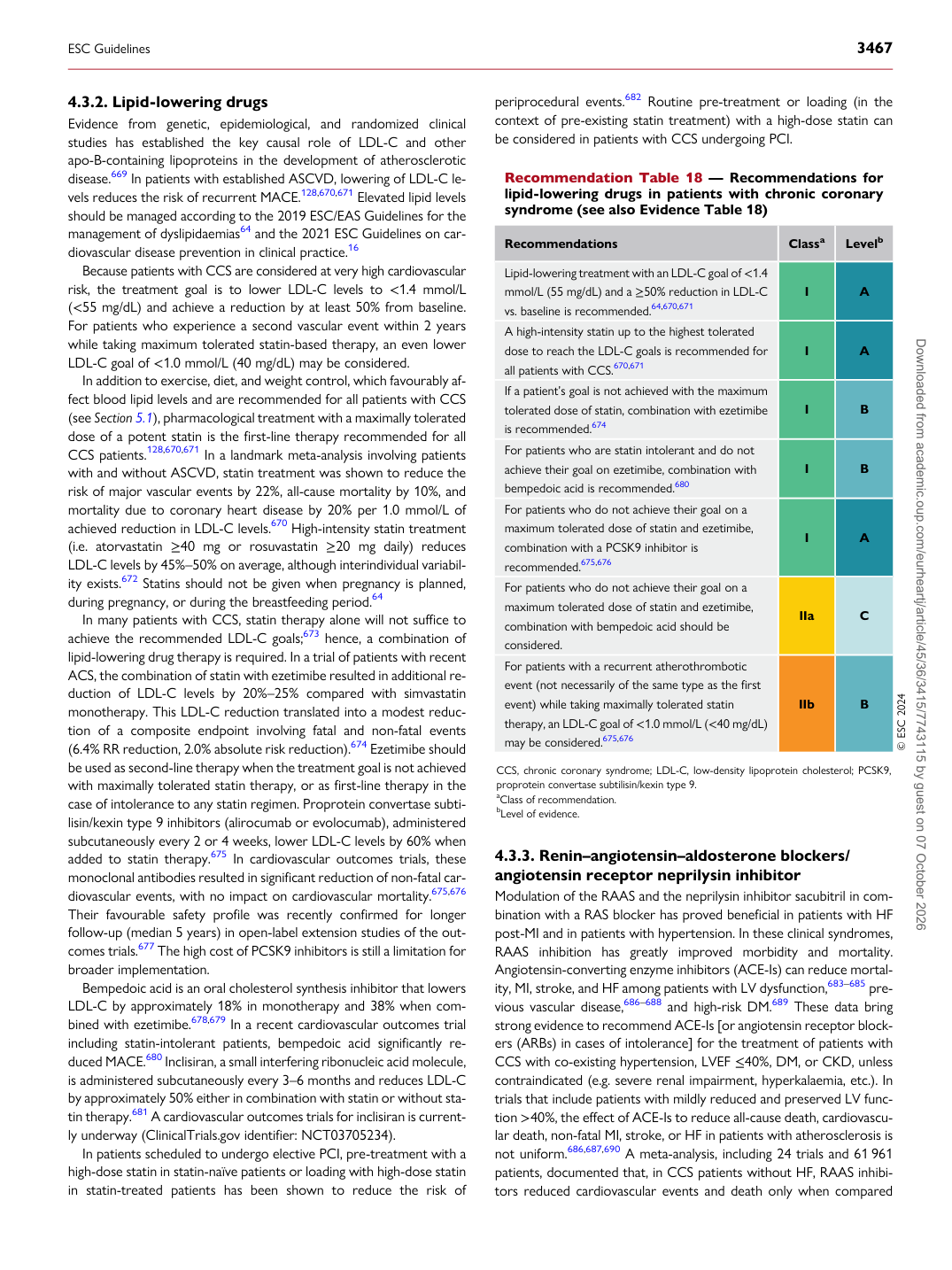
Recommendation Table 18 — Recommendations for lipid-lowering drugs in patients with chronic coronary syndrome (see also Evidence Table 18)

Recommendations Classa Levelb

Lipid-lowering treatment with an LDL-C goal of <1.4 mmol/L (55 mg/dL) and a ≥50% reduction in LDL-C vs. baseline is recommended.64,670,671 I A A high-intensity statin up to the highest tolerated dose to reach the LDL-C goals is recommended for all patients with CCS.670,671 I A If a patient’s goal is not achieved with the maximum tolerated dose of statin, combination with ezetimibe is recommended.674 I B For patients who are statin intolerant and do not achieve their goal on ezetimibe, combination with bempedoic acid is recommended.680 I B For patients who do not achieve their goal on a maximum tolerated dose of statin and ezetimibe, combination with a PCSK9 inhibitor is recommended.675,676 I A For patients who do not achieve their goal on a maximum tolerated dose of statin and ezetimibe, combination with bempedoic acid should be considered. IIa C For patients with a recurrent atherothrombotic event (not necessarily of the same type as the first event) while taking maximally tolerated statin therapy, an LDL-C goal of <1.0 mmol/L (<40 mg/dL) may be considered.675,676 IIb B © ESC 2024

CCS, chronic coronary syndrome; LDL-C, low-density lipoprotein cholesterol; PCSK9, proprotein convertase subtilisin/kexin type 9. aClass of recommendation. bLevel of evidence.

ESC Guidelines                                                                                                                                                                                          3467

Downloaded from academic.oup.com/eurheartj/article/45/36/3415/7743115 by guest on 07 October 2026