p.52 抽出テキスト
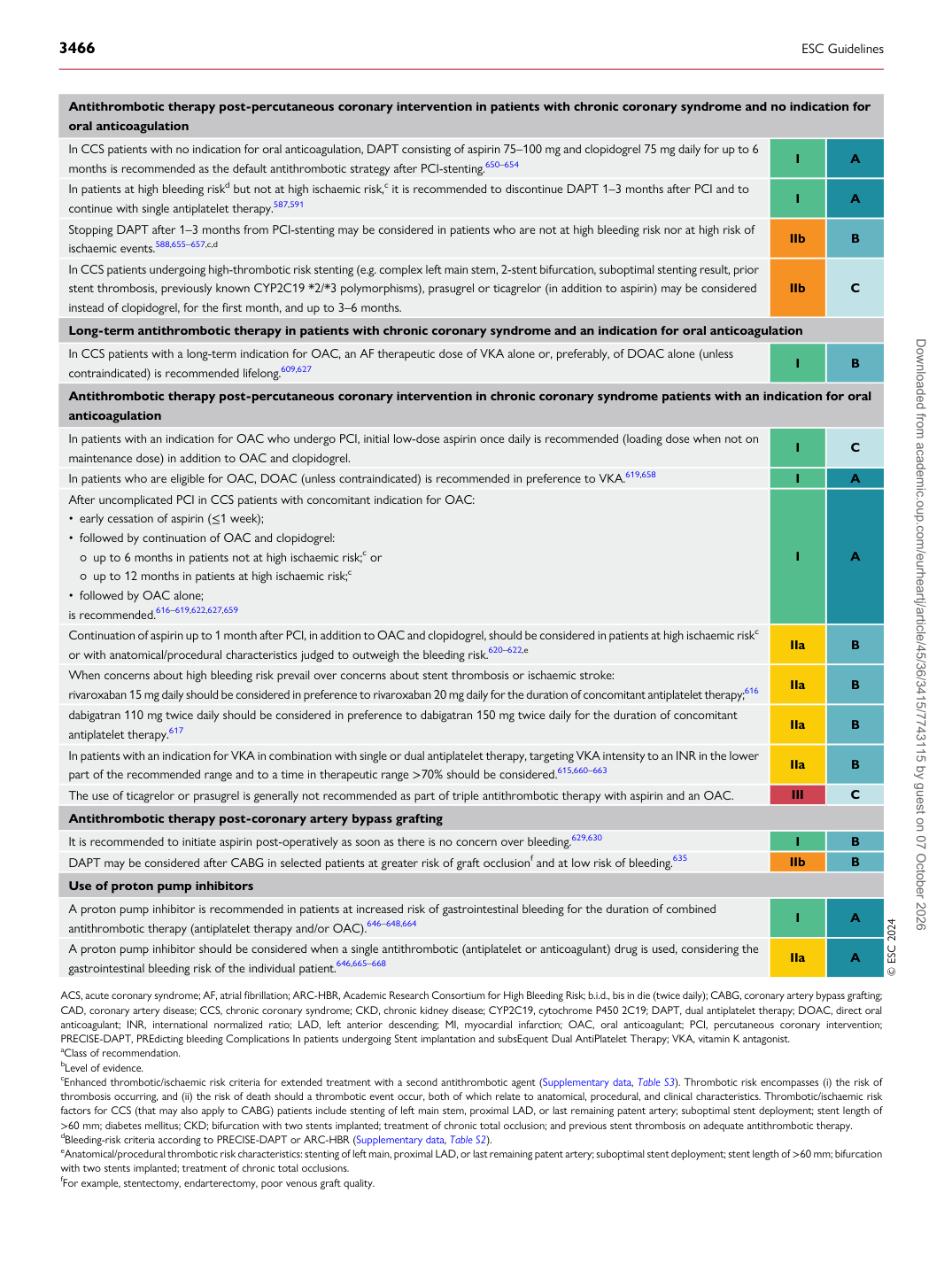
Antithrombotic therapy post-percutaneous coronary intervention in patients with chronic coronary syndrome and no indication for oral anticoagulation In CCS patients with no indication for oral anticoagulation, DAPT consisting of aspirin 75–100 mg and clopidogrel 75 mg daily for up to 6 months is recommended as the default antithrombotic strategy after PCI-stenting.650–654 I A In patients at high bleeding riskd but not at high ischaemic risk,c it is recommended to discontinue DAPT 1–3 months after PCI and to continue with single antiplatelet therapy.587,591 I A Stopping DAPT after 1–3 months from PCI-stenting may be considered in patients who are not at high bleeding risk nor at high risk of ischaemic events.588,655–657,c,d IIb B In CCS patients undergoing high-thrombotic risk stenting (e.g. complex left main stem, 2-stent bifurcation, suboptimal stenting result, prior stent thrombosis, previously known CYP2C19 *2/*3 polymorphisms), prasugrel or ticagrelor (in addition to aspirin) may be considered instead of clopidogrel, for the first month, and up to 3–6 months. IIb C Long-term antithrombotic therapy in patients with chronic coronary syndrome and an indication for oral anticoagulation In CCS patients with a long-term indication for OAC, an AF therapeutic dose of VKA alone or, preferably, of DOAC alone (unless contraindicated) is recommended lifelong.609,627 I B Antithrombotic therapy post-percutaneous coronary intervention in chronic coronary syndrome patients with an indication for oral anticoagulation In patients with an indication for OAC who undergo PCI, initial low-dose aspirin once daily is recommended (loading dose when not on maintenance dose) in addition to OAC and clopidogrel. I C In patients who are eligible for OAC, DOAC (unless contraindicated) is recommended in preference to VKA.619,658 I A After uncomplicated PCI in CCS patients with concomitant indication for OAC: • early cessation of aspirin (≤1 week); • followed by continuation of OAC and clopidogrel: ⚬up to 6 months in patients not at high ischaemic risk;c or

⚬up to 12 months in patients at high ischaemic risk;c • followed by OAC alone; is recommended.616–619,622,627,659 I A Continuation of aspirin up to 1 month after PCI, in addition to OAC and clopidogrel, should be considered in patients at high ischaemic riskc or with anatomical/procedural characteristics judged to outweigh the bleeding risk.620–622,e IIa B When concerns about high bleeding risk prevail over concerns about stent thrombosis or ischaemic stroke: rivaroxaban 15 mg daily should be considered in preference to rivaroxaban 20 mg daily for the duration of concomitant antiplatelet therapy;616 IIa B dabigatran 110 mg twice daily should be considered in preference to dabigatran 150 mg twice daily for the duration of concomitant antiplatelet therapy.617 IIa B In patients with an indication for VKA in combination with single or dual antiplatelet therapy, targeting VKA intensity to an INR in the lower part of the recommended range and to a time in therapeutic range >70% should be considered.615,660–663 IIa B The use of ticagrelor or prasugrel is generally not recommended as part of triple antithrombotic therapy with aspirin and an OAC. III C Antithrombotic therapy post-coronary artery bypass grafting It is recommended to initiate aspirin post-operatively as soon as there is no concern over bleeding.629,630 I B DAPT may be considered after CABG in selected patients at greater risk of graft occlusionf and at low risk of bleeding.635 IIb B Use of proton pump inhibitors A proton pump inhibitor is recommended in patients at increased risk of gastrointestinal bleeding for the duration of combined antithrombotic therapy (antiplatelet therapy and/or OAC).646–648,664 I A A proton pump inhibitor should be considered when a single antithrombotic (antiplatelet or anticoagulant) drug is used, considering the gastrointestinal bleeding risk of the individual patient.646,665–668 IIa A © ESC 2024

ACS, acute coronary syndrome; AF, atrial fibrillation; ARC-HBR, Academic Research Consortium for High Bleeding Risk; b.i.d., bis in die (twice daily); CABG, coronary artery bypass grafting; CAD, coronary artery disease; CCS, chronic coronary syndrome; CKD, chronic kidney disease; CYP2C19, cytochrome P450 2C19; DAPT, dual antiplatelet therapy; DOAC, direct oral anticoagulant; INR, international normalized ratio; LAD, left anterior descending; MI, myocardial infarction; OAC, oral anticoagulant; PCI, percutaneous coronary intervention; PRECISE-DAPT, PREdicting bleeding Complications In patients undergoing Stent implantation and subsEquent Dual AntiPlatelet Therapy; VKA, vitamin K antagonist. aClass of recommendation. bLevel of evidence. cEnhanced thrombotic/ischaemic risk criteria for extended treatment with a second antithrombotic agent (Supplementary data, Table S3). Thrombotic risk encompasses (i) the risk of thrombosis occurring, and (ii) the risk of death should a thrombotic event occur, both of which relate to anatomical, procedural, and clinical characteristics. Thrombotic/ischaemic risk factors for CCS (that may also apply to CABG) patients include stenting of left main stem, proximal LAD, or last remaining patent artery; suboptimal stent deployment; stent length of >60 mm; diabetes mellitus; CKD; bifurcation with two stents implanted; treatment of chronic total occlusion; and previous stent thrombosis on adequate antithrombotic therapy. dBleeding-risk criteria according to PRECISE-DAPT or ARC-HBR (Supplementary data, Table S2). eAnatomical/procedural thrombotic risk characteristics: stenting of left main, proximal LAD, or last remaining patent artery; suboptimal stent deployment; stent length of >60 mm; bifurcation with two stents implanted; treatment of chronic total occlusions. fFor example, stentectomy, endarterectomy, poor venous graft quality. Downloaded from academic.oup.com/eurheartj/article/45/36/3415/7743115 by guest on 07 October 2026