p.51 抽出テキスト
antithrombotic therapy when there is a very high risk of stent thrombosis and a low bleeding risk.619,623,624 After a 6- to 12-month period of double antithrombotic therapy, in most AF-PCI CCS patients, OAC alone is preferred over continuation of double antithrombotic therapy.625,626 An open-label randomized trial, conducted in 2236 Japanese AF patients who had undergone PCI (71% of patients) or CABG (11% of patients) >1 year before or had known CAD not requiring revascularization, compared rivaroxaban monotherapy (15 or 10 mg once daily based on creatinine clearance) with rivaroxaban plus SAPT (mostly aspirin).627 At a median follow-up of 23 months, the occurrence of ISTH major bleeding and of all-cause deaths were each significantly lower with rivaroxaban monotherapy, whereas MACE occurrence did not differ significantly in the two treatment arms.627 Whether the above considerations remain valid when the indication for OAC is other than AF, e.g. mechanical heart valves (where DOACs are not indicated) or VTE, is uncertain given limited available evidence. In the absence of data regarding the efficacy for MACE prevention of rivaroxaban 10 mg once daily and apixaban 2.5 mg twice daily, which should be used for extended OAC after the first 6 months of therapeutic anticoagulation in patients with VTE,628 it is recommended to resume full doses of these anticoagulants in case of concomitant CCS.

4.3.1.3 Coronary artery bypass grafting and antithrombotic therapy

Low-dose aspirin is recommended lifelong in patients undergoing CABG.629,630 Aspirin should be continued until the day of CABG and restarted as soon as there is no concern over bleeding, possibly within 24 h of CABG.631,632 In general, other antithrombotic drugs should be stopped at intervals related to their duration of action (prasugrel stopped ≥7 days before; clopidogrel ≥5 days before; ticagrelor ≥3 days before; and rivaroxaban, apixaban, edoxaban, and dabigatran 1–2 days before, depending on drug and renal function).633,634 Although not consistent, there is evidence that DAPT with a P2Y12 receptor inhibitor compared with aspirin monotherapy provides higher graft patency rates after CABG.635,636,637 A meta-analysis of four RCTs, involving 1316 patients (with 3079 grafts) followed for 3 to 12 months after CABG, reported superior vein graft patency with ticagrelor-based DAPT vs. aspirin alone, but with increased rates of BARC 2–5 (but not BARC 3–5) bleeds, and no significant differences in cardiovascular death, or the composite of cardiovascular death, MI, and stroke, or the composite of all-cause death, MI, stroke, and revascularization.635 Therefore, in patients undergoing CABG for CCS, DAPT is not routinely indicated; however, it may be considered in selected cases at increased risk of graft occlusion who are not at high bleeding risk (defined in Supplementary data, Tables S2 and S3).

Transient new-onset AF is common 2 to 3 days after CABG, occurring in approximately one-third of patients.638 AF after CABG is associated with a higher stroke risk,639 which is, however, lower than that with AF unrelated to surgery.640 The impact of early OAC initiation on patient outcomes remains unclear.641,642 In a Danish cohort study, early OAC initiation was associated with a lower risk of thromboembolic events,641 while in a Swedish cohort study, OAC was associated with no reduction of thrombo-embolic complications but an increased risk of major bleeding.642 Decisions on OAC should consider thrombo-embolic and bleeding risks, timing, and duration of post-operative AF. Longer AF durations and delayed-onset post-CABG have higher risks. We refer to the 2024 ESC Guidelines for the management of AF regarding recommendations for OAC in this context. It is unknown whether, in such patients, the combination of aspirin and OAC may be more effective compared with OAC alone in preventing ischaemic events post-CABG.

4.3.1.4 Proton pump inhibitors

Antithrombotic therapy may provoke GI bleeding, especially in patients at increased risk, such as the elderly, those with a history of GI bleeding or peptic disease, high alcohol consumption, chronic use of steroids or nonsteroidal anti-inflammatory drugs (NSAIDs), or receiving a combination of antithrombotic drugs.643–645 In patients on various types of antithrombotic therapy, proton pump inhibitors may be effective in reducing the risk of GI bleeding, in particular from gastroduodenal lesions.646–648 In general, gastric protection with proton pump inhibitors is recommended in patients at increased risk of GI bleeding for as long as any antithrombotic therapy is administered.65,86 Because the proton pump inhibitors omeprazole and esomeprazole inhibit CYP2C19, when administered with clopidogrel, they reduce exposure to clopidogrel’s active metabolite; while their use is discouraged in combination with clopidogrel, univocal effects of these combinations on the risk of ischaemic events or stent thrombosis have not been demonstrated (https://www.ema.europa.eu/en/medicines/ human/EPAR/plavix).643,646 Of note, proton pump inhibitors do not increase MACE vs. placebo in patients with CVD.646

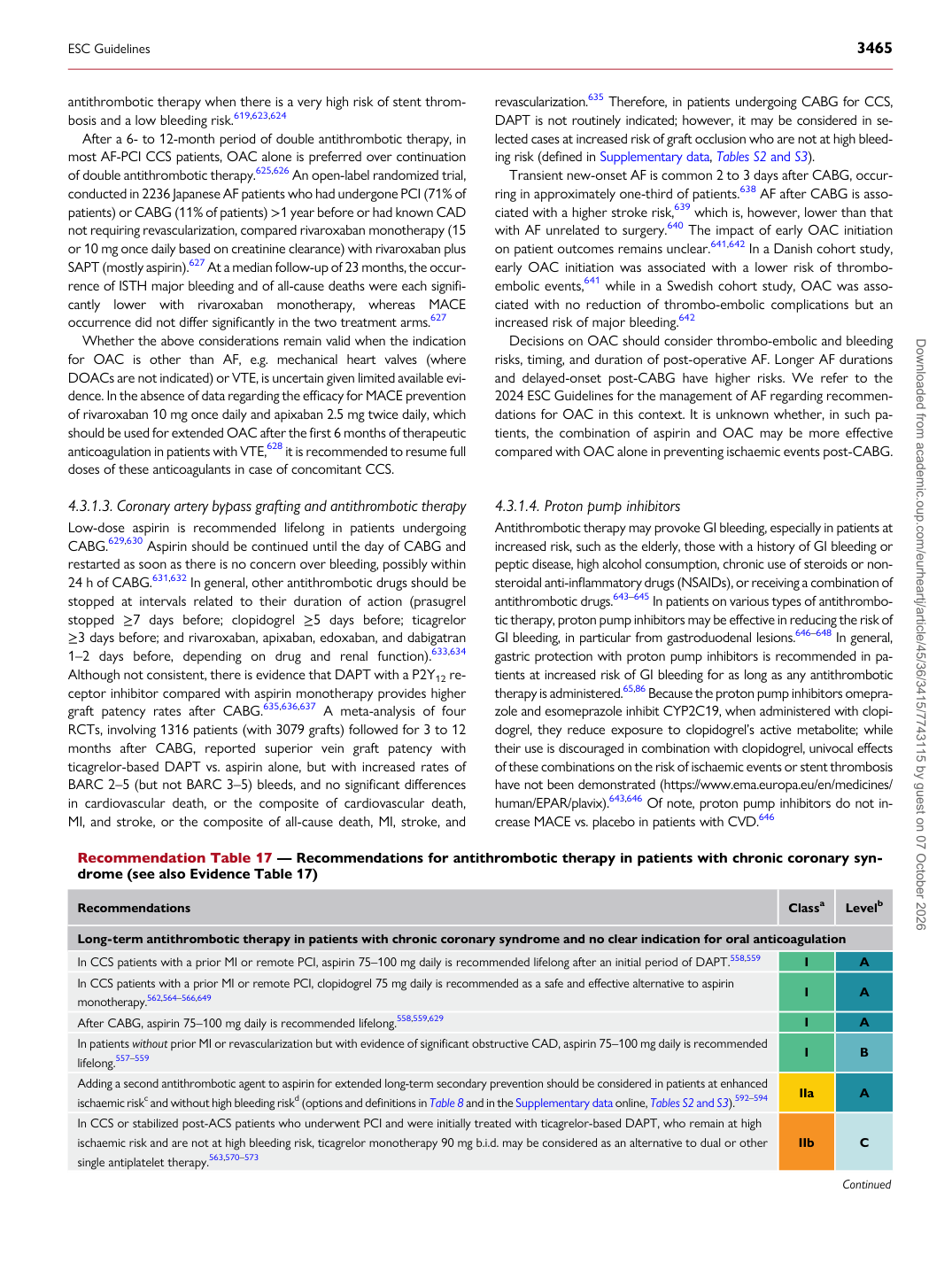
Recommendation Table 17 — Recommendations for antithrombotic therapy in patients with chronic coronary syndrome (see also Evidence Table 17)

Recommendations Classa Levelb

Long-term antithrombotic therapy in patients with chronic coronary syndrome and no clear indication for oral anticoagulation In CCS patients with a prior MI or remote PCI, aspirin 75–100 mg daily is recommended lifelong after an initial period of DAPT.558,559 I A In CCS patients with a prior MI or remote PCI, clopidogrel 75 mg daily is recommended as a safe and effective alternative to aspirin monotherapy.562,564–566,649 I A After CABG, aspirin 75–100 mg daily is recommended lifelong.558,559,629 I A In patients without prior MI or revascularization but with evidence of significant obstructive CAD, aspirin 75–100 mg daily is recommended lifelong.557–559 I B Adding a second antithrombotic agent to aspirin for extended long-term secondary prevention should be considered in patients at enhanced ischaemic riskc and without high bleeding riskd (options and definitions in Table 8 and in the Supplementary data online, Tables S2 and S3).592–594 IIa A In CCS or stabilized post-ACS patients who underwent PCI and were initially treated with ticagrelor-based DAPT, who remain at high ischaemic risk and are not at high bleeding risk, ticagrelor monotherapy 90 mg b.i.d. may be considered as an alternative to dual or other single antiplatelet therapy.563,570–573 IIb C

Continued

ESC Guidelines                                                                                                                                                                                          3465

Downloaded from academic.oup.com/eurheartj/article/45/36/3415/7743115 by guest on 07 October 2026