p.50 抽出テキスト
treatment with ticagrelor or prasugrel.601,602 In patients with CCS, current evidence does not support the routine use of genotype or platelet function testing.602–607 However, in patients undergoing high-risk PCI who are known carriers of a CYP2C19 loss-of-function allele, replacing aspirin plus clopidogrel with aspirin plus ticagrelor or prasugrel is a reasonable option.600,607,608

4.3.1.2 Anticoagulant therapy

4.3.1.2.1. Monotherapy with oral anticoagulant. Historical randomized data from patients with recent MI not undergoing PCI, followed for up to 4 years, showed that OAC monotherapy with a vitamin K antagonist (VKA) targeted to an international normalized ratio (INR) of about 3.0–4.0 was at least as effective as low-dose aspirin in preventing MACE, but with a significant increase in major bleeding.609,610 Moreover, given the obsoletely high INR target and the cumbersome management, VKA has not gained popularity for secondary prevention in patients with CCS. Successful introduction of the direct oral anticoagulants (DOACs) for stroke prevention in AF and for prevention and treatment of venous thrombo-embolism (VTE) has renewed the interest in OAC for patients with CAD. The COMPASS trial in CCS and/or PAD patients at high ischaemic risk, however, reported no significant ischaemic benefit of rivaroxaban monotherapy 5 mg twice daily over aspirin alone, with a significantly higher incidence of modified-ISTH major bleeding, although not of fatal bleeding.594 Thus, in CCS patients without a concomitant long-term indication for OAC, OAC monotherapy with either VKA or rivaroxaban (the only DOAC currently tested in this context) is not recommended. OAC may be considered, however, when antiplatelet agents are not tolerated, if the risk of bleeding is not high,594,611 or in CCS patients with a concomitant long-term indication for OAC (see below).

4.3.1.2.2 Combination of anticoagulant and antiplatelet therapy

after percutaneous coronary intervention in chronic coronary syndrome patients with AF or other indication for oral anticoagulant. Approximately one in five patients with AF need to undergo PCI, with a theoretical indication for both OAC for stroke prevention (for which DOACs are preferred to VKA) and DAPT for stent thrombosis and MI prevention, leading to triple antithrombotic therapy.612,613

The combination of an OAC plus DAPT, however, leads to an increased bleeding risk, and major bleeding is associated with earlier mortality and should therefore be avoided when possible.614 In this setting, the results of five RCTs have shown that double compared with triple antithrombotic therapy reduced major or clinically relevant non-major bleeding, without a significant increase of ischaemic events, leading to the recommended use of double antithrombotic therapy (OAC plus P2Y12 receptor inhibitor, mostly clopidogrel) after a 1–4 week period of triple antithrombotic therapy in CCS patients with AF undergoing PCI.615–620 The AUGUSTUS trial (Open-Label, 2 × 2 Factorial, Randomized Controlled, Clinical Trial to Evaluate the Safety of Apixaban versus Vitamin K Antagonist and Aspirin versus Aspirin Placebo in Patients with AF and Acute Coronary Syndrome or Percutaneous Coronary Intervention) additionally demonstrated that the DOAC apixaban reduced major or clinically relevant non-major bleeding compared with VKA, independently of a double or triple antithrombotic regimen.619 The AUGUSTUS trial and several meta-analyses demonstrated that aspirin compared with placebo reduced stent thrombosis events, which occurred mainly during the first 30 days after PCI and not thereafter, while increasing bleeding risk.620–622 Thus, based on the combined evidence, double antithrombotic therapy with a DOAC and clopidogrel for up to 12 months should be standard care for CCS patients with AF undergoing PCI, with additional aspirin only for a limited initial period (from during PCI up to a maximum of 30 days in patients at high ischaemic risk). In patients with the highest bleeding risk, clopidogrel discontinuation at 6 (or even 3) months post-PCI and continuation of OAC alone may be considered when ischaemic risk is not high [Class IIb/level of evidence (LOE) C]. Ticagrelor or prasugrel should generally not be used as part of triple antithrombotic therapy, while ticagrelor, and possibly prasugrel (although specific data are not available), may be considered as part of double

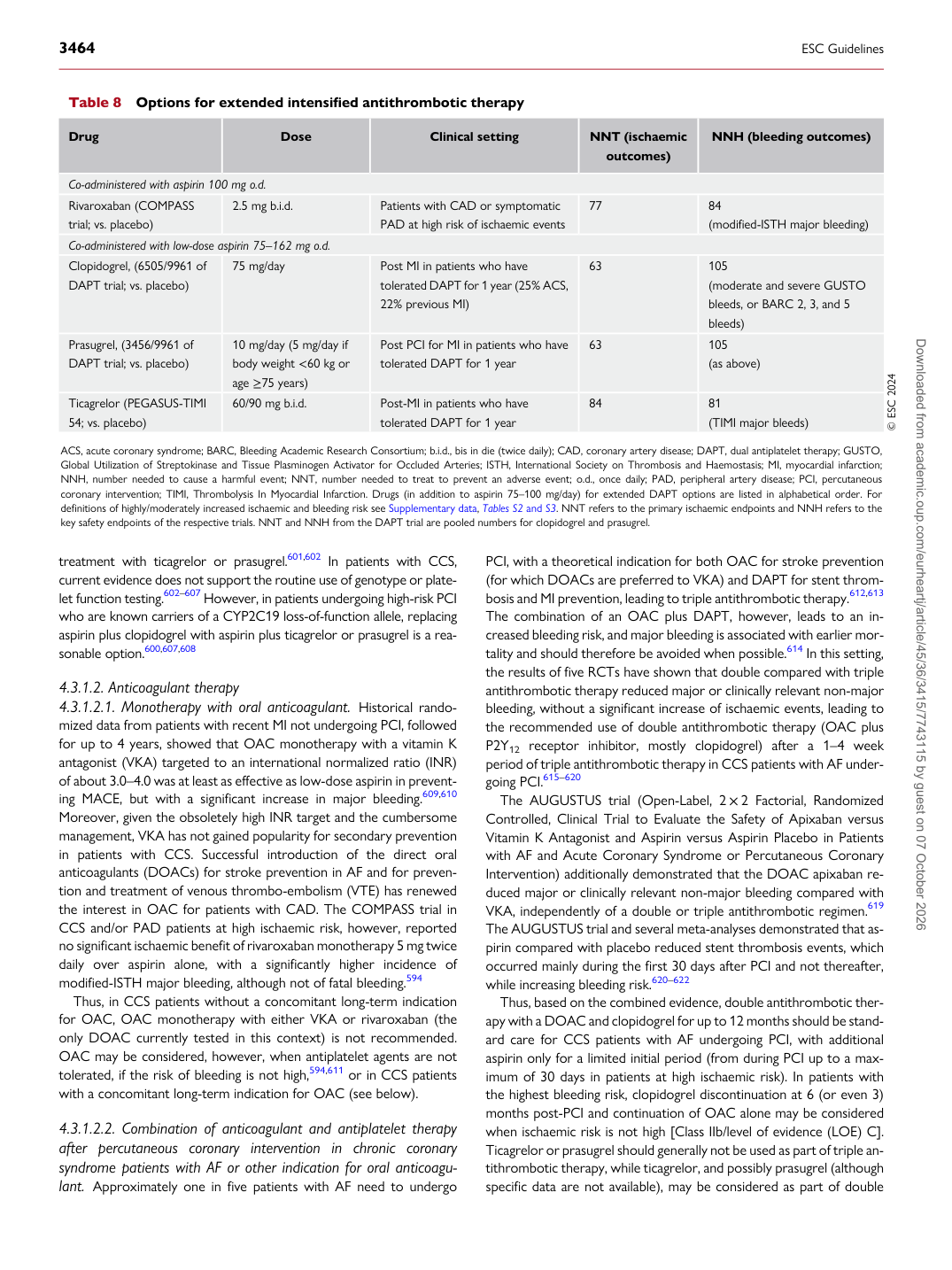
Table 8 Options for extended intensified antithrombotic therapy

Drug Dose Clinical setting NNT (ischaemic

outcomes) NNH (bleeding outcomes)

Co-administered with aspirin 100 mg o.d. Rivaroxaban (COMPASS trial; vs. placebo) 2.5 mg b.i.d. Patients with CAD or symptomatic PAD at high risk of ischaemic events 77 84 (modified-ISTH major bleeding) Co-administered with low-dose aspirin 75–162 mg o.d. Clopidogrel, (6505/9961 of DAPT trial; vs. placebo) 75 mg/day Post MI in patients who have

tolerated DAPT for 1 year (25% ACS, 22% previous MI) 63 105

(moderate and severe GUSTO bleeds, or BARC 2, 3, and 5 bleeds)

Prasugrel, (3456/9961 of DAPT trial; vs. placebo) 10 mg/day (5 mg/day if

body weight <60 kg or age ≥75 years) Post PCI for MI in patients who have

tolerated DAPT for 1 year 63 105

(as above)

Ticagrelor (PEGASUS-TIMI 54; vs. placebo) 60/90 mg b.i.d. Post-MI in patients who have

tolerated DAPT for 1 year 84 81

(TIMI major bleeds) © ESC 2024

ACS, acute coronary syndrome; BARC, Bleeding Academic Research Consortium; b.i.d., bis in die (twice daily); CAD, coronary artery disease; DAPT, dual antiplatelet therapy; GUSTO, Global Utilization of Streptokinase and Tissue Plasminogen Activator for Occluded Arteries; ISTH, International Society on Thrombosis and Haemostasis; MI, myocardial infarction; NNH, number needed to cause a harmful event; NNT, number needed to treat to prevent an adverse event; o.d., once daily; PAD, peripheral artery disease; PCI, percutaneous coronary intervention; TIMI, Thrombolysis In Myocardial Infarction. Drugs (in addition to aspirin 75–100 mg/day) for extended DAPT options are listed in alphabetical order. For definitions of highly/moderately increased ischaemic and bleeding risk see Supplementary data, Tables S2 and S3. NNT refers to the primary ischaemic endpoints and NNH refers to the key safety endpoints of the respective trials. NNT and NNH from the DAPT trial are pooled numbers for clopidogrel and prasugrel. Downloaded from academic.oup.com/eurheartj/article/45/36/3415/7743115 by guest on 07 October 2026