p.45 抽出テキスト
observational studies and meta-analyses is conflicting (some suggest an association between beta-blockers and better clinical outcomes, whereas others show a lack of association).521,523–526 There have been only two open-label trials testing the efficacy of beta blockers in post-MI patients (NCT03278509 and NCT01155635), though both trials were underpowered to yield solid conclusions.527 To further elucidate the benefit of beta-blockers in this clinical scenario, three European pragmatic, prospective, large-scale RCTs recruiting post-ACS patients with preserved LVEF to receive beta-blockers or control treatment are currently underway.522,528–530 The duration of beta-blocker therapy, in the long run, is a matter of debate, particularly in patients with prior MI and preserved LVEF.531 Evidence from RCTs assessing beta-blockers rarely goes beyond a few years of follow-up, but patients are often given continuous treatment up to old age.531 Observational data are also conflicting in this regard. One study has suggested that the clinical benefit of beta-blockers might be restricted to the first year after the index event, showing that their discontinuation at 1 year was not associated with higher 5-year mortality.532 In contrast, a Swedish study starting the follow-up 1 year after the ACS episode has shown a lack of association between the use of beta-blockers and a composite of all-cause mortality, MI, unscheduled revascularization, or hospitalization for HF.533 Another study has shown that the discontinuation of beta-blockers beyond 1 year after acute MI was associated with an increased risk of a composite of death or readmission for ACS, but not of all-cause mortality.534 The impact of beta-blocker withdrawal 6–12 months after uncomplicated ACS in patients with LVEF ≥40% is being tested in two large-scale RCTs (NCT03498066, NCT04769362.535

4.2.3 Combination therapy

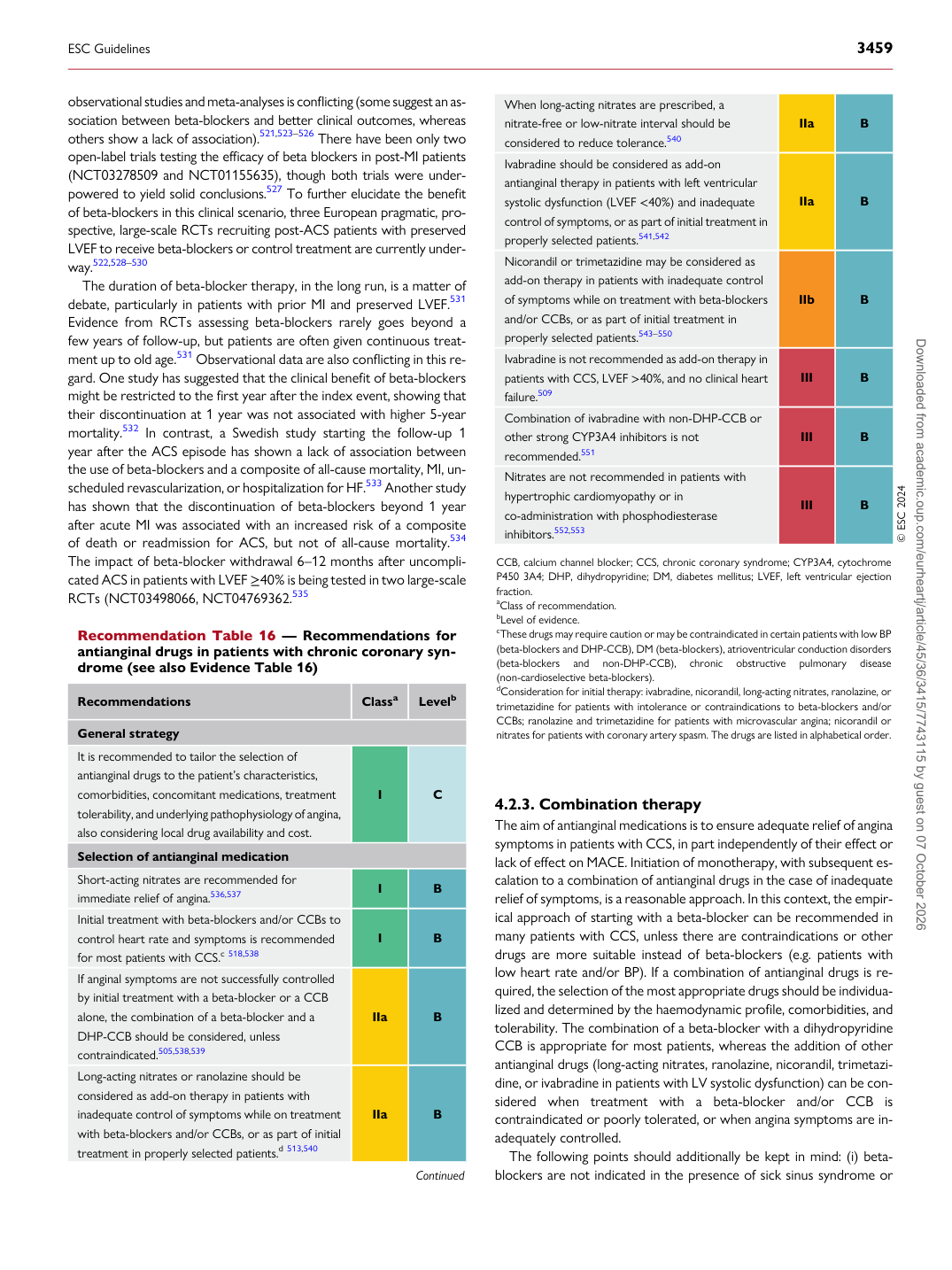
The aim of antianginal medications is to ensure adequate relief of angina symptoms in patients with CCS, in part independently of their effect or lack of effect on MACE. Initiation of monotherapy, with subsequent escalation to a combination of antianginal drugs in the case of inadequate relief of symptoms, is a reasonable approach. In this context, the empirical approach of starting with a beta-blocker can be recommended in many patients with CCS, unless there are contraindications or other drugs are more suitable instead of beta-blockers (e.g. patients with low heart rate and/or BP). If a combination of antianginal drugs is required, the selection of the most appropriate drugs should be individualized and determined by the haemodynamic profile, comorbidities, and tolerability. The combination of a beta-blocker with a dihydropyridine CCB is appropriate for most patients, whereas the addition of other antianginal drugs (long-acting nitrates, ranolazine, nicorandil, trimetazidine, or ivabradine in patients with LV systolic dysfunction) can be considered when treatment with a beta-blocker and/or CCB is contraindicated or poorly tolerated, or when angina symptoms are inadequately controlled. The following points should additionally be kept in mind: (i) betablockers are not indicated in the presence of sick sinus syndrome or

Recommendation Table 16 — Recommendations for antianginal drugs in patients with chronic coronary syndrome (see also Evidence Table 16)

Recommendations Classa Levelb

General strategy It is recommended to tailor the selection of antianginal drugs to the patient’s characteristics, comorbidities, concomitant medications, treatment tolerability, and underlying pathophysiology of angina, also considering local drug availability and cost. I C Selection of antianginal medication Short-acting nitrates are recommended for immediate relief of angina.536,537 I B Initial treatment with beta-blockers and/or CCBs to control heart rate and symptoms is recommended for most patients with CCS.c 518,538 I B If anginal symptoms are not successfully controlled by initial treatment with a beta-blocker or a CCB alone, the combination of a beta-blocker and a DHP-CCB should be considered, unless contraindicated.505,538,539 IIa B Long-acting nitrates or ranolazine should be considered as add-on therapy in patients with inadequate control of symptoms while on treatment with beta-blockers and/or CCBs, or as part of initial treatment in properly selected patients.d 513,540 IIa B

Continued When long-acting nitrates are prescribed, a

nitrate-free or low-nitrate interval should be considered to reduce tolerance.540 IIa B Ivabradine should be considered as add-on antianginal therapy in patients with left ventricular systolic dysfunction (LVEF <40%) and inadequate control of symptoms, or as part of initial treatment in properly selected patients.541,542 IIa B Nicorandil or trimetazidine may be considered as add-on therapy in patients with inadequate control of symptoms while on treatment with beta-blockers and/or CCBs, or as part of initial treatment in properly selected patients.543–550 IIb B Ivabradine is not recommended as add-on therapy in patients with CCS, LVEF >40%, and no clinical heart failure.509 III B Combination of ivabradine with non-DHP-CCB or other strong CYP3A4 inhibitors is not recommended.551 III B Nitrates are not recommended in patients with hypertrophic cardiomyopathy or in co-administration with phosphodiesterase inhibitors.552,553 III B © ESC 2024

CCB, calcium channel blocker; CCS, chronic coronary syndrome; CYP3A4, cytochrome P450 3A4; DHP, dihydropyridine; DM, diabetes mellitus; LVEF, left ventricular ejection fraction. aClass of recommendation. bLevel of evidence. cThese drugs may require caution or may be contraindicated in certain patients with low BP (beta-blockers and DHP-CCB), DM (beta-blockers), atrioventricular conduction disorders (beta-blockers and non-DHP-CCB), chronic obstructive pulmonary disease (non-cardioselective beta-blockers). dConsideration for initial therapy: ivabradine, nicorandil, long-acting nitrates, ranolazine, or trimetazidine for patients with intolerance or contraindications to beta-blockers and/or CCBs; ranolazine and trimetazidine for patients with microvascular angina; nicorandil or nitrates for patients with coronary artery spasm. The drugs are listed in alphabetical order.

ESC Guidelines                                                                                                                                                                                          3459

Downloaded from academic.oup.com/eurheartj/article/45/36/3415/7743115 by guest on 07 October 2026