p.44 抽出テキスト
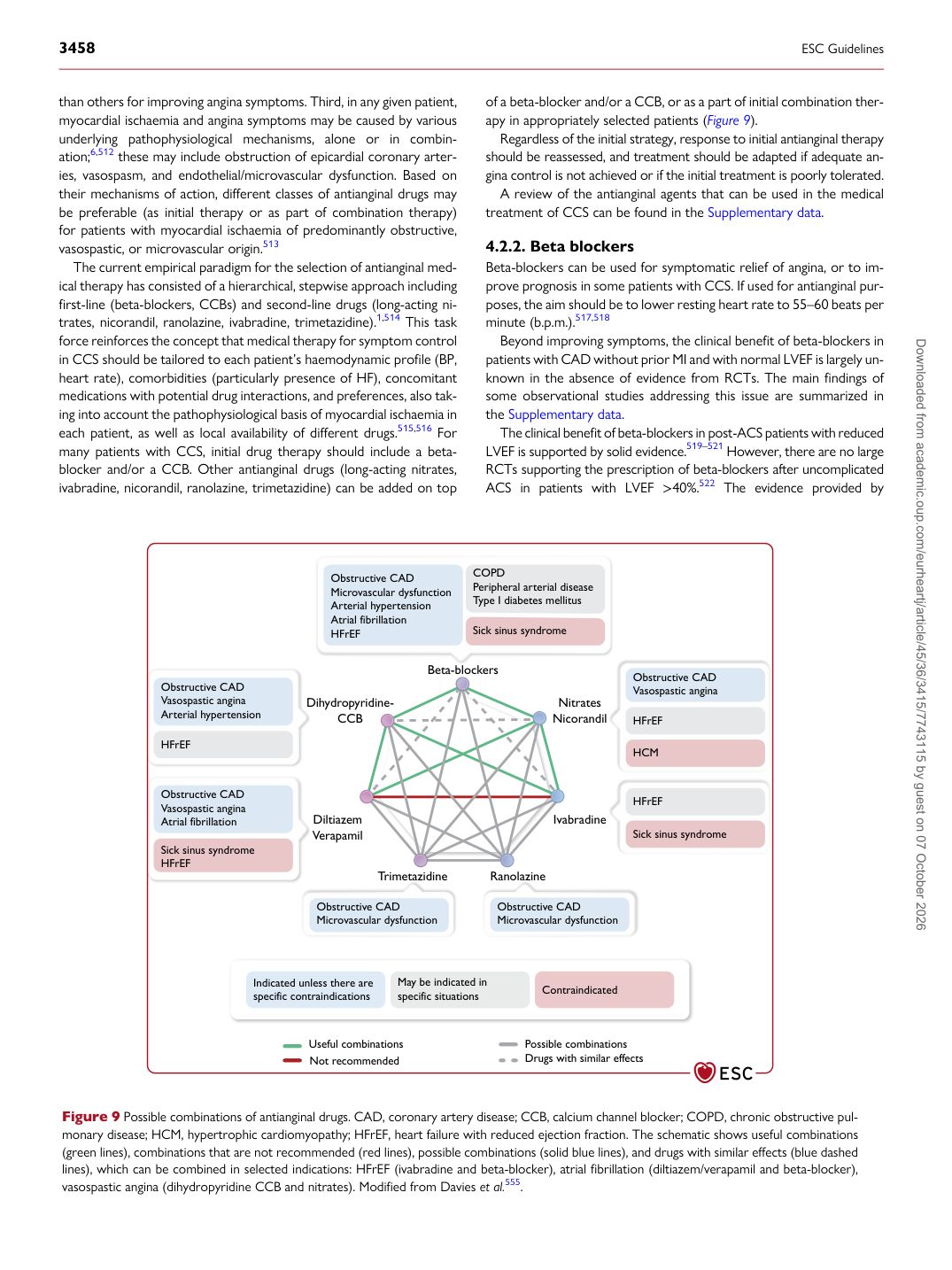
than others for improving angina symptoms. Third, in any given patient, myocardial ischaemia and angina symptoms may be caused by various underlying pathophysiological mechanisms, alone or in combination;6,512 these may include obstruction of epicardial coronary arteries, vasospasm, and endothelial/microvascular dysfunction. Based on their mechanisms of action, different classes of antianginal drugs may be preferable (as initial therapy or as part of combination therapy) for patients with myocardial ischaemia of predominantly obstructive, vasospastic, or microvascular origin.513 The current empirical paradigm for the selection of antianginal medical therapy has consisted of a hierarchical, stepwise approach including first-line (beta-blockers, CCBs) and second-line drugs (long-acting nitrates, nicorandil, ranolazine, ivabradine, trimetazidine).1,514 This task force reinforces the concept that medical therapy for symptom control in CCS should be tailored to each patient’s haemodynamic profile (BP, heart rate), comorbidities (particularly presence of HF), concomitant medications with potential drug interactions, and preferences, also taking into account the pathophysiological basis of myocardial ischaemia in each patient, as well as local availability of different drugs.515,516 For many patients with CCS, initial drug therapy should include a betablocker and/or a CCB. Other antianginal drugs (long-acting nitrates, ivabradine, nicorandil, ranolazine, trimetazidine) can be added on top of a beta-blocker and/or a CCB, or as a part of initial combination therapy in appropriately selected patients (Figure 9).

Regardless of the initial strategy, response to initial antianginal therapy should be reassessed, and treatment should be adapted if adequate angina control is not achieved or if the initial treatment is poorly tolerated. A review of the antianginal agents that can be used in the medical treatment of CCS can be found in the Supplementary data.

4.2.2 Beta blockers

Beta-blockers can be used for symptomatic relief of angina, or to improve prognosis in some patients with CCS. If used for antianginal purposes, the aim should be to lower resting heart rate to 55–60 beats per minute (b.p.m.).517,518 Beyond improving symptoms, the clinical benefit of beta-blockers in patients with CAD without prior MI and with normal LVEF is largely unknown in the absence of evidence from RCTs. The main findings of some observational studies addressing this issue are summarized in the Supplementary data. The clinical benefit of beta-blockers in post-ACS patients with reduced LVEF is supported by solid evidence.519–521 However, there are no large RCTs supporting the prescription of beta-blockers after uncomplicated ACS in patients with LVEF >40%.522 The evidence provided by

Useful combinations Possible combinations Drugs with similar effects Not recommended

Beta-blockers

Dihydropyridine-

CCB

Diltiazem Verapamil

Trimetazidine Ranolazine Ivabradine

Nitrates Nicorandil

Obstructive CAD Microvascular dysfunction Arterial hypertension Atrial fibrillation HFrEF

Obstructive CAD Vasospastic angina Arterial hypertension COPD Peripheral arterial disease Type I diabetes mellitus

Obstructive CAD Vasospastic angina Atrial fibrillation

Obstructive CAD Microvascular dysfunction Obstructive CAD Microvascular dysfunction Obstructive CAD Vasospastic angina

May be indicated in specific situations HCM

Sick sinus syndrome

Sick sinus syndrome HFrEF Sick sinus syndrome

HFrEF

HFrEF

HFrEF

Contraindicated Indicated unless there are specific contraindications

Figure 9 Possible combinations of antianginal drugs. CAD, coronary artery disease; CCB, calcium channel blocker; COPD, chronic obstructive pulmonary disease; HCM, hypertrophic cardiomyopathy; HFrEF, heart failure with reduced ejection fraction. The schematic shows useful combinations (green lines), combinations that are not recommended (red lines), possible combinations (solid blue lines), and drugs with similar effects (blue dashed lines), which can be combined in selected indications: HFrEF (ivabradine and beta-blocker), atrial fibrillation (diltiazem/verapamil and beta-blocker), vasospastic angina (dihydropyridine CCB and nitrates). Modified from Davies et al.555. Downloaded from academic.oup.com/eurheartj/article/45/36/3415/7743115 by guest on 07 October 2026