p.43 抽出テキスト
inactive adults, light-intensity physical activity, even as little as 15 min a day, is likely to produce benefits.479

4.1.3 Exercise therapy

Exercise training, either alone or in the context of multidisciplinary, exercise-based cardiac rehabilitation, leads to reduction in hospitalizations, adverse cardiovascular events, mortality rates, and improved CVD risk profile in patients with ASCVD.480–483 Therefore, exercise is a therapy that should be offered to every CCS patient in the setting of secondary disease prevention.16 Exercise training should be individually prescribed according to the FITT (frequency, intensity, time, type) model for aerobic and resistance training.484 For aerobic training (walking, jogging, cycling, swimming, etc.), an exercise frequency of at least 3 days/week, preferably 6–7 days/week, at moderate or moderate-to-high intensity is recommended. Relative intensity is determined based on an individual’s maximum (peak) effort, e.g. percentage of cardiorespiratory fitness (%VO2 max), percentage of maximum (peak) heart rate (%HRmax) or ventilatory thresholds (VT1 and VT2).485 To date, there is insufficient evidence to promote high-intensity interval training over moderate-intensity continuous training; nevertheless, optimizing total energy expenditure (either by increasing intensity or total exercise volume) is related to greater favourable changes in cardiovascular risk and physical fitness.486 Moderate-intensity continuous training is the most feasible and costeffective aerobic training modality for patients with CCS. High-intensity interval training can be prescribed in selected patients for specific targets of intervention (e.g. to increase VO2 peak).485 Resistance exercise in addition to aerobic training is associated with lower risks of total cardiovascular events and all-cause mortality.16 The suggested prescription is one to three sets of 8–12 repetitions, at the intensity of 6%–80% of the individual’s one-repetition maximum, at a frequency of at least 2 days per week, using a variety of 8–10 different exercises involving each major muscle group.16,484 Exercise is contraindicated in patients with refractory/unstable angina and other high-risk cardiovascular conditions (e.g. high-grade arrhythmias, decompensated HF, severe aortic dilatation, active thromboembolic disease). In non-cardiac unstable conditions (e.g. active infection, uncontrolled diabetes, end-stage cancer, chronic obstructive pulmonary disease exacerbation), exercise is contraindicated. Maintenance of the prescribed exercise regimen is crucial. According to a meta-regression analysis, no single exercise component predicts mortality outcomes, whereas the largest reductions in total and cardiovascular mortality were seen in post-cardiac rehabilitation patients with the highest adherence rate.487 In addition, continuation of the exercise therapy (Phase III cardiac rehabilitation) is recommended as it will result in increased/maintained functional capacity, QoL, and physical activity levels.488 Sharing decision-making and offering a personalized prescription, based on the patient’s preferences (self-selected training) and abilities (age, concomitant diseases, leisure and working habits, logistical restraints), is recommended to increase long-term adherence.489 In addition, smartphone applications490 and wearable activity trackers491 may assist in long-term adherence to physical activity goals and exercise therapy (see Section 6.2.1.3).492 Home-based cardiac rehabilitation with or without telemonitoring may increase participation and be as effective as centre-based cardiac rehabilitation.493 Telehealth interventions are more effective than no intervention and may also complement conventional cardiac rehabilitation.494,495 Also, mobile device-based healthcare (mHealth) delivery through smartphones may be as effective as traditional centre-based cardiac rehabilitation, showing significant improvements in health-related QoL.496

Small, single-centre studies on exercise training in patients with INOCA show that it is feasible and improves cardiorespiratory function and QoL.497 Larger trials are needed to determine the optimal rehabilitation protocols and define its long-term benefits.

4.2 Antianginal/anti-ischaemic medication

4.2.1. General strategy In patients with CCS, antianginal medical therapy aims to control symptoms while ensuring acceptable tolerability and patient adherence. Several factors should be considered for the selection of antianginal medical therapy. First, there is no robust evidence from direct comparisons that some antianginal drugs are more effective than others for improving symptoms.504,505 There have been no large randomized trials comparing head-to-head the historically first approved antianginal medications [i.e. beta-blockers or calcium channel blockers (CCBs)] vs. newer anti-ischaemic drugs (ivabradine, nicorandil, ranolazine, trimetazidine);504,506 the latter have been tested in smaller trials assessing non-inferiority compared with beta-blockers507 or CCBs,508 or in a larger trial as add-on therapy with a background of beta-blockers and/or CCBs.508,509 Moreover, there is no evidence that any antianginal medication may improve long-term cardiovascular outcomes, except betablockers if administered within 1 year after an acute MI.510 Second, many patients require a combination of anti-ischaemic drugs to adequately control symptoms.511 It remains unclear whether upfront combination therapy with two antianginal drugs is preferable to monotherapy, or which combinations of antianginal classes may be better

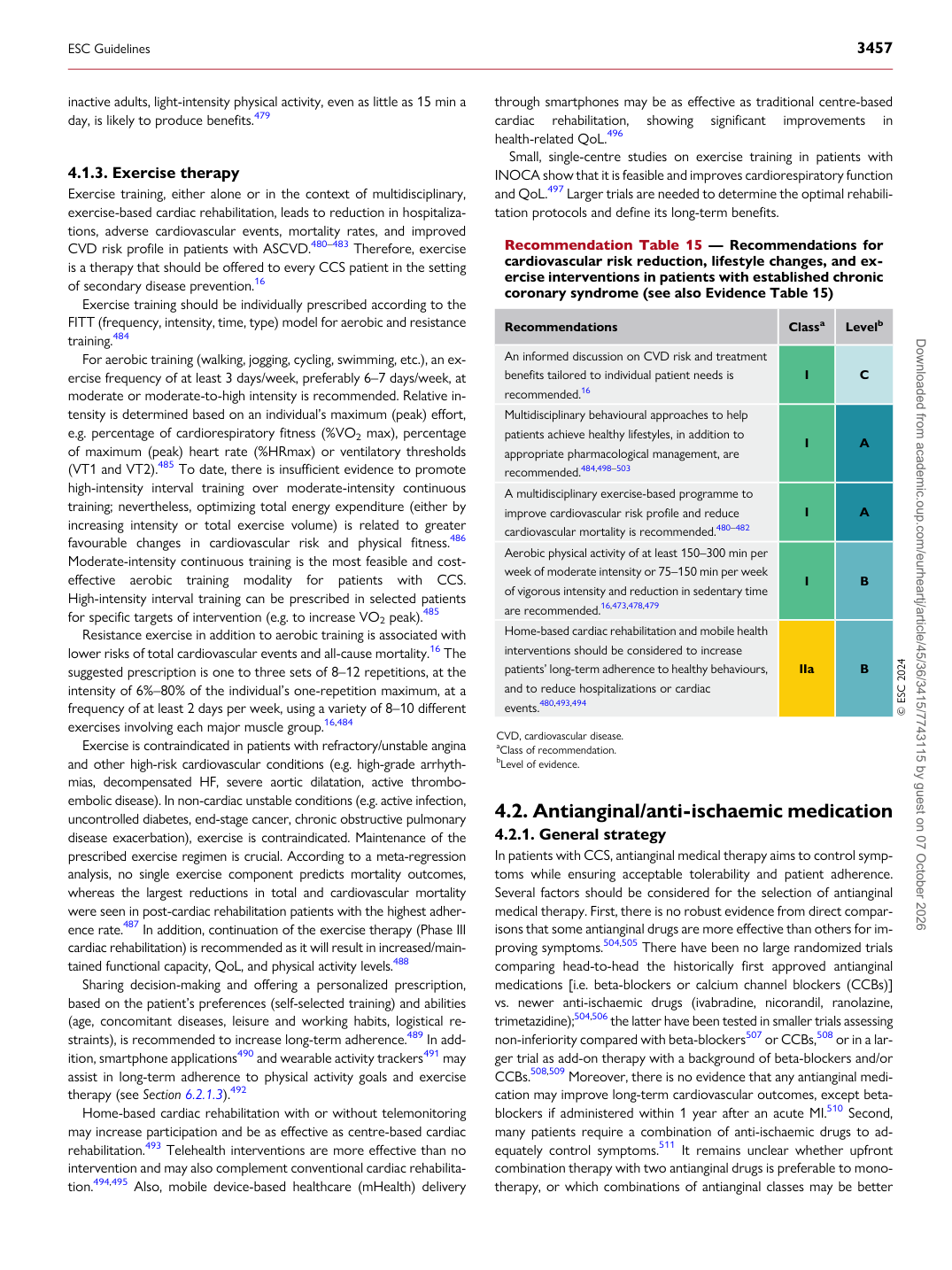
Recommendation Table 15 — Recommendations for cardiovascular risk reduction, lifestyle changes, and exercise interventions in patients with established chronic coronary syndrome (see also Evidence Table 15)

Recommendations Classa Levelb

An informed discussion on CVD risk and treatment benefits tailored to individual patient needs is recommended.16 I C Multidisciplinary behavioural approaches to help patients achieve healthy lifestyles, in addition to appropriate pharmacological management, are recommended.484,498–503 I A A multidisciplinary exercise-based programme to improve cardiovascular risk profile and reduce cardiovascular mortality is recommended.480–482 I A Aerobic physical activity of at least 150–300 min per week of moderate intensity or 75–150 min per week of vigorous intensity and reduction in sedentary time are recommended.16,473,478,479 I B Home-based cardiac rehabilitation and mobile health interventions should be considered to increase patients’ long-term adherence to healthy behaviours, and to reduce hospitalizations or cardiac events.480,493,494 IIa B © ESC 2024

CVD, cardiovascular disease. aClass of recommendation. bLevel of evidence.

ESC Guidelines                                                                                                                                                                                          3457

Downloaded from academic.oup.com/eurheartj/article/45/36/3415/7743115 by guest on 07 October 2026