p.41 抽出テキスト
min of chest discomfort after sublingual nitroglycerine increases the likelihood of CCS. Patients may be advised to refrain from strenuous physical activities before the diagnostic process is completed and should be instructed what to do if prolonged anginal chest pain indicative of acute MI arises. Guideline-directed management and therapy are started during or after the diagnostic process is concluded. The main goals of treating CCS are to improve both QoL and life expectancy. This involves various interventions to reduce the risk of (i) cardiac mortality, (ii) non-fatal ischaemic events, (iii) progression of epicardial and/or microvascular chronic coronary disease, and (iv) symptoms and limitations caused by CCS. When deciding on treatment options, it is important to consider patient preferences, possible complications of procedures or medications, and healthcare costs. In shared decision-making with patients, clinicians should clearly explain that certain treatments can alleviate symptoms, while others can reduce the likelihood of ischaemic events.

4 Guideline-directed therapy

4.1 Patient education, lifestyle

optimization for risk-factor control, and exercise therapy 4.1.1. Patient education In CCS patients, education on risk factors and symptom management is associated with improvements in knowledge, self-care, and patient empowerment, and may improve health-related QoL.436 In addition, education can facilitate long-term adherence to lifestyle interventions.437,438 Educational programmes—either alone or as a core component of multidisciplinary care management programmes—promote patients’ awareness of their condition and the rationale for lifestyle interventions. However, awareness of CVD risk factors through education alone might be insufficient for adoption of healthy behaviour.439 Therefore, self-care programmes are needed to enable patients to have a major role in coping with their condition and accepting their prescribed treatment.440,441 Elements in patient education include (modifiable) risk factors in relation to individual cardiovascular risk, since risk perception is an integral part of many major health behaviour theories, ultimately leading to modification of human habits.441,442 Information on benefits of risk-factor control on recurrence risk, disease progression, complications, and overall survival should be discussed. The format, time horizon, and outcome used for risk estimation influence patient perceptions and should be considered when designing risk communication tools.443–445 Lifelong education for patient-centred information and problembased learning is superior to home-sent information in improving riskfactor control in the long term.438,444 Refer to Section 6.2.1 for further guidance on patient education.

4.1.2 Key lifestyle interventions for risk-factor

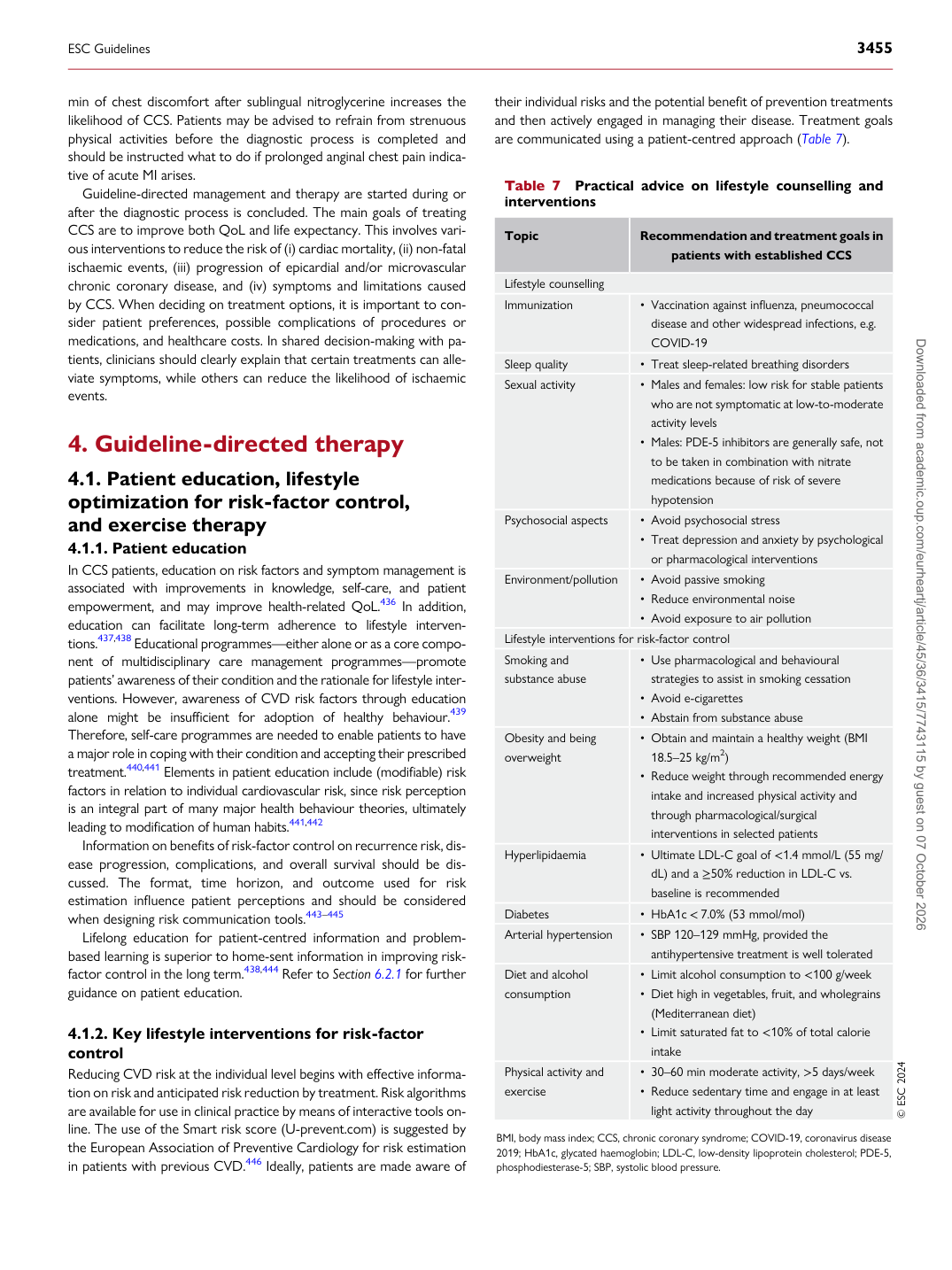
control Reducing CVD risk at the individual level begins with effective information on risk and anticipated risk reduction by treatment. Risk algorithms are available for use in clinical practice by means of interactive tools online. The use of the Smart risk score (U-prevent.com) is suggested by the European Association of Preventive Cardiology for risk estimation in patients with previous CVD.446 Ideally, patients are made aware of their individual risks and the potential benefit of prevention treatments and then actively engaged in managing their disease. Treatment goals are communicated using a patient-centred approach (Table 7).

Table 7 Practical advice on lifestyle counselling and interventions

Topic Recommendation and treatment goals in

patients with established CCS

Lifestyle counselling Immunization • Vaccination against influenza, pneumococcal

disease and other widespread infections, e.g. COVID-19

Sleep quality • Treat sleep-related breathing disorders Sexual activity • Males and females: low risk for stable patients

who are not symptomatic at low-to-moderate activity levels • Males: PDE-5 inhibitors are generally safe, not

to be taken in combination with nitrate medications because of risk of severe hypotension

Psychosocial aspects • Avoid psychosocial stress

• Treat depression and anxiety by psychological or pharmacological interventions

Environment/pollution • Avoid passive smoking • Reduce environmental noise

• Avoid exposure to air pollution

Lifestyle interventions for risk-factor control Smoking and substance abuse • Use pharmacological and behavioural strategies to assist in smoking cessation

• Avoid e-cigarettes • Abstain from substance abuse

Obesity and being overweight • Obtain and maintain a healthy weight (BMI

18.5–25 kg/m2) • Reduce weight through recommended energy

intake and increased physical activity and through pharmacological/surgical interventions in selected patients

Hyperlipidaemia • Ultimate LDL-C goal of <1.4 mmol/L (55 mg/ dL) and a ≥50% reduction in LDL-C vs.

baseline is recommended

Diabetes • HbA1c < 7.0% (53 mmol/mol) Arterial hypertension • SBP 120–129 mmHg, provided the antihypertensive treatment is well tolerated Diet and alcohol consumption • Limit alcohol consumption to <100 g/week • Diet high in vegetables, fruit, and wholegrains

(Mediterranean diet) • Limit saturated fat to <10% of total calorie intake

Physical activity and exercise • 30–60 min moderate activity, >5 days/week • Reduce sedentary time and engage in at least

light activity throughout the day © ESC 2024

BMI, body mass index; CCS, chronic coronary syndrome; COVID-19, coronavirus disease 2019; HbA1c, glycated haemoglobin; LDL-C, low-density lipoprotein cholesterol; PDE-5, phosphodiesterase-5; SBP, systolic blood pressure.

ESC Guidelines                                                                                                                                                                                          3455

Downloaded from academic.oup.com/eurheartj/article/45/36/3415/7743115 by guest on 07 October 2026