p.40 抽出テキスト
registries showing that plaque burden and presence of adverse plaque characteristics, especially low-attenuation plaque, are the strongest predictors of fatal and non-fatal MI above the classical risk factors, including stenosis severity.210,415–417 These findings emphasize a major advantage of anatomical imaging by CCTA as an initial test in selected patients, allowing the assessment of severity and extent of obstructive CAD as well as coronary plaque characteristics. Regarding the prognostic impact of inducible myocardial ischaemia by functional stress imaging, the evidence remains conflicting. While there are extensive data from large observational studies315,418–425 consistently demonstrating a robust prognostic value conferred by the extent of inducible ischaemia as detected by functional imaging (e.g. ≥3/16 abnormal segments at stress echocardiography, ≥10% LV ischaemia at nuclear or magnetic resonance perfusion imaging, or decreased hyperaemic flow or flow reserve at quantitative PET imaging), post hoc analyses of the randomized COURAGE426,427 and ISCHEMIA317 trials showed that only CAD severity, but not ischaemia severity, was independently predictive of long-term mortality and MI risk. These discrepancies may be explained by selection and entry biases between registries and RCTs.428 Registries typically report on allcomer populations with suspected CCS referred for diagnostic testing and/or revascularization, representing the real-life scenario. RCTs usually include only a very selected group of patients, and the external applicability of their findings is always open for debate. As COURAGE and ISCHEMIA selectively included only patients with functionally moderate or severe myocardial ischaemia but without any information on CAD anatomical severity, it becomes harder to demonstrate a prognostic effect of myocardial ischaemia, and the anatomical burden becomes the prominent prognostic factor. The PROMISE (Prospective Multicenter Imaging Study for Evaluation of Chest Pain) trial, which included patients more representative of an all-comer population, demonstrated that CCTA, mainly by detecting non-obstructive CAD, outperformed functional testing in predicting outcomes, emphasizing the prognostic significance of imaging coronary atherosclerosis beyond myocardial ischaemia.208 However, adding the Framingham Risk Score to the functional test result improved its prognostic value, making the difference with anatomical testing insignificant. Both modalities are thus equivalent for detecting CCS symptoms and predicting outcomes when considering risk factors. Besides imaging coronary atherosclerosis, the additional benefit of ICA is the ability to perform intracoronary pressure measurements. While FFR of ≤0.8 and iFR of ≤0.89 have been associated with a higher risk of vessel-related cardiovascular events, it is important to remember that a lower FFR/iFR reflects more profound ischaemia in the vessel territory and is associated with a progressive and proportional increase in risk.318,319 A similar observation has been made with FFR-CT.401 It has also been shown that for any given FFR value, a more proximal lesion is associated with more extensive ischaemia and an increased risk of a clinical event.429 In addition, global FFR, summing the coronary pressure collected in each of the three main coronary vessel territories as a single patientrelated index (normal value of global FFR = 1 + 1 + 1 = 3), can appreciate overall cardiovascular risk; patients with a borderline FFR but with a global FFR of <2.72 showed a significantly increased risk compared with higher global-FFR patients.430,431 One of the main limitations of such a global integrative approach based on invasive coronary pressure is that it requires advancing a pressure wire in each of the three coronary arteries, which is not often performed341 and is not recommended as a routine, based on the RIPCORD2347 and FUTURE results.346 Recent methods using 3-dimensional image reconstruction and computational fluid dynamics enable FFR estimation with CCTA432 or with ’wire-less’ invasive coronary angiography.433,434 This allows a less invasive, easier and more accurate global FFR calculation, provided imaging is of sufficiently good quality.369–371

In summary, when assessing event risk, clinicians should choose an integrative approach, considering risk factors, comorbidities, LV dysfunction, the severity of myocardial ischaemia, the number of functionally significantly stenotic coronary arteries, and the coronary plaque burden and characteristics, as all of these are likely interrelated factors that affect overall prognosis.

3.4 STEP 4: Initial therapy

Initial therapy frequently starts during the diagnostic process. In individuals with a high suspicion of CCS, sublingual nitroglycerine is frequently prescribed to treat anginal pain symptoms. Rapid relief within 1 or 2

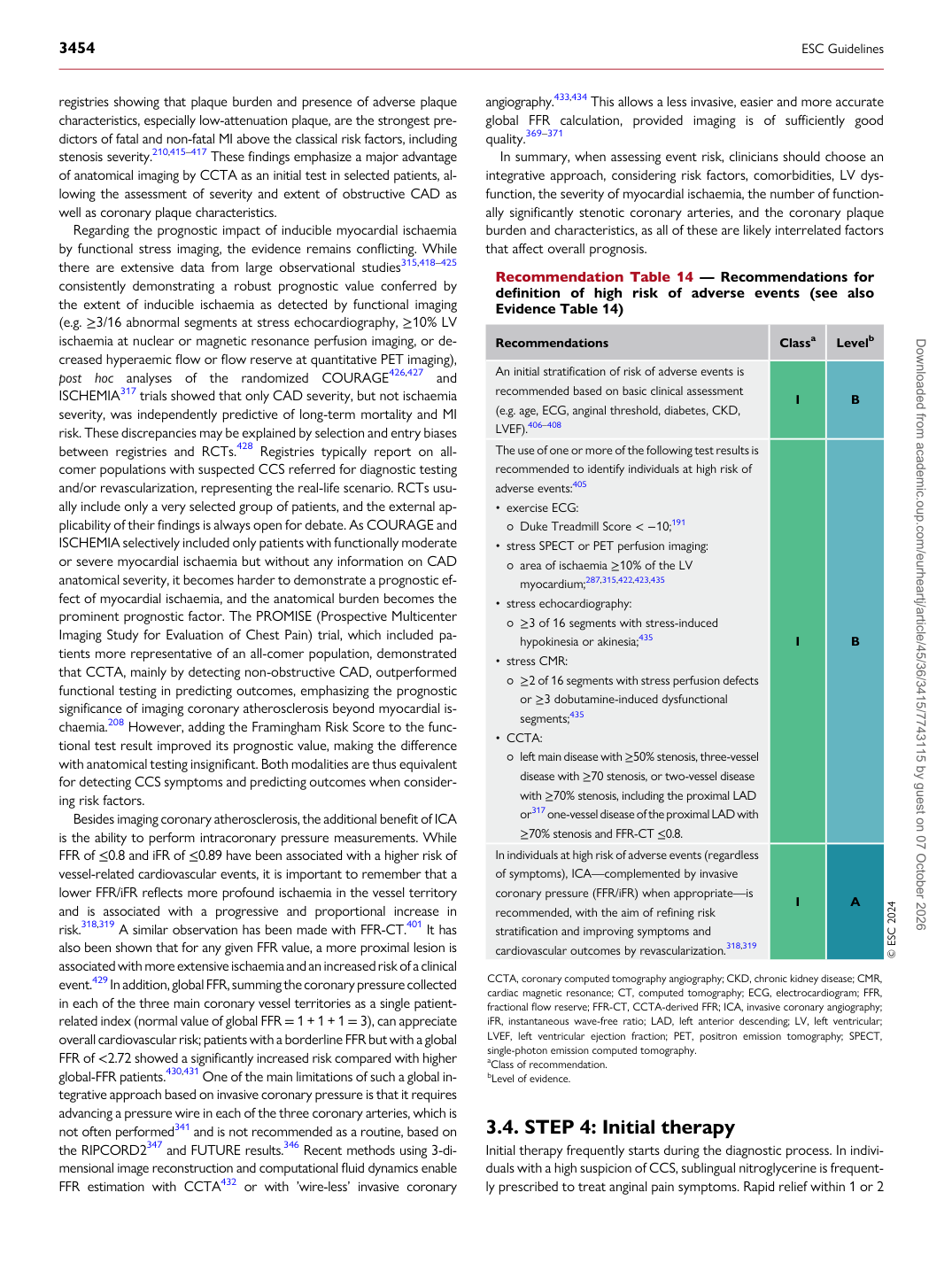
Recommendation Table 14 — Recommendations for definition of high risk of adverse events (see also Evidence Table 14)

Recommendations Classa Levelb

An initial stratification of risk of adverse events is recommended based on basic clinical assessment (e.g. age, ECG, anginal threshold, diabetes, CKD, LVEF).406–408 I B The use of one or more of the following test results is recommended to identify individuals at high risk of adverse events:405 • exercise ECG:

⚬Duke Treadmill Score < −10;191 • stress SPECT or PET perfusion imaging:

⚬area of ischaemia ≥10% of the LV

myocardium;287,315,422,423,435 • stress echocardiography:

⚬≥3 of 16 segments with stress-induced

hypokinesia or akinesia;435 • stress CMR:

⚬≥2 of 16 segments with stress perfusion defects

or ≥3 dobutamine-induced dysfunctional segments;435 • CCTA:

⚬left main disease with ≥50% stenosis, three-vessel

disease with ≥70 stenosis, or two-vessel disease with ≥70% stenosis, including the proximal LAD or317 one-vessel disease of the proximal LAD with ≥70% stenosis and FFR-CT ≤0.8. I B In individuals at high risk of adverse events (regardless of symptoms), ICA—complemented by invasive coronary pressure (FFR/iFR) when appropriate—is recommended, with the aim of refining risk stratification and improving symptoms and cardiovascular outcomes by revascularization.318,319 I A © ESC 2024

CCTA, coronary computed tomography angiography; CKD, chronic kidney disease; CMR, cardiac magnetic resonance; CT, computed tomography; ECG, electrocardiogram; FFR, fractional flow reserve; FFR-CT, CCTA-derived FFR; ICA, invasive coronary angiography; iFR, instantaneous wave-free ratio; LAD, left anterior descending; LV, left ventricular; LVEF, left ventricular ejection fraction; PET, positron emission tomography; SPECT, single-photon emission computed tomography. aClass of recommendation. bLevel of evidence. Downloaded from academic.oup.com/eurheartj/article/45/36/3415/7743115 by guest on 07 October 2026